Seven of Swords Tarot Card Meaning

Quick Meaning

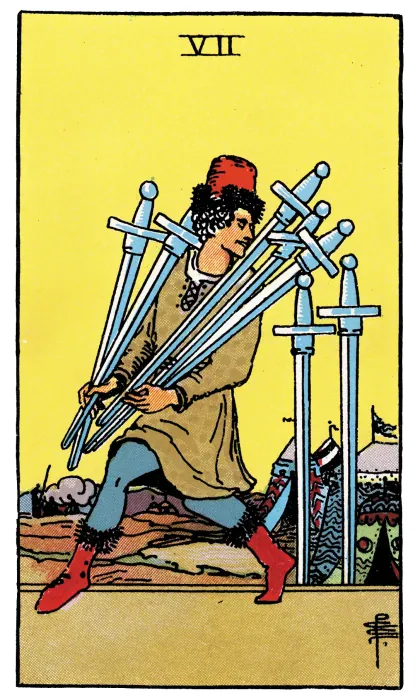
The Seven of Swords shows a figure carrying five blades from a camp while looking back at the two left behind. The act may be escape, retrieval, or deception, but it depends on staying partly unseen and leaves something unfinished. Exposure, confession, or a rising future cost can force the plan to change.

  • strategy
  • secrecy
  • evasion
  • independent action
  • selective disclosure
  • accountability
Seven of Swords tarot card from a Rider-Waite-Smith-style deck
Seven of Swords · Swords suit Artwork by Pamela Colman Smith (1909) · Public Domain Mark 1.0
Number
7
Upright tendency
Maybe
Reversed tendency
Leans no

Seven of Swords upright and reversed meaning

Upright

The Seven of Swords concerns action shaped by what others can and cannot see. Discretion can protect a legitimate plan, while withholding can deny another person information needed for their own choice. The backward glance and remaining swords make consequence part of the tactic from the beginning. A clever maneuver is incomplete if its immediate success leaves exposure, unfair burdens, or damaged trust waiting behind it.
Reversed

Reversed, concealment starts demanding more effort than the original plan. An inconsistency, disclosure, or abandoned tactic may make the hidden part of the situation visible. Exposure alone does not settle whether the evasion has ended. A meaningful correction supplies the information that changes another person's choice and accepts their response; a series of minimal admissions can preserve the same strategy under the appearance of greater honesty.

Love, work, and practical questions

Love & relationships

Love

Upright. Privacy, avoidance, hidden plans, or an incomplete truth may affect the relationship. The card does not automatically mean cheating. Ask about the inconsistency you can actually name, and notice whether a calm question brings honesty or another layer of evasion.

Reversed. Something withheld may become speakable or be exposed through contradiction. Disclosure starts a conversation rather than restoring trust automatically; the person affected still determines what closeness remains possible.

Feelings

Upright. Interest may be guarded, privately considered, or protected from vulnerability. The card cannot establish intent; a response to a clear question is more informative than interpreting every silence as a hidden strategy.

Reversed. They may be difficult to hide, accompanied by guilt, or ready for more direct expression. A person can confess selectively to control the narrative. Ask what remains relevant to the decision rather than rewarding disclosure for its drama.

Work & money

Career

Upright. Discretion may suit a confidential project or difficult environment. Its usefulness depends on whether the approach protects necessary privacy or leaves colleagues carrying hidden costs and unfinished responsibilities.

Reversed. An unofficial workaround may be exposed, a copied idea may be discovered, or a private plan may finally need open discussion. Someone may correct course before greater harm occurs. Put the actual situation on the table and involve whoever can resolve it fairly.

Money

Upright. Unequal information about fees or obligations may affect an exchange. Legitimate privacy differs from withholding that leaves someone carrying a consequence they had no opportunity to understand or question.

Reversed. A discrepancy or hidden expense may become visible when secrecy no longer works. The material issue is whether disclosure restores informed choice, rather than simply changing who knows about the cost.

Yes or No Tendency

Upright: Maybe

Maybe: the tactic depends on context, with necessary discretion weighed against withheld information and possible exposure.

Reversed: Leans no

No while a material truth remains concealed and the strategy still depends on avoiding its consequences.

These tendencies use the reference question “Do current conditions support moving forward?” Your question and circumstances can change the interpretation; this is not a guaranteed outcome.

Symbols in Seven of Swords

What is carried away and what remains behind make secrecy incomplete from the outset.

Five swords carried away
The figure removes most of the available weapons through a covert, incomplete action.
Two swords left behind
The plan does not clear the field entirely, leaving evidence, risk, or unresolved opposition.
The backward glance
Attention remains on discovery and the people behind, emphasizing secrecy and consequence.
The distant camp
A wider community or organization is affected even though the central action is taken alone.

Traditional associations: Swords · air · thought, communication, and conflict · Seven · assessment, challenge, or discernment. Association systems differ between traditions.

Reading notes for Seven of Swords

Example: I am planning a surprise celebration, but keeping it secret means asking one friend to cover several tasks. How much should I reveal?

Illustrative reading

Keeping the celebration private serves the surprise, while withholding the extent of the extra work affects the friend's ability to agree. The Seven separates those two kinds of information. The friend can understand the time and responsibility involved without knowing every detail of the event. The card's useful distinction is whether discretion preserves the plan or simply transfers its unfinished burden to someone who has not chosen it.

Questions about Seven of Swords

Does the Seven of Swords always mean cheating?

Infidelity is not established by this image. The Seven may involve privacy, avoidance, theft, or strategic withholding, and the surrounding question must identify what information or responsibility is at stake before motive can be judged.

Is the Seven of Swords always bad?

Direct confrontation is not always wise. The card can favor discretion, private preparation, or leaving a hostile scene without announcing every move. The question is whether silence protects a necessary freedom or simply makes the difficult part someone else's surprise.

What does the Seven of Swords reversed mean?

Reversed, a hidden action may be exposed, confessed, or abandoned because the strategy is no longer sustainable. It can also show self-deception becoming harder to maintain.

Elena is ArcaSeer’s named editorial voice. How Elena’s notes are created