The High Priestess Tarot Card Meaning

Quick Meaning

The High Priestess tarot card means quiet knowing: information that is present but not yet spoken, and intuition that needs time. Upright, it favors observing, listening, and keeping your own counsel. Reversed, it can suggest ignored instincts, silence used to avoid a conversation, or withheld information affecting a choice. As a yes or no card, The High Priestess is a maybe in both orientations.

Upright
  • intuition
  • inner knowledge
  • patience
  • mystery
Reversed
  • ignored instincts
  • secrets
  • confusion

Updated

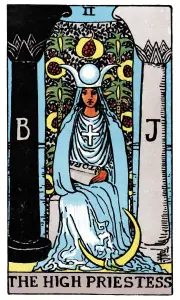
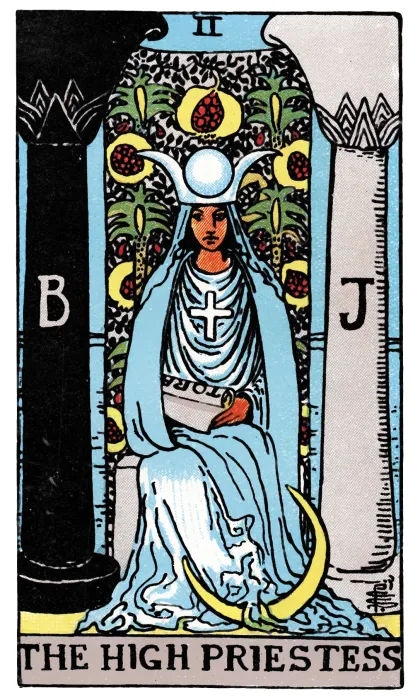
The High Priestess tarot card from a Rider-Waite-Smith-style deck
The High Priestess · Major Arcana 2 Artwork by Pamela Colman Smith (1910) · Public Domain Mark 1.0 · Image usage
Ask your own question: free AI reading
Arcana Major
Number2
Upright tendencyMaybe
Reversed tendencyMaybe

The High Priestess upright and reversed meaning

The High Priestess tarot card upright

The High Priestess upright meaning

The upright High Priestess means listening and observing before deciding what to say or do. It points to intuition, careful observation, and timing. The right moment to speak may not have come yet.

The High Priestess gives weight to what has not yet been said, without treating silence as proof of a secret. A hunch about a job offer, a sense that a friend is holding something back, or a feeling that a decision needs another week can all belong here.

It does not mean ignoring facts. The card works best when intuition sends you looking for evidence. If something feels off in an agreement, the High Priestess suggests reading it again slowly. Signing it on faith and rejecting it on a hunch are both outside what the card supports.

It also covers privacy. Some things you know are yours to keep for now: a plan still forming, a feeling you have not sorted out, or a decision you want to make without commentary from others.

This kind of silence has a purpose: understanding the question before offering an answer. It can last days or weeks. It becomes less useful when someone else needs information from you and has no way of knowing when you will respond.

The High Priestess tarot card reversed

The High Priestess reversed meaning

When reversed, The High Priestess can suggest instincts being dismissed, fear being mistaken for intuition, or silence withholding information that another person needs.

A strong impression can deserve attention without being accurate. You may dismiss a concern because you cannot yet explain it, or feel certain that something is wrong because an outcome frightens you. A sign of fear is an "inner voice" that says something different each day, usually whatever is most frightening.

Silence becomes avoidance when it lets you postpone a conversation you know is needed. Delaying a hard conversation for months is different from waiting a few days to think.

Privacy can also conflict with another person's ability to choose. Keeping a possible move to yourself while you think it through differs from withholding a confirmed move from someone making shared plans with you. The question is whether your silence now affects their decision. If the information is yours, you can still choose how and when to share it.

Two questions help here. What facts support your inner sense, and what would count against it? Is anyone waiting on information you hold? A sense that rests only on mood deserves a second look. Someone waiting points to avoidance or withheld information, and that person needs an answer.
The High Priestess in love, career, and money

The High Priestess in love & relationships

The High Priestess love meaning

Upright

Romantically, The High Priestess can suggest attraction that is quiet, slow, or not yet spoken. Someone may be interested and private about it, or a relationship may be in a stage where much is felt and little is said. The card favors paying attention to how someone behaves over time more than to what they announce. In a relationship, it can mean a partner needs space to think before talking about something important. If you are single, it supports letting a connection develop without pushing for a label in the first weeks.

Reversed

The card can point to secrets, unspoken resentment, or one person withholding something the other needs to know. It can also describe ignoring your own unease about a relationship because the evidence is not yet clear. If you keep noticing the same small inconsistency, name it calmly and ask about it.

The High Priestess as feelings

Upright

As feelings, The High Priestess points to feelings that have not been said, and the card cannot show how strong they are. Someone may be reserved by nature, still working out what they feel, or simply not very interested. If they have already shown interest, they may want to keep the feeling private for now.

Reversed

With The High Priestess reversed, the feelings may be confused or deliberately hidden. Someone may be holding back emotions they do not want to show, or feel uneasy about something they have not raised with you. The distance can come from their own uncertainty as much as from anything between you.

The High Priestess: how someone sees you

Upright

The High Priestess may suggest someone sees you as perceptive, calm, and a little hard to read. They may notice that you listen more than you talk, and that you seem to understand more than you say.

Reversed

They may see you as distant or secretive, or feel that part of you stays closed off. They may be unsure whether your reserve reflects privacy, uncertainty, or a wish for distance. Silence can read as distance even when you were simply undecided.

A card can suggest how someone might see you. Only that person can tell you what they actually think.

The High Priestess in career & money

The High Priestess career meaning

Upright

In a career reading, The High Priestess favors research, analysis, and roles that reward discretion, such as editing, counseling, data work, or anything involving confidential information. It suits gathering information before a decision, especially in a negotiation or a job search. Before an important meeting, list what you know, what you suspect, and what you still need to find out. Keep plans to yourself until they are firm. In a job search, learn about a company from people who work there before you apply.

Reversed

The card can point to office politics, information being withheld from you, or a doubt about a workplace that you keep dismissing. It can also describe staying silent when colleagues need your input to do their jobs. If you suspect you are missing information, ask for it in writing so the answer is on record.

The High Priestess money meaning

Upright

Where money is concerned, The High Priestess favors quiet review: reading statements, checking subscriptions, and understanding an offer fully before agreeing to it. It is not a card for rushed financial decisions. Before a big purchase, wait a week and see whether you still want it. Keep account details and plans private while they form.

Reversed

The High Priestess, reversed, can point to hidden fees, unclear terms, or money matters someone is not being open about. Ask for the full cost in writing, including what happens if you cancel. Read the renewal terms on anything you signed up for in the last year.

For investment or debt decisions, talk to a qualified financial professional.

The High Priestess as advice and as a person

The High Priestess as advice

Upright

As guidance, The High Priestess suggests observing before committing to an explanation. For a few days, write down the detail that caught your attention, separately from what you suspect it means, and look at what repeats.

Reversed

With The High Priestess reversed, if you are withholding a fact another person needs, tell them what is settled and what remains undecided. Choose a calm moment, and say it plainly once.

The High Priestess as a person

Upright

As a person, The High Priestess may describe someone quiet, observant, and hard to read, who listens closely and shares little about their own plans. They may pause before giving an opinion and prefer to discuss personal matters with a small circle. They notice changes in mood quickly.

Reversed

It can describe someone who keeps secrets that affect others, or who dismisses their own instincts until a problem is obvious. It can also describe someone whose silence is read as judgment, even when it is not meant that way.

Is The High Priestess a yes or no card?

Upright: Maybe

The upright High Priestess is a maybe. The card asks whether an important detail is still unknown or unsaid. If so, waiting for that information may be more useful than forcing an answer. What you learn may support either a yes or a no, and the answer should rest on those facts.

Reversed: Maybe

It is also a maybe, for a different reason. The missing piece may be something you are avoiding, or something another person is withholding. While the information stays hidden, treat the plan as unconfirmed, even if it looks promising.

These tendencies use the reference question “Do current conditions support moving forward?” Your question and circumstances can change the interpretation; this is not a guaranteed outcome.

The High Priestess and spirituality

On a spiritual level, The High Priestess points to inner knowing and contemplative practice: silent meditation, journaling, recording dreams, or studying one text over a long time. The card also respects privacy in spiritual life. A private practice can leave room for an understanding you are not ready to explain, and some insights only become clear after a long period of quiet.

Symbols in The High Priestess

The High Priestess sits between two pillars, a black one marked B and a white one marked J. Behind her hangs a veil patterned with pomegranates. She wears a blue robe, a horned crown that holds a round disk, and a cross on her chest. A scroll marked TORA lies partly hidden in her lap, and a crescent moon rests at her feet.

The pillars frame a threshold. Opposites stand on either side, and she sits between them without choosing one.

The veil marks a boundary between what is shown and what stays behind it. The pomegranates suggest richness on the other side.

The half-covered scroll stands for knowledge that is held and studied, and not displayed all at once.

The crescent moon links her with changing inner states and with receptivity. In the Golden Dawn system, the card is assigned to the Moon, which echoes Waite's description of her as receiving light.

Traditional associations: Major Arcana II · Intuition, silence, and hidden knowledge · Traditionally associated with the Moon. Association systems differ between traditions.

Reading notes for The High Priestess

Example reading. A sales assistant has received a job offer that pays well. During the interviews, two different people avoided a question about why the last person in the role left. They ask, "What should I know before accepting?" and draw The High Priestess upright.

A reading would not claim there is a hidden problem. It would point to the unanswered question and suggest asking it directly. What they learn, not the card, should decide the offer.

The High Priestess FAQ

What do B and J stand for on The High Priestess card?

B and J stand for Boaz and Jachin, the two pillars at the entrance of Solomon's Temple in the Bible. Waite places the High Priestess between the black and white pillars of the mystic Temple, with the Temple veil behind her. The pair suggests opposites held in balance.

Why was The High Priestess once called the Popess?

Popess is an older title for this figure, and Waite also records Pope Joan and Female Pontiff. He objects to interpreting her as the Pope's wife. His own account centers on a hidden sacred tradition, which gives context to modern readings about knowledge that is not immediately available.

What does the scroll in her lap mean?

The scroll is marked TORA, which Waite says signifies the Greater Law, the Secret Law, and the second sense of the Word. It is partly covered by her mantle, which he says shows that some things are implied and some spoken. In a reading, it supports the difference between having knowledge and sharing it.

Why do older books list passion for The High Priestess reversed?

Waite's reversed meanings for the card are passion, moral or physical ardor, conceit, and surface knowledge. Those are his recorded divinatory terms. This guide uses a modern reading focused on the difference between observation, assumption, and withholding information, and keeps the older list as historical context.

Sources: A. E. Waite, The Pictorial Key to the Tarot (1910), Part II: II — The High Priestess; Israel Regardie, The Complete Golden Dawn System of Magic, The Tarot: names and attributions of the Tarot trumps (Book T)