Seven of Wands Tarot Card Meaning

Quick Meaning

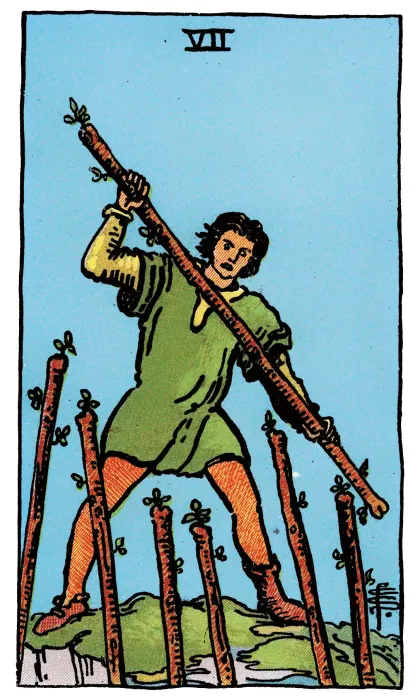
The Seven of Wands shows one defender on uneven high ground facing six challengers outside the frame. The advantage is real, but so is the cost of answering every challenge. Exhaustion, fighting everything at once, or doubt about the position can make it wiser to choose what truly deserves protection.

  • defense
  • conviction
  • boundaries
  • pressure
  • advantage
  • selective resistance
Seven of Wands tarot card from a Rider-Waite-Smith-style deck
Seven of Wands · Wands suit Artwork by Pamela Colman Smith (1909) · Public Domain Mark 1.0
Number
7
Upright tendency
Leans yes
Reversed tendency
Leans no

Seven of Wands upright and reversed meaning

Upright

The Seven of Wands protects ground already gained. Its elevated figure has an advantage, but holding that position still costs energy. Incoming objections and demands do not all carry the same stakes. Selective resistance preserves what matters by distinguishing a threat to the substance from pressure aimed at taste, status, or access. Courage here includes deciding which challenges deserve an answer instead of allowing every challenge to set the agenda.
Reversed

Sustained defense can become a pattern of reacting before understanding what is approaching. Exhaustion may make every question feel hostile, or the defended position may have changed while resistance continues automatically. The card does not make persistence noble or withdrawal weak. It brings the original value beside the present cost, allowing the difference between an important boundary and a contest that has consumed its own purpose to become visible.

Love, work, and practical questions

Love & relationships

Love

Upright. A stated value or shared agreement may face repeated pressure. Protect what actually matters while allowing legitimate concerns to be heard; treating every question as interference can make the defense consume the relationship.

Reversed. An important boundary may collapse from exhaustion, or guardedness may turn all contact into conflict. Separate what must remain protected from a defensive habit that no longer matches the present situation.

Feelings

Upright. Care may coexist with protectiveness and concern about outside pressure. A person's need for space can be respected without automatically reading it as rejection or expecting affection to erase every boundary.

Reversed. Overwhelm may make another conflict feel impossible, even where care remains. Practical support and a clear decision reveal more than assuming either strong commitment or weak commitment from defensiveness alone.

Work & money

Career

Upright. Scrutiny or competing demands can place a professional standard under pressure. Keeping the essential requirement distinct from minor objections preserves attention for the work rather than making constant defense the entire role.

Reversed. Relentless demands may consume the capacity needed to perform, while loud resistance can also mask weak preparation. These are different problems: one concerns depleted support, the other the substance of the position.

Money

Upright. A limited budget, savings, or disputed charge may attract competing claims. The value of what is protected must be considered alongside the cost of protecting it; pressure alone settles neither question.

Reversed. Repeated claims or emergencies may wear down resources and attention. The strain can exceed the amount of a single dispute, making every further demand feel equally threatening regardless of its actual stakes.

Yes or No Tendency

Upright: Leans yes

Usually yes when there is a meaningful value to protect and a viable position from which to respond.

Reversed: Leans no

Usually no when indiscriminate defense or depleted support makes the current position unsustainable.

These tendencies use the reference question “Do current conditions support moving forward?” Your question and circumstances can change the interpretation; this is not a guaranteed outcome.

Symbols in Seven of Wands

Advantage, unseen demands, and hurried preparation share the same defensive scene.

The high ground
Elevation gives the defender an advantage while also isolating him at the point of pressure.
Six wands from below
Challenges enter the frame without visible owners, emphasizing multiple demands and incomplete context.
The single crosswise wand
One staff becomes an active boundary and concentrates the figure's response.
Mismatched footwear
Different shoes suggest haste, imperfect preparation, or the need to hold a position without ideal conditions.

Traditional associations: Wands · fire · action, desire, and creative will · Seven · assessment, challenge, or discernment. Association systems differ between traditions.

Questions about Seven of Wands

What does the Seven of Wands mean in a love reading?

Upright: A relationship or personal value may be under pressure from repeated testing, criticism, or outside demands. Protect the agreement the two of you actually made, but do not dismiss every concern as interference. If someone keeps crossing a stated limit, name the consequence rather than reopening the same argument. Reversed: Someone can be so guarded that every question feels like an attack, or so tired of conflict that an important boundary collapses. The relationship needs a distinction between safety and permanent combat. Ask which issue is non-negotiable and which defensive habit can be lowered.

What does the Seven of Wands reversed mean?

Reversed, defense becomes exhaustion, scattered reactivity, or a refusal to reconsider a position that no longer deserves the cost. Pressure may exceed the available support.

Is the Seven of Wands a yes or no card?

Upright: Yes. There is something real to protect and an earned position from which to respond, although the card does not choose the tactic. Reversed: No for now when exhaustion, lack of support, or indiscriminate defensiveness makes the present position impossible to sustain responsibly.

Elena is ArcaSeer’s named editorial voice. How Elena’s notes are created