Six of Swords upright meaning
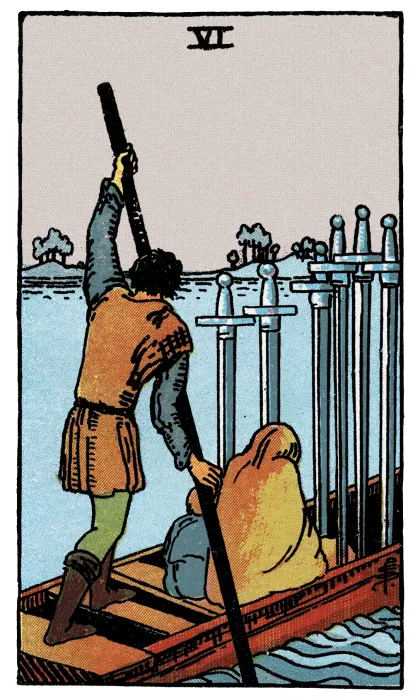
Upright, the Six of Swords means you are moving through a transition toward calmer conditions. You may be leaving a stressful job, recovering after a breakup, moving to a new home, or slowly letting go of a pattern that caused trouble.
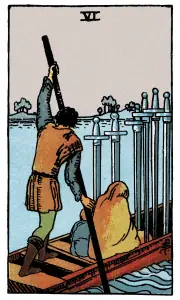
The card describes a passage, not an arrival. The far shore is in view, and you are still on the water. Progress may be quiet and gradual. Sadness may come with you, even when the change is right.
It also emphasizes help. The ferryman steers. Support from a friend, a mentor, or family can make the crossing easier. You do not need to prove you can do it alone.
The swords in the boat matter. A new setting does not automatically resolve old thinking. If an argument, a fear, or a habit traveled with you, it will still need attention on the other side.
Waite's meanings include travel by water, a route, a way, and an expedient.
A practical way to use the card is to list what you are leaving behind, what you are taking with you, and who can help with the move. Pack only what you need, in every sense. Ask for one specific kind of help this week.
Six of Swords reversed meaning
When reversed, the Six of Swords can suggest a delayed transition, a passage that keeps being interrupted, or old problems carried into a new situation.
A delayed transition looks like knowing you need to leave and not yet being able to. Circumstances or fear may be holding you at the shore.
An interrupted passage looks like starting to move on and then being pulled back: answering an old message, returning to an old routine, or having the same argument in a new place.
Old problems carried forward show up as moving to a new job and finding the same frustrations. The setting changed, and the pattern did not.
The reversed card can also suggest a crossing with no clear destination.
Waite's reversed meanings shift to declaration, confession, and publicity, which can suggest a transition that becomes public, or one that requires saying something out loud.
Ask what keeps the boat from moving. Practical barriers come down one at a time, starting with the most urgent. A pull back toward the shore you left weakens when contact with it is limited. A problem that follows you across says something about what you are bringing, not only where you are going. A crossing with no destination needs one small goal for the next month.