Nine of Swords Tarot Card Meaning

Quick Meaning

In the Nine of Swords, no attacker stands in the room; the figure wakes beneath a wall of repeated blades. Fear, guilt, or memory has become most convincing in isolation. When daylight or another voice enters the closed loop, relief may begin, but that shift alone does not prove the underlying concern is resolved.

  • anxiety
  • rumination
  • night fear
  • guilt
  • catastrophic thinking
  • support
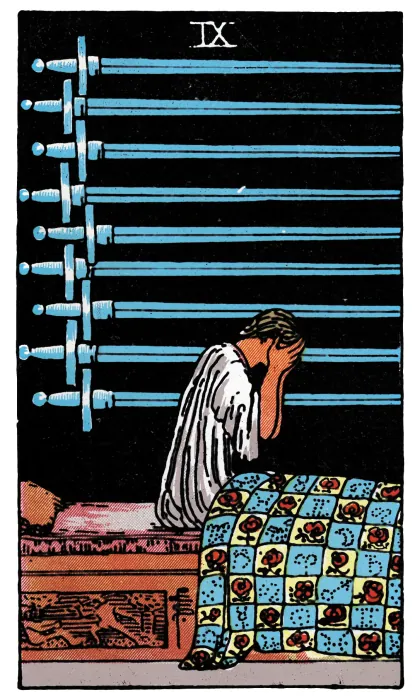
Nine of Swords tarot card from a Rider-Waite-Smith-style deck
Nine of Swords · Swords suit Artwork by Pamela Colman Smith (1909) · Public Domain Mark 1.0
Number
9
Upright tendency
Leans no
Reversed tendency
Maybe

Nine of Swords upright and reversed meaning

Upright

The Nine of Swords shows a mind returning to the same feared scene when outside context has gone quiet. A remembered mistake, unanswered question, or feeling of guilt can grow until it appears to explain everything. The distress is real, but the card cannot confirm the imagined event or another person's intentions. Its interpretive value is separating a specific concern from the larger accusation that private repetition has built around it.

Reversed

Reversed, fear may occupy less space without disappearing. Naming a concern or hearing another perspective can interrupt its isolation, while shame, vigilance, or exhaustion may remain. The change is in how the experience is carried, not proof of recovery or deterioration. A clearer account has edges: one responsibility can be acknowledged without turning every memory into evidence against the self. Persistent distress calls for support beyond a card reading.

Love, work, and practical questions

Love & relationships

Love

Upright. An unanswered exchange can grow into an imagined dialogue filled with guilt or suspicion. The Nine concerns the fear occupying that silence, rather than evidence of a partner's hidden intentions.

Reversed. Reversed, suspicion or guilt may occupy less of the relationship's emotional field, or shame may remain difficult to share. The change concerns how fear is carried; it does not reveal the other person's intentions or establish readiness for closeness.

Feelings

Upright. The Nine of Swords suggests worry, guilt, dread, or fear of causing and receiving pain. Someone may be preoccupied but unable to communicate clearly. Their anxiety can be intense without revealing whether they want reunion, distance, or any particular future action.

Reversed. Relief, shame, or emotional exhaustion may coexist after fear is named. None proves readiness for closeness; availability depends on whether someone can communicate and receive a response without demanding certainty.

Work & money

Career

Upright. At work, a mistake, deadline, or accusation may continue long after the office is quiet. The Nine distinguishes the specific event from the private tribunal built around it, especially when fear of future judgment has become larger than the error itself.

Reversed. At work, a feared evaluation may lose some authority, allowing the mistake, consequence, or repairable detail to become more specific. Vigilance may persist after the immediate pressure has passed.

Money

Upright. An unknown balance or fear of loss can grow through private repetition. The card concerns the pressure surrounding an unanswered figure; it cannot establish the amount owed or forecast financial disaster.

Reversed. A visible number or corrected estimate may interrupt catastrophic thinking without removing the obligation. The concern becomes more bounded, even if the financial facts themselves have not substantially changed.
Yes or No Tendency

Upright: Leans no

No as a symbolic tendency while fear and guilt crowd out a proportionate view of the question.

Reversed: Maybe

Maybe: reduced emotional pressure leaves room for another account, although uncertainty or vigilance may remain.

These tendencies use the reference question “Do current conditions support moving forward?” Your question and circumstances can change the interpretation; this is not a guaranteed outcome.

Symbols in Nine of Swords

Repeated blades surround a private scene in which fear has lost ordinary context.

The figure covering the face
The posture shows distress turned inward and difficulty meeting the surrounding situation directly.
Nine horizontal swords
Repeated blades line the dark wall like persistent thoughts with no visible endpoint.
The black background
Night removes context and reinforces how isolation can magnify uncertainty.
The carved bed and patterned quilt
Detailed images beneath the person suggest memory, personal history, and a world still present around the fear.

Traditional associations: Swords · air · thought, communication, and conflict · Nine · culmination, independence, or resilience. Association systems differ between traditions.

Questions about Nine of Swords

What does the Nine of Swords mean in a love reading?

In love, the Nine can show guilt, suspicion, or an unanswered exchange expanding in private after the conversation has ended. The card does not reveal another person's thoughts; its relationship task is to show how imagined dialogue can occupy the space left by silence.

What does the Nine of Swords reversed mean?

Reversed, the closed nighttime world may admit another voice, ordinary daylight, or the possibility that guilt has a specific object rather than unlimited reach. The feared account occupies less of the room, even when the remembered event remains painful.

Is the Nine of Swords a yes or no?

Upright: No. Fear, guilt, or anticipation has filled the frame after ordinary perspective narrowed in the night. Reversed: Maybe. The feared account occupies less of the room now, but shame, vigilance, or uncertainty may still be active.

Elena is ArcaSeer’s named editorial voice. How Elena’s notes are created