Justice Tarot Card Meaning

Quick Meaning

Justice asks whether a rule would still feel fair if the roles were reversed. The scales weigh the facts, and the raised sword shows that a decision must follow. The card is out of balance when key facts are missing, one side gets a different standard, or someone avoids responsibility.

  • fairness
  • truth
  • accountability
  • cause and effect
  • law
  • clear decisions
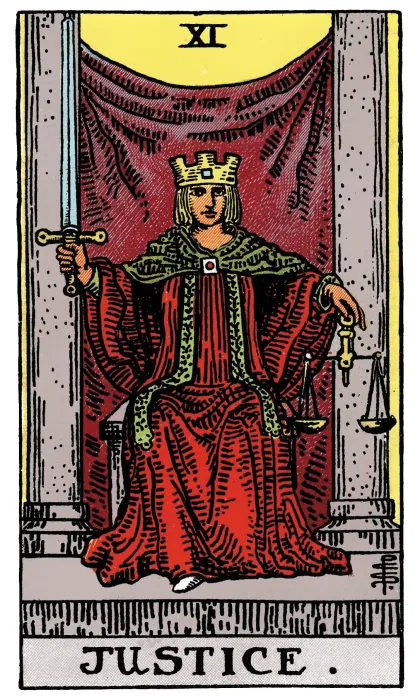
Justice tarot card from a Rider-Waite-Smith-style deck
Justice · Major Arcana 11 Artwork by Pamela Colman Smith (1909) · Public Domain Mark 1.0
Arcana
Major
Number
11
Upright tendency
Leans yes
Reversed tendency
Leans no

Justice upright and reversed meaning

Upright

Justice considers a decision through a standard that could be explained from either side. Facts, prior agreements, and foreseeable consequences all matter; personal preference should not quietly replace the rule. Accountability is wider than blame. It can involve correcting an error, acknowledging a benefit, or accepting the consequences of a fair process. The aim is proportionate responsibility, even when the answer is uncomfortable or unwelcome.
Reversed

Reversed, an apparently orderly process may rely on missing context or unequal expectations. One side can control the record, preserve a private exception, or change the explanation to avoid responsibility. The useful focus is the specific point where the standard bends, rather than a general verdict that someone is unjust. A defensible correction must address the omission or inconsistency without assuming that suspicion already proves wrongdoing.

Love, work, and practical questions

Love & relationships

Love

Upright. Honest accounts and explicit agreements can clarify responsibility within a relationship. Fairness includes room for difficult information and expectations that both people can reasonably be asked to meet.

Reversed. Selective memory or double standards may protect one person's position. A disagreement becomes clearer when the shared agreement is separated from expectations that only one partner must satisfy.

Feelings

Upright. Interest may be measured through trust, effort, and mutual expectations. Someone can care sincerely while wanting a clear account of the responsibility they would accept in the connection.

Reversed. Resentment or defensiveness may arise from feeling judged unfairly. An internal scorecard can obscure context, so distance alone cannot reveal the verdict a person has reached.

Work & money

Career

Upright. Reviews and agreements benefit from clear criteria and a record of relevant exceptions. The emphasis is a process people can understand and challenge, not a promised favorable outcome.

Reversed. A workplace evaluation may apply expectations inconsistently. The discrepancy needs factual examination through policy and records; the card does not determine the formal response or establish misconduct.

Money

Upright. Prices and obligations can be examined through a consistent standard. The material question is how costs and benefits are distributed and whether the reasoning remains defensible from either side.

Reversed. An exception or hidden assumption may make a balanced-looking arrangement unequal. Inconsistency is the theme, while actual figures and agreements are needed to establish whether an error exists.

Yes or No Tendency

Upright: Leans yes

Yes when facts and a clear agreement support a consistent assessment. Fair consideration matters more than receiving the outcome one already prefers.

Reversed: Leans no

No while omissions, unequal standards, or avoided responsibility weaken the decision. The problem lies in the reliability of the assessment, not an automatic personal verdict.

These tendencies use the reference question “Do current conditions support moving forward?” Your question and circumstances can change the interpretation; this is not a guaranteed outcome.

Symbols in Justice

Scales, sword, and pillars connect comparison with a consequential decision under a stated standard.

The scales in the left hand
The level pans place comparison before action and suggest that each claim should be given proportionate weight.
The upright double-edged sword
The sword is held ready and vertical. It suggests a decision that can cut in more than one direction and carries consequences once applied.
The two stone pillars
The seated figure is framed by a formal structure, reinforcing that judgment depends on a stated standard rather than a passing preference.

Traditional associations: Major Arcana XI in the Rider-Waite-Smith sequence · Fairness, accountability, and consequence · Traditionally associated with Libra. Association systems differ between traditions.

Reading notes for Justice

Example: How should I decide when both sides have a reasonable argument?

Illustrative reading

One side may rely on an original promise while the other relies on a later exception. Justice separates those claims before comparing them: what rule applied, what was its scope, and who knew about the change? Equal attention does not require identical blame. The example makes fairness a traceable explanation of agency and consequences, rather than an average of two incompatible accounts.

Questions about Justice

What element is Justice associated with?

Air is the elemental correspondence through Libra in the Golden Dawn system. The scales are the card’s visible symbol; Libra’s place among the Air signs supplies the elemental classification. You do not need to infer the element from the sword alone.

Is Justice associated with Libra?

Yes, Justice is associated with Libra in the Golden Dawn correspondence system. That symbolic connection belongs to the card’s interpretive framework and does not establish anyone’s zodiac sign.

Elena is ArcaSeer’s named editorial voice. How Elena’s notes are created