Eight of Swords Tarot Card Meaning

Quick Meaning

The Eight of Swords tarot card means feeling trapped: choices seem closed, and fear or narrowed thinking makes the way out hard to see. Upright, it asks which limits are real and which are held by worry. Reversed, it can point to a way out becoming visible, a first step toward freedom, or a fear losing its grip. On a yes or no question, the Eight of Swords leans no upright and leans yes reversed.

Upright
  • feeling trapped
  • self-limiting beliefs
  • fear
  • powerlessness
Reversed
  • freedom
  • new perspective
  • regaining control

Updated

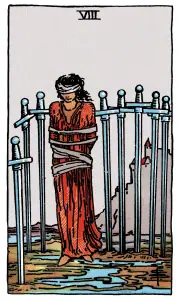
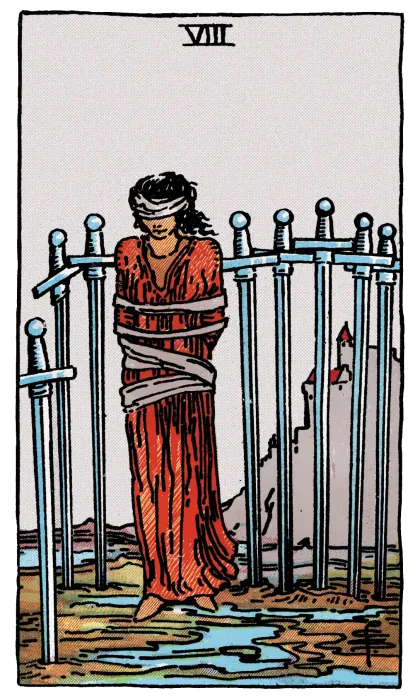
Eight of Swords tarot card from a Rider-Waite-Smith-style deck
Eight of Swords · Swords suit Artwork by Pamela Colman Smith (1910) · Public Domain Mark 1.0 · Image usage
Ask your own question: free AI reading
Arcana Minor · Swords
Number8
Upright tendencyLeans no
Reversed tendencyLeans yes

Eight of Swords upright and reversed meaning

Eight of Swords tarot card upright

Eight of Swords upright meaning

When upright, the Eight of Swords means you feel stuck, with few or no good options. It may feel like a trap, with every step blocked.

Swords are the suit of the mind, so this card often concerns how a situation is being thought about. Fear, self-doubt, and narrowed attention can make choices look smaller than they are. "I can't leave this job, no one else will hire me." "I can't say no, they'll be angry." The thought feels like a wall.

The card does not say every limit is imagined. Real constraints exist: money, responsibilities, other people's power. The useful question is which part of the restriction is real, and which part is held in place by fear.

Waite's phrase temporary durance is a useful key to the picture: a real constraint, not drawn as a permanent one. Whether your own situation is temporary depends on its actual conditions.

A practical way to use the card is to write down the limits you feel. Next to each, note whether it is a fact you have checked, or a fear you have not tested. For one of the untested ones, take a small step to check it. Send one application, ask one question, or tell one trusted person how stuck you feel. Then notice what changed.

Eight of Swords tarot card reversed

Eight of Swords reversed meaning

The reversed Eight of Swords can suggest a way out becoming visible, fear starting to loosen, or a first step taken after a long period of feeling stuck.

A visible way out looks like suddenly noticing an option you had overlooked: a person you could ask for help, a rule that turns out to be flexible, or a door that was never locked.

Loosening fear looks like the worried thought losing some of its power. You still feel anxious, and you act anyway.

A first step shows up as doing one small thing toward freedom, such as booking a meeting, telling someone the truth, or researching an alternative.

The reversal can also show one part of the enclosure becoming clearer, such as a deadline that can move.

Waite's reversed list leans toward disquiet, difficulty, and opposition, and toward what is unforeseen. In this guide's reading, leaving a narrow place can be uneasy, even when it is the right move.

Upright, the figure stands still among the swords. Reversed, something has started to shift, and the useful move is to act while it lasts. An option you can now see is worth testing soon, and loosened fear is a window for one action. A step already taken calls for the next one, and a way out that depends on another person calls for asking them directly.
Eight of Swords in love, career, and money

Eight of Swords in love & relationships

Eight of Swords love meaning

Upright

In love, the Eight of Swords can describe feeling trapped in a relationship, stuck in a pattern, or afraid to say what you need. It can also describe narrowed choices, such as believing you will never find anyone better, or that leaving or staying is impossible. Look at which limits are real and which come from fear. Tell one trusted friend how you feel, and listen to their view. If a relationship ever feels unsafe, reach out to people you trust for support. Single readers may be holding back from dating because of self-doubt or a past hurt. One small step, such as accepting an invitation, can test the fear.

Reversed

The card may show a way out of a stuck pattern, or growing courage to say what you need. Someone may finally speak honestly, set a boundary, or make a decision they had avoided. Take the next step while the clarity is there. Ask for support if the change feels large.

Eight of Swords as feelings

Upright

In a feelings position, the Eight of Swords suggests feeling stuck, anxious, or unable to act. Someone may care for you and feel blocked by fear, obligations, or self-doubt. They may believe they have fewer options than they do, and may need time before acting. Their hesitation may be more about their own limits than about you.

Reversed

The reversed Eight of Swords points to feelings that are loosening. Someone who felt trapped may be gaining confidence or seeing a way forward. They may be ready to act on feelings they had held back, or to talk about what has been holding them.

Eight of Swords: how someone sees you

Upright

You may come across as stuck, anxious, or holding back. Some may want to help you, and may not know how. Others may see you as limiting yourself, and may want to point out options you have not noticed.

Reversed

Some may see you as finding your courage, or as someone breaking free from a hard situation. They may notice that you seem lighter, or more willing to take risks, and may want to cheer you on.

A card can suggest how someone might see you. Only that person can tell you what they actually think.

Eight of Swords in career & money

Eight of Swords career meaning

Upright

At work, the Eight of Swords can describe feeling trapped in a job, stuck in a role with no clear way forward, or held back by rules, a difficult manager, or fear of change. List the real constraints, such as notice periods or money needs, and separate them from fears you have not checked. Look into one alternative this week: a course, a conversation with a recruiter, or an internal transfer. If self-doubt is the main barrier, write down three things you do well, with examples. Talk with someone who has made a similar move, and ask what the first month was like.

Reversed

When the Eight of Swords is reversed, it can describe finding a way out of a stuck work situation, gaining confidence to apply for something new, or a restriction lifting. Act on the opening while it is available. Update your CV, send the application, or have the conversation you have avoided. Ask a mentor for feedback on your plan.

Eight of Swords money meaning

Upright

Financially, the Eight of Swords can point to feeling trapped by finances, or avoiding your accounts out of fear. Look at the real figures, so you are working from facts instead of fear. Make one small change you can control, such as cancelling one unused subscription.

Reversed

When the Eight of Swords is reversed, it can point to finding a way out of a financial bind, or seeing an option you had missed. Write down the steps and begin with the first.

For investment or debt decisions, talk to a qualified financial professional.

Eight of Swords as advice and as a person

Eight of Swords as advice

Upright

Taken as advice, the Eight of Swords suggests checking which walls are real. Test one fear with a small action, and ask for help from someone outside the situation.

Reversed

The advice of the reversed Eight of Swords is to keep moving while the way out is visible. Take the next small step, then the one after it, without waiting to feel completely ready. Tell someone what you are doing, so the move feels real.

Eight of Swords as a person

Upright

Describing a person, the Eight of Swords can show someone who feels powerless, anxious, or held back, and who may underestimate their own options. They often think carefully, and that same care can turn into worry.

Reversed

Reversed, the Eight of Swords can describe someone regaining confidence and agency, who is starting to make choices after a period of feeling stuck. They may be surprised by what they can do.

Is Eight of Swords a yes or no card?

Upright: Leans no

In its upright position, the Eight of Swords leans no while fear or narrowed thinking is shaping the decision. Check your assumptions first. A choice made from fear may not reflect your real options. Once one fear has been tested, the answer may change for the better.

Reversed: Leans yes

The Eight of Swords reversed leans yes. A way out is becoming visible, and the card favors taking a step through it. The yes is strongest when you act on a real opening, not on panic. Start with the smallest action that moves you forward, and keep going while your nerve holds.

These tendencies use the reference question “Do current conditions support moving forward?” Your question and circumstances can change the interpretation; this is not a guaranteed outcome.

Eight of Swords and spirituality

For spiritual questions, the Eight of Swords relates to the limits the mind creates and how they can loosen. Practices that calm fearful thinking, such as slow breathing, mindful walking, or noticing anxious thoughts without obeying them, fit the card. It suggests that freedom often begins with a small shift in attention. Notice one thought that feels like a wall, and question it gently.

Symbols in Eight of Swords

The Eight of Swords shows a woman in a red dress standing on wet, muddy ground. Cloth binds her arms and covers her eyes. Eight swords are planted in the ground around her, loosely, with an open gap in front of her. Puddles lie at her feet. Behind her, a castle stands on a high rocky cliff under a gray sky.

The blindfold limits what she can see. She may not know that the way ahead is open.

The binding holds her arms but leaves her legs free. That leaves room for movement.

The swords form an incomplete fence. They surround her without closing every path.

The wet ground makes each step uncertain.

The distant castle keeps power and real conditions in the picture. Some limits come from outside, not only from fear.

Waite describes a woman bound and hoodwinked, with the swords of the card about her, and adds that it is a card of temporary durance more than irretrievable bondage.

Traditional associations: Swords · air · thought, communication, and conflict · Eight · movement, skill, or constraint. Association systems differ between traditions.

Reading notes for Eight of Swords

Example reading. Someone has worked in the same role for six years. They feel undervalued and stuck, and they believe no other company would hire them because their skills are too specialized. They ask, "Is there any way forward?" and draw the Eight of Swords upright.

The card points to a limit that may be partly real and partly fear. It suggests testing the belief with one action, such as asking a former colleague how they moved roles, or applying for one position. One conversation or one application is enough to find out whether the swords around them stand as close as they seem.

Eight of Swords FAQ

What is the Eight of Swords called in Book T?

Book T calls it the Lord of Shortened Force and assigns Jupiter in Gemini. The title suggests strength that has been cut short or restricted, which fits a figure who has the power to move and feels unable to use it.

Is the Eight of Swords a self-imposed trap?

Sometimes, in part. Reading it as a self-imposed trap is a modern interpretation. Waite only calls it temporary durance, not irretrievable bondage. Fear and narrowed thinking can make limits seem larger than they are. The card also keeps real constraints in the picture, so it is worth separating the two.

Why are the woman's legs free on the Eight of Swords?

Her arms are bound and her eyes covered, while her legs remain free. Many readers take this as a sign that movement is still possible, even if it feels hard. The swords also leave a gap, suggesting a path she cannot yet see.

How is the Eight of Swords different from the Four of Pentacles?

The Four of Pentacles describes holding tightly to security by choice, out of fear of losing it. The Eight of Swords describes feeling unable to move, held in place by fear and limited sight. One holds on to what it has. The other cannot yet see a way to move.

Sources: A. E. Waite, The Pictorial Key to the Tarot (1910), Part III: Eight of Swords; Israel Regardie, The Complete Golden Dawn System of Magic, The Tarot: names and attributions of the Tarot trumps (Book T)