The Hermit Tarot Card Meaning

Quick Meaning

The Hermit tarot card means stepping back from noise and other people's opinions to find the guidance you actually trust. Upright, it favors solitude, reflection, and careful thinking that lights the next few steps. Reversed, it can point to isolation, guarded knowledge, endless analysis, or too much outside input. In yes or no readings, The Hermit is a maybe upright and leans no reversed.

Upright
  • introspection
  • solitude
  • inner guidance
  • wisdom
Reversed
  • isolation
  • loneliness
  • withdrawal

Updated

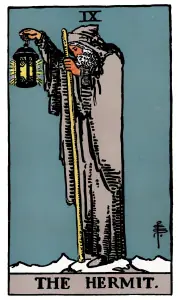
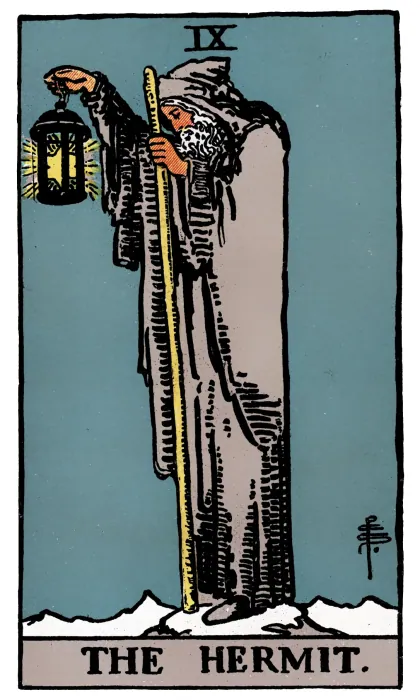
The Hermit tarot card from a Rider-Waite-Smith-style deck
The Hermit · Major Arcana 9 Artwork by Pamela Colman Smith (1910) · Public Domain Mark 1.0 · Image usage
Ask your own question: free AI reading
Arcana Major
Number9
Upright tendencyMaybe
Reversed tendencyLeans no

The Hermit upright and reversed meaning

The Hermit tarot card upright

The Hermit upright meaning

Drawn upright, The Hermit means taking time away from outside pressure to think clearly. It points to solitude, reflection, and wisdom that comes from your own experience.

The Hermit deliberately narrows the field of attention, stepping back from competing advice and opinions. That might mean a weekend without your phone before a big decision, a period of study, or a break from dating to understand what you want. The aim is to hear your own judgment without the noise.

The lantern can be read as an image of limited guidance. You might settle which kind of work interests you before knowing which employer would suit you. That is a useful conclusion, even though other questions still need information. Waiting for a full map may mean never leaving.

The Hermit can also represent teaching. The figure holds his light up so others can see it. Holding up what you have learned for someone else to examine gives private reflection a use beyond the retreat.

A practical way to use the card is to set a defined period of reflection, with a start and an end. Decide what question you are taking into it, and write down your conclusion when it ends, even if it is one sentence.

The Hermit tarot card reversed

The Hermit reversed meaning

Drawn reversed, The Hermit can suggest unhelpful isolation, guarded expertise, endless analysis, or so much outside input that there is no room to think.

A retreat can lose its purpose. You have stopped attending a group you once enjoyed, but the extra evenings alone bring no relief or understanding. Loneliness can follow. The point is to notice whether this withdrawal still serves you.

Knowledge can also become something to protect. An experienced volunteer may answer questions with instructions but never explain the reasoning, which leaves everyone dependent on them.

Reflection can keep a decision permanently out of reach. Reading another account of a new profession will not tell you whether you enjoy its daily work as directly as speaking with someone who does it.

The reversal can run the other way too: asking everyone for an opinion because silence feels uncomfortable. Then another conversation only adds noise.

What has your time alone produced lately? Loneliness with nothing changed suggests isolation. Held-back reasoning, or others kept dependent on what only you know, suggests guarded expertise. Many thoughts and no decision call for testing one conclusion in the real world this week, and a life with no quiet at all needs some scheduled.
The Hermit in love, career, and money

The Hermit in love & relationships

The Hermit love meaning

Upright

In love, The Hermit can describe a need for space, a quiet period, or time to understand what you want from a relationship. It does not automatically mean a breakup. In a couple, it favors agreeing on what the distance is for and when you will reconnect, so the other person is not left guessing. A quiet period can strengthen a couple when both people know it is temporary. If you are single, it supports a deliberate pause from dating to reflect on past patterns, without treating that pause as permanent.

Reversed

When The Hermit is reversed, it may point to withdrawal without explanation, emotional distance, or loneliness inside a relationship. It can also describe someone avoiding connection because they fear being hurt again. Unannounced retreat leaves the other person carrying uncertainty. If you are the one withdrawing, say how long you need and when you will be back in touch, even if the answer is approximate.

The Hermit as feelings

Upright

As feelings, The Hermit can suggest affection being considered privately, or uncertainty that someone wants time to understand. They may care about you and need time alone to sort out what they feel. They may need a day to answer a serious question.

Reversed

When The Hermit is reversed here, feelings may be withdrawn or lonely. Someone may be pulling away out of fear, or feel unable to share what is going on inside. They may want connection and not know how to reach for it. Their quiet may say more about their own state than about you.

The Hermit: how someone sees you

Upright

Someone may see you as wise, thoughtful, and independent, a person who thinks before speaking and does not need constant company. Some may find you hard to get close to at first, especially if you share conclusions more readily than the thoughts behind them.

Reversed

The impression may be of someone distant, closed off, or hard to reach. People may not know whether you want to be left alone or want to be asked. Telling them can change the impression.

A card can suggest how someone might see you. Only that person can tell you what they actually think.

The Hermit in career & money

The Hermit career meaning

Upright

At work, The Hermit favors focused independent work, research, specialist expertise, and roles that reward depth. It suits writing, analysis, study, or a period of planning before a career change. Block out uninterrupted time on your calendar and protect it. It also supports seeking out one experienced mentor instead of collecting opinions from everyone. If you are deciding on a new direction, take a few days away from the job to think.

Reversed

When The Hermit is reversed, it can describe isolation at work, such as working remotely without contact or being shut out of decisions. It can also point to refusing help or keeping knowledge to yourself. Share one piece of your work in progress with a trusted colleague this week. If you have been planning a change for a long time, take one concrete step, such as a conversation with someone in the new field.

The Hermit money meaning

Upright

Financially, The Hermit points to examining your own priorities away from social pressure. You may notice that an expensive habit belongs to a group you no longer enjoy. Review subscriptions and recurring costs in one sitting. A month of tracking every expense can show what you actually value.

Reversed

Reversed, The Hermit can suggest keeping money worries private until nobody knows you need help, or being so cautious that sensible opportunities pass. Talk through one money concern with someone you trust.

For investment or debt decisions, talk to a qualified financial professional.

The Hermit as advice and as a person

The Hermit as advice

Upright

As advice, The Hermit suggests choosing a defined period of solitude and protecting it from other people's urgency. Take a question you can actually answer alone, such as what you value about a role, and come back with that answer. A day, a weekend, or a week all count.

Reversed

The advice of the reversed Hermit is to test your private conclusion with one trustworthy person or one real-world step before extending the retreat. Contact may give you what more thinking cannot.

The Hermit as a person

Upright

Describing a person, The Hermit may point to someone private and reflective, who prefers a few substantial conversations to constant company. They may think before answering, spend time studying a subject, or ask for quiet before deciding. They give advice sparingly, and they notice what others miss.

Reversed

When The Hermit is reversed, it can point to someone who keeps withdrawing after others try to include them, or who shares conclusions without allowing questions. They may come across as aloof when they are actually lonely. A small invitation without pressure may help.

Is The Hermit a yes or no card?

Upright: Maybe

In its upright position, The Hermit is a maybe. The card favors reflection before action. Take time to think the decision through on your own terms first, and the answer may become clear. Once you have a conclusion you trust, and it fits the facts and the agreement of anyone else involved, you can move forward with it. Pressure from others to decide quickly does not change this answer.

Reversed: Leans no

It leans no while isolation, avoidance, or endless analysis is keeping you from engaging with the real situation. Talking to someone involved, or taking one small step to test the idea, can change the answer. Waiting for a certainty that may never arrive keeps it at no.

These tendencies use the reference question “Do current conditions support moving forward?” Your question and circumstances can change the interpretation; this is not a guaranteed outcome.

The Hermit and spirituality

In spiritual practice, The Hermit points to retreat, contemplation, and seeking wisdom through quiet practice: a silent retreat, even a short one, long walks, or time away from screens. It also favors studying with a teacher whose approach you can question. The card suggests that solitude has value when it leads you back to others with something to offer, even if only a clearer question.

Symbols in The Hermit

The Hermit depicts an old, bearded man in a long gray cloak and hood, standing alone on a snowy height. In his right hand he raises a lantern with a six-pointed star inside it. In his left he holds a tall yellow staff. The sky behind him is a plain gray-blue.

The lantern and star stand for guidance. The small light against the empty sky suggests guidance for a limited part of the way, enough to see the next steps.

The staff suggests support on difficult ground.

The gray cloak strips away display.

The snowy height gives perspective, and it is also cold and far from others. The card shows the value of distance and its cost at the same time.

Waite stresses that the Hermit is holding his lantern up from a height he has already reached. In his reading, this is a card of attainment more than of searching, and the raised light is an invitation to others to follow.

Traditional associations: Major Arcana IX · Solitude, discernment, and inner guidance · Traditionally associated with Virgo. Association systems differ between traditions.

Reading notes for The Hermit

Example reading. A senior engineer has been offered a promotion that would mean managing people for the first time. Friends and family have each given strong, different opinions. They ask, "What do I need to decide this well?" and draw The Hermit upright.

They might compare the parts of management they would welcome, such as coaching colleagues, with the specialist work they would have less time for. The card does not say whether to accept. It directs attention to whether they want the daily work behind the title.

The Hermit FAQ

What zodiac sign is The Hermit associated with?

In the Golden Dawn system, The Hermit corresponds to Virgo, an earth sign associated with care, analysis, and discernment. The link suits a card about careful thought. It belongs to that system and does not mean the person in your reading is a Virgo.

What is in The Hermit's lantern?

A six-pointed star. Waite notes that the star shines inside the lantern and that the Hermit holds it up from a height he has already reached. He reads the raised light as saying, in effect, "where I am, you also may be." The lantern is an invitation as much as a guide.

Why does Waite reject "occult isolation" for The Hermit?

Waite objects to the idea that the figure withdraws to protect a private spiritual influence from contact with others. He treats the raised light as something visible to those who are ready for it. That is different from the everyday question of needing time alone, which is one of the modern uses of the card here.

How is The Hermit different from The High Priestess?

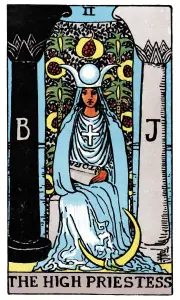
The High Priestess emphasizes what remains unspoken or unknown, while The Hermit emphasizes deliberate reflection and guidance. She sits at a threshold and keeps what she knows. His raised light suggests an understanding that can be offered to others. This compares the two images.

Sources: A. E. Waite, The Pictorial Key to the Tarot (1910), Part II: IX — The Hermit; Israel Regardie, The Complete Golden Dawn System of Magic, The Tarot: names and attributions of the Tarot trumps (Book T)