Four of Swords Tarot Card Meaning

Quick Meaning

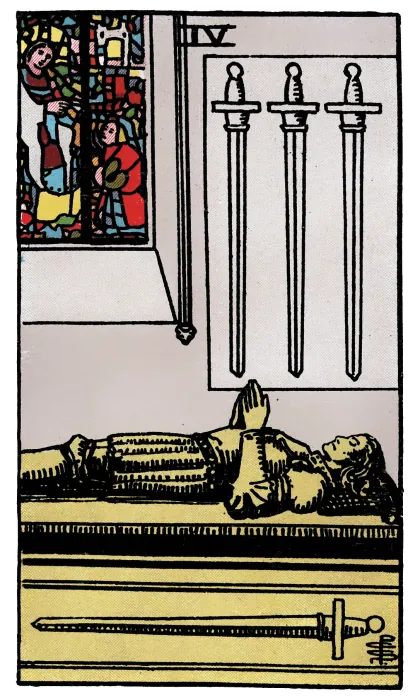
Inside a quiet chamber, three swords hang on the wall while one lies near a resting figure. Withdrawal creates an interval for recovery, prayer, or reconsideration. It is not necessarily a permanent disappearance. When the quiet breaks, it can signal return and renewed activity, but also restlessness, caution, or a pause that did not restore what was depleted.

  • rest
  • recovery
  • contemplation
  • pause
  • retreat
  • integration
Four of Swords tarot card from a Rider-Waite-Smith-style deck
Four of Swords · Swords suit Artwork by Pamela Colman Smith (1909) · Public Domain Mark 1.0
Number
4
Upright tendency
Maybe
Reversed tendency
Leans no

Four of Swords upright and reversed meaning

Upright

The Four of Swords creates a protected interval when further argument or information no longer improves judgment. The nearby blades show that the issue still exists, but it need not demand an immediate response. This is rest with a function: allowing an experience to settle enough to be seen differently. Its value lies in the quality of attention that returns, rather than in the mere passage of quiet time.
Reversed

Reversed, an interval may end without having become truly restorative. Rumination can continue behind a closed door, or attention may return in uneven stretches that do not yet fit the former pace. The card can describe reawakening as well as restless exhaustion. Distinguishing them requires looking at what changed during the pause; actual capacity and health circumstances, rather than the orientation of a card, determine an appropriate return.

A common misreading: A quiet interval is not automatically laziness or avoidance. Its value lies in whether attention becomes more capable of meeting the unresolved issue.

Love, work, and practical questions

Love & relationships

Love

Upright. Quiet or reduced contact may allow a conflict to settle. Its meaning is space for clearer attention, rather than a prediction that distance will restore the bond or erase the issue.

Reversed. Silence may be becoming avoidance, or someone may be ready to re-enter conversation with more perspective. Do not assume renewed contact means the issue is resolved. Begin with one narrow topic and stop if the old reactive pattern immediately returns.

Feelings

Upright. The Four of Swords suggests a need for space, quiet, and reduced emotional demand. Someone may be processing rather than rejecting the connection. Their stated boundary should be honored without constructing a promise about what they will decide later.

Reversed. They may be restless, ready to reconnect, or frustrated that distance has not created clarity. A person can miss contact and still need a different relationship structure. Start slowly and ask what changed during the pause.

Work & money

Career

Upright. Saturated judgment can make repeated review less useful. A protected interval may help restore perspective; actual workload, leave, and return conditions depend on workplace agreements, present capacity, and appropriate support.

Reversed. At work, notifications, guilt, or fear of returning may keep a break from becoming mentally quiet. Attention may return in uneven bursts. The central distinction is between reawakening and a return to the exact conditions that exhausted judgment in the first place.

Money

Upright. A paused transaction or protected reserve may offer relief from repeated decision pressure. The quiet changes the experience of the question; balances, terms, and due dates still require factual attention.

Reversed. Deferred money matters may return before confidence feels restored. The card describes friction between uneven attention and continuing obligations, rather than determining which payment or transaction should proceed.

Yes or No Tendency

Upright: Maybe

Maybe: the answer remains open while a quieter interval allows the situation to be seen more clearly.

Reversed: Leans no

No in this reading: continuing mental noise means the interval has not yet produced a settled judgment.

These tendencies use the reference question “Do current conditions support moving forward?” Your question and circumstances can change the interpretation; this is not a guaranteed outcome.

Symbols in Four of Swords

The quiet chamber keeps the swords present while removing their immediate demand on attention.

The resting effigy
A horizontal, prayerful figure makes stillness, withdrawal, and protected recovery the main action.
Three swords on the wall
Prior conflict remains visible but is stored outside the resting body.
The single horizontal sword
One blade lies close to the figure, preserving readiness without demanding immediate use.
The stained-glass window
A small relational scene introduces meaning, care, and sanctuary into the otherwise austere chamber.

Traditional associations: Swords · air · thought, communication, and conflict · Four · stability, limits, or consolidation. Association systems differ between traditions.

Questions about Four of Swords

Does the Four of Swords mean death?

No: the tomb-like setting is not a prediction of death. Waite describes an effigy in prayer and includes both retreat and tomb imagery in his older divinatory list. Those associations are not evidence of a future death; in a present-day reading, the image can frame rest or withdrawal without establishing what will happen to someone’s health.

What does the Four of Swords mean in a relationship?

A relationship may need quiet, reduced contact, or time to process a conflict before another productive conversation is possible. Define the pause so it does not become indefinite punishment. State what contact remains, when to check in, and what each person is using the space to consider.

What does the Four of Swords reversed mean?

Reversed, the quiet interval is breaking. That may signal renewed activity and return, but it can also show restlessness, caution, interrupted recovery, or withdrawal that has continued without restoring clarity.

Elena is ArcaSeer’s named editorial voice. How Elena’s notes are created