Three of Swords Tarot Card Meaning

Quick Meaning

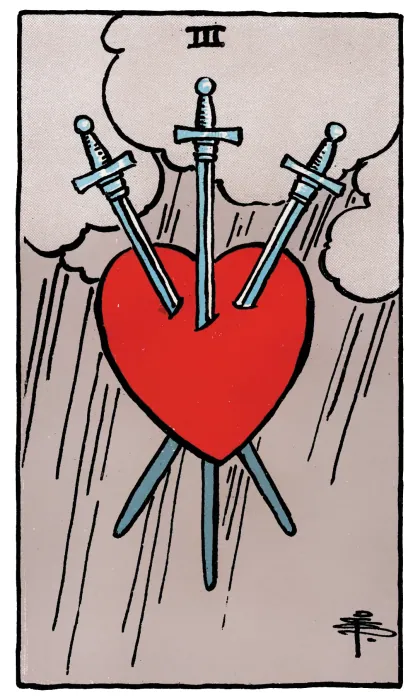
Three swords pierce an exposed heart beneath rain and heavy cloud, with no person shown to assign blame. The image names the wound created by separation, rejection, or a painful truth before asking what comes next. Pain may begin to ease, remain denied, or return when forgiveness is demanded before trust has changed.

  • heartbreak
  • painful truth
  • grief
  • separation
  • sorrow
  • necessary acknowledgement
Three of Swords tarot card from a Rider-Waite-Smith-style deck
Three of Swords · Swords suit Artwork by Pamela Colman Smith (1909) · Public Domain Mark 1.0
Number
3
Upright tendency
Leans no
Reversed tendency
Maybe

Three of Swords upright and reversed meaning

Upright

The Three of Swords gives a painful experience a clear shape. A rejection, separation, or difficult truth may be undeniable even when its cause or another person's intention remains uncertain. Naming the wound can support grief without enlarging the facts into a verdict on every future relationship. The image describes emotional pain, not a prediction of physical harm, and leaves room for care before demanding closure or reconciliation.
Reversed

Reversed, the relationship to pain begins to matter as much as the original injury. There may be less reactivity and more room to speak, or silence may conceal denial and resentment. Healing does not require granting someone renewed access or proving that the event no longer hurts. The useful distinction is whether remembering the injury allows clearer boundaries and choices, or repeatedly returns the person to the same argument.

Love, work, and practical questions

Love & relationships

Love

Upright. Heartbreak, rejection, or a painful disclosure can change a bond. The card names the hurt without proving its cause; reconciliation and appropriate support depend on the actual situation.

Reversed. A person may be ready to release resentment, speak about an injury, or accept an ending. Pain may instead be minimized because conflict feels inconvenient. Reconciliation requires changed behavior and consent; forgiveness does not require renewed access.

Feelings

Upright. The Three of Swords suggests hurt, grief, disappointment, or fear of further injury. Someone may still love the person connected with the pain. Remaining feeling does not cancel the boundary or imply that reconciliation is desired.

Reversed. They may be softening, processing, or held under a controlled surface. A person can forgive and still choose distance. Look for reduced reactivity and clearer boundaries rather than assuming healing must restore closeness.

Work & money

Career

Upright. A rejection or difficult review may feel larger than the professional event itself. The card separates the specific feedback from a judgment that one setback defines an entire career.

Reversed. A difficult professional event may be losing its power, especially when lessons and boundaries have been made concrete. If the wound keeps returning, examine unresolved process, reputation, or financial consequences rather than demanding emotional closure alone.

Money

Upright. A loss may have become specific through a rejected application, divided asset, or expense associated with a rupture. The card describes its emotional weight rather than predicting another material setback.

Reversed. The financial aftermath may become easier to account for while still reopening hurt. Revised expectations or shared expenses can give a loss clearer boundaries without making its emotional consequences disappear.

Yes or No Tendency

Upright: Leans no

Usually no under present conditions: the known injury or separation changes what is workable.

Reversed: Maybe

Maybe, if acknowledgment and changed behavior address the injury; less pain does not automatically justify resuming the old arrangement.

These tendencies use the reference question “Do current conditions support moving forward?” Your question and circumstances can change the interpretation; this is not a guaranteed outcome.

Symbols in Three of Swords

The exposed heart and surrounding weather make emotional pain visible without identifying its cause.

The red heart
A single exposed organ makes emotional vulnerability and injury immediate rather than symbolic at a distance.
Three piercing swords
Blades connect words, thoughts, and decisions with a wound that has entered lived feeling.
The gray clouds
The entire background is obscured, reflecting how pain can narrow the visible field.
The falling rain
Continuous rain sustains the atmosphere of grief while also suggesting movement rather than a frozen scene.

Traditional associations: Swords · air · thought, communication, and conflict · Three · development, expression, or collaboration. Association systems differ between traditions.

Questions about Three of Swords

Does the Three of Swords mean death?

No: the pierced heart is not evidence that someone will die. Waite’s divinatory list concerns absence, separation, and rupture, rather than a medical diagnosis. It can give form to emotional pain, but it cannot identify a fatal event or explain a physical symptom.

Does the Three of Swords prove that someone is cheating?

No. Waite associates the Three of Swords with absence, separation and rupture; this does not make the number of swords a count of people in a relationship. Fiebig and Bürger also explore the meeting of thought and feeling: putting a painful experience into words can help you understand it. A reading may give you language for a concern, but an accusation requires evidence from the relationship itself. Ask what happened and what remains unknown before deciding how to respond.

What does the Three of Swords reversed mean?

Reversed, the injury may no longer be the only thing visible. The event remains painful, yet it can be placed in time: something that happened, not a sentence on every relationship or future attempt. Recovery here is not forced forgiveness; it is the return of choices that the wound had narrowed.

Elena is ArcaSeer’s named editorial voice. How Elena’s notes are created