Two of Swords Tarot Card Meaning

Quick Meaning

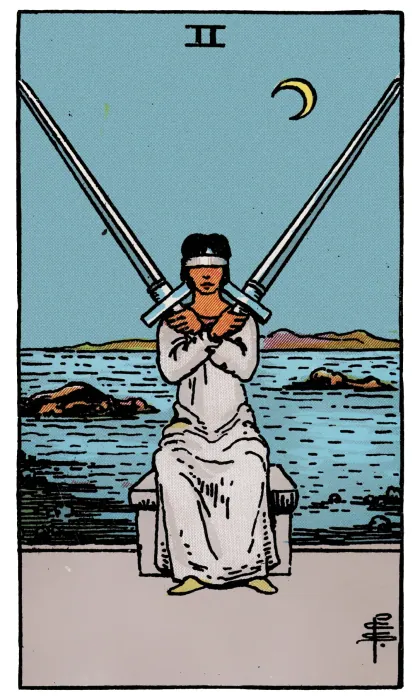
A blindfolded figure crosses her arms while balancing two swords that reach outward above her shoulders; water and rocks remain behind her. The pause keeps two competing concerns in view without forcing an immediate answer. New information or growing pressure may disturb the balance before the choice feels complete or comfortable.

  • stalemate
  • avoidance
  • difficult choice
  • boundaries
  • limited information
  • temporary balance
Two of Swords tarot card from a Rider-Waite-Smith-style deck
Two of Swords · Swords suit Artwork by Pamela Colman Smith (1909) · Public Domain Mark 1.0
Number
2
Upright tendency
Maybe
Reversed tendency
Leans no

Two of Swords upright and reversed meaning

Upright

The Two of Swords holds opposing positions in a guarded balance. Waiting can protect a decision from pressure while a missing fact or necessary conversation becomes available. Yet the pause has a cost of its own. The blindfold may shelter someone from a difficult consequence as much as from incomplete information. The card asks what would make choosing possible, and whether continued neutrality is already favoring one outcome.
Reversed

Reversed, maintaining the stalemate becomes harder than admitting the tradeoff. A disclosure, deadline, or accumulated consequence can force an excluded part of the decision into view. Movement need not feel comfortable, and ending uncertainty does not make the selected option sound. The distinction is between information that genuinely changes the choice and a rushed answer whose only purpose is to escape the strain of holding both positions.

Love, work, and practical questions

Love & relationships

Love

Upright. Two needs or guarded positions may keep a relationship suspended. A pause can make room for a difficult conversation, but silence should not become an assumed agreement or an unspoken promise.

Reversed. A delayed conversation may finally occur, or conflicting messages may make trust harder. The reversal can show a rushed choice made to escape tension. Clarify what was decided, what remains open, and whether both people had equal room to speak.

Feelings

Upright. The Two of Swords suggests guardedness, ambivalence, and a reluctance to expose preference. Someone may fear that any answer will change the relationship. Respect the boundary, but do not invent a hidden yes inside an explicit pause.

Reversed. They may be surfacing after suppression or becoming more confused under pressure. A person could speak abruptly because the stalemate is no longer tolerable. Give the statement time to settle and confirm what action it actually implies.

Work & money

Career

Upright. At work, equal-looking options, competing priorities, or unclear authority can suspend a decision. One missing fact may matter, but so may the consequence each option carries. Name the exact decision and the one fact or owner needed before the pause has served its purpose.

Reversed. New information may separate the options, or too many opinions may make the original objective harder to see. A deadline increases pressure without creating clarity. The reversal often marks the moment when maintaining the stalemate becomes more difficult than acknowledging the tradeoff already taking shape.

Money

Upright. Two costs may remain difficult to compare, either because information is missing or because acknowledging a consequence feels uncomfortable. Leaving the accounts or choice untouched can carry a cost too.

Reversed. An overlooked figure or accumulated obligation can make continued indecision harder. Relief from finally choosing is different from affordability: the financial tradeoff remains even when the uncertainty ends.

Yes or No Tendency

Upright: Maybe

Maybe: a protected pause can be useful while the deciding information or criterion remains unresolved.

Reversed: Leans no

No while pressure to end the stalemate substitutes for understanding what each option requires giving up.

These tendencies use the reference question “Do current conditions support moving forward?” Your question and circumstances can change the interpretation; this is not a guaranteed outcome.

Symbols in Two of Swords

The guarded posture shows the effort required to keep opposing positions suspended.

The balanced swords
Two equal blades form a stable barrier, showing balance maintained through continued effort.
The blindfold
Limited sight can represent missing information, deliberate neutrality, or protection from a difficult consequence.
The crescent moon
Partial lunar light reinforces that the situation is not fully illuminated or emotionally settled.
The water and rocks
A broad emotional field contains fixed obstacles beneath the figure's controlled intellectual pose.

Traditional associations: Swords · air · thought, communication, and conflict · Two · polarity, choice, or balance. Association systems differ between traditions.

Questions about Two of Swords

What does the Two of Swords mean in a love reading?

A relationship may be caught between two needs, with both people protecting themselves from the conversation that would change the balance. Do not force an answer before safety exists, but set a time to return. Silence is not a durable agreement and should not be interpreted as consent.

What does the Two of Swords reversed mean?

Reversed, the suspended decision is no longer holding. A deadline, disclosure, or accumulating consequence brings the excluded part of the choice into view, and movement begins before relief does. The strain comes from admitting what each option costs, not from proof that either option is wrong.

Is the Two of Swords a yes or no?

Upright: Maybe; the choice remains balanced or protected because a deciding fact, conversation, or criterion has not yet been established. Reversed: No until the tradeoff can be stated clearly; a rushed attempt to escape uncertainty is not a sound decision.