Temperance Tarot Card Meaning

Quick Meaning

The Temperance tarot card means balance found through patience and steady adjustment: combining different needs, people, or parts of life into something that works. Upright, it favors moderation, compromise that suits everyone involved, and gradual progress. Reversed, it can point to excess, swinging between extremes, or a compromise that leaves one side carrying the strain. As a yes or no card, Temperance leans yes upright and is a maybe reversed.

Upright
  • balance
  • moderation
  • patience
  • harmony
Reversed
  • excess
  • imbalance
  • impatience

Updated

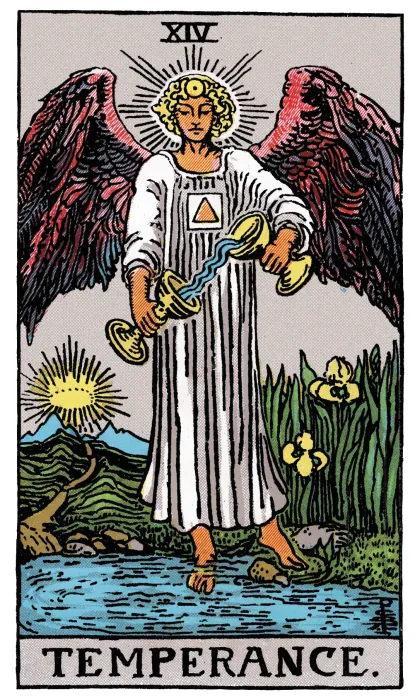
Temperance tarot card from a Rider-Waite-Smith-style deck
Temperance · Major Arcana 14 Artwork by Pamela Colman Smith (1910) · Public Domain Mark 1.0 · Image usage
Ask your own question: free AI reading
Arcana Major
Number14
Upright tendencyLeans yes
Reversed tendencyMaybe

Temperance upright and reversed meaning

Temperance tarot card upright

Temperance upright meaning

Drawn upright, Temperance means finding the right mix. It points to balance, patience, and the slow work of bringing different things together so that none of them takes over.

Temperance looks for a workable proportion between things that still matter, without assuming one must be abandoned. Work and rest, ambition and family, saving and enjoying, your needs and someone else's: the card looks for a rhythm that can hold them all. A schedule that leaves time for exercise and friends, a budget with room for pleasure, or a relationship where both people adjust a little all fit.

The card also favors gradual change. Pouring from cup to cup takes time and attention. Sudden overhauls tend to tip into the opposite extreme, while small, repeated adjustments are more likely to last.

Two friends planning a trip might need both quiet time and shared activities. One afternoon together and an evening apart may suit them better than trying to do everything at the same pace.

A practical way to use the card is to name the two things you are trying to balance and write down what each needs to stay workable. A compromise that starves one side completely is not what this card describes. Look for the version where both get enough.
Temperance tarot card reversed

Temperance reversed meaning

Reversed, Temperance can suggest excess, repeated overcorrection, an unequal compromise, or impatience with gradual change.

One part of life may crowd out the rest. A new project can be absorbing without being a problem, but if every meal and conversation is interrupted by it, the cost has become visible.

Overcorrection makes balance harder to keep. Someone follows a rigid spending plan, abandons it after one unplanned purchase, then starts an even stricter version. A sign is that every new plan starts with the words "from now on."

An arrangement may also look calm because the same person always adjusts. They change their plans, take the less convenient shift, or stop raising a need. That is not a compromise both people can sustain.

Impatience runs through all of these. A change that needs several attempts is declared a failure after the first, before it had a fair trial.

The pattern over the last few months usually shows which one fits. If one area keeps growing, excess is likely. If you keep swinging, the problem is overcorrection. If things look calm and someone feels drained, the compromise is uneven. In each case, the first step is a baseline you can keep up, not another extreme.

Temperance in love, career, and money

Temperance in love & relationships

Temperance love meaning

Upright

In love, Temperance favors patience, measured honesty, and two people learning how their different rhythms can fit together. It can describe a calm, steady relationship, or a period of repair after conflict, where trust is rebuilt through consistent behavior over time. For a couple returning after a separation or a hard argument, small kept promises matter more than big gestures. Compromise here creates a livable middle, and does not ask one person to shrink so that conflict stays quiet. If you are single, the card supports a balanced approach: neither rushing nor closing yourself off.

Reversed

Reversed, Temperance may show emotional swings between intensity and distance, or one person's pace setting every decision. It can also describe incompatible needs being treated as a simple communication problem. Lower the temperature first, then state the difference that cannot be negotiated away, and see whether a stable agreement is possible. If you are the one always adjusting, say so plainly.

Temperance as feelings

Upright

Emotionally, Temperance can suggest calm, steady feelings. Someone may care about you in a balanced, unhurried way, wanting to build something that lasts. They may be consistent, patient, and willing to meet you halfway, with a pace of contact that leaves room for both people's lives.

Reversed

With Temperance reversed, their feelings may be unbalanced or volatile. Someone may feel very strongly one week and pull back the next, or feel that they give more than they receive. They may want more stability than they currently have, and not know how to ask for it. Their mood may change with stress outside the relationship.

Temperance: how someone sees you

Upright

Someone may see you as calm, sensible, and easy to be with, a person who keeps the peace and finds common ground. They may come to you when they need perspective. Your patience may reassure them.

Reversed

They may see you as inconsistent, or as someone who goes to extremes. Some may feel you take on too much and stretch yourself thin.

A card can suggest how someone might see you. Only that person can tell you what they actually think.

Temperance in career & money

Temperance career meaning

Upright

At work, Temperance favors cooperation, steady progress, and roles that bring people or ideas together, such as mediation, coordination, or team leadership. It fits coordinating teams with different working methods, so one team's deadlines do not depend on the other working late. It also favors a sustainable pace. If you are working long hours, find one change that would make your week more balanced and keep it for a month.

Reversed

Temperance, reversed, can describe overwork, conflict between teams, or a role that pulls you in incompatible directions. It can also point to rushed bursts of work followed by abandoned tasks. Set a baseline of hours you can sustain, and protect it from new requests. If two demands are really incompatible, raise that with whoever sets them instead of trying to satisfy both.

Temperance money meaning

Upright

Financially, Temperance points to moderation: a budget with room for both saving and enjoyment, and steady habits over sudden changes. A plan that sets aside a fixed share of each payment fits the card well. Plan treats on a schedule, so enjoyment does not have to come from impulse, and review the plan every few months to adjust it gently.

Reversed

Temperance, reversed, can point to overspending followed by strict cutbacks, then overspending again. It can also describe a household where one person's spending is balanced by another's sacrifice. Aim for a middle you can keep, such as a weekly spending limit that includes something enjoyable.

For investment or debt decisions, talk to a qualified financial professional.

Temperance as advice and as a person

Temperance as advice

Upright

For advice, Temperance suggests protecting what each side must keep, and refusing a compromise that only works by exhausting one participant. Adjust in small steps, and check the result after each one. For example, move bedtime fifteen minutes earlier each week instead of all at once.

Reversed

With Temperance reversed, stop compensating for one extreme with another. Restore a baseline you can maintain, even if it feels too modest at first, and build from there.

Temperance as a person

Upright

Describing a person, Temperance may point to someone patient and able to bring different needs into a conversation. They may suggest a workable pace, invite the quieter participant to speak, or adjust a plan without abandoning its purpose. They tend to stay level when others are upset.

Reversed

The reversed card can describe someone who lives in extremes, or someone who keeps the peace for others at their own expense. They may agree to incompatible plans, then withdraw after taking on more than they wanted.

Is Temperance a yes or no card?

Upright: Leans yes

Upright, Temperance leans yes, especially if the plan can be introduced gradually and adjusted along the way. The yes is strongest when the change fits alongside your existing commitments, without one side carrying all the strain. A plan that demands everything at once weakens the yes.

Reversed: Maybe

A maybe. The plan may work, but excess, imbalance, or an unsteady pace needs to be corrected first. If you can find a sustainable rhythm, the answer may move toward yes. If the plan depends on pushing to an extreme, it leans toward no. Start smaller than you think you need to.

These tendencies use the reference question “Do current conditions support moving forward?” Your question and circumstances can change the interpretation; this is not a guaranteed outcome.

Temperance and spirituality

On a spiritual level, Temperance relates to integration: bringing practice into daily life, and joining body, feeling, and thought. Finding a rhythm that suits your body, work, and rest matters more here than any single method. Waite says the card tempers and harmonizes the psychic and material natures. In a modern reading, that can include combining practices from different traditions in a way that feels coherent.

Symbols in Temperance

Temperance shows a winged figure in a white robe pouring water between two gold cups. A sun-like disk shines on the figure's forehead, and a triangle inside a square is marked on the chest. One foot stands in a pool of water and the other on the grassy bank. Yellow irises grow nearby. A path leads from the water toward distant mountains, where a bright light rises with the faint shape of a crown in it.

The two cups and the flowing water stand for exchange and adjustment, mixing two things in the right proportion. One foot in water and one on land joins feeling with practical reality. Neither side is abandoned.

The triangle inside the square suggests a higher aim held inside a stable, practical frame. The path toward the light suggests that balance is built over a long route, not reached in one step. Waite describes the figure as neither male nor female. The angel stands for a quality, not a particular person.

Traditional associations: Major Arcana XIV · Moderation, integration, and calibration · Traditionally associated with Sagittarius. Association systems differ between traditions.

Reading notes for Temperance

Example reading. A nurse started a demanding evening course while working full-time. For two months they have studied until midnight on weekdays and then slept most of the weekend. They ask, "How can I keep this up?" and draw Temperance upright.

The card points to the swing between overwork and collapse. It suggests a fixed, modest study time each evening, with one evening off and some study on the weekend. The card does not promise they will pass. They would still need to check that schedule against the course requirements.

Temperance FAQ

What zodiac sign is Temperance associated with?

The Golden Dawn assigns Temperance to Sagittarius, a fire sign associated with direction and long-term aims. The pairing can be read as purpose combined with patience. It is a symbolic link within that system and does not describe every Sagittarius.

Did Waite read Temperance reversed as excess?

Not exactly. His divinatory list for the reversed card includes disunion, unfortunate combinations, and competing interests, rather than simply making moderation its opposite. That supports looking at how parts fail to work together. The readings of overcorrection and unequal compromise on this page are modern applications.

Why is the card called Temperance?

Temperance is one of the classical virtues, alongside Justice and Strength. Waite says the name is used because, when its rule holds, it tempers, combines, and harmonizes the psychic and material sides of a person. His own list of meanings includes economy, moderation, frugality, and management.

How is Temperance different from the Two of Pentacles?

Temperance blends different things into a new, steady mixture over time, while the Two of Pentacles juggles competing demands to keep them all moving. Temperance is calm and gradual. The Two of Pentacles is quick, playful, and sometimes close to dropping something.

Sources: A. E. Waite, The Pictorial Key to the Tarot (1910), Part II: XIV — Temperance; Israel Regardie, The Complete Golden Dawn System of Magic, The Tarot: names and attributions of the Tarot trumps (Book T)