The Devil Tarot Card Meaning

Quick Meaning

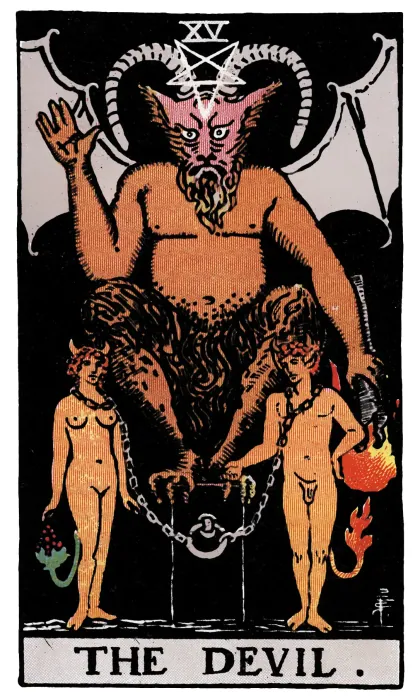
The Devil crouches on a pedestal above two figures loosely chained at its base. The image exposes a bond held in place by desire, fear, secrecy, status, or unequal terms without pretending every limit is easy to leave. Seeing the bond clearly can begin to loosen it, but the card cannot replace real safety, support, or freedom.

  • attachment
  • temptation
  • control
  • shadow
  • dependency
  • materialism
The Devil tarot card from a Rider-Waite-Smith-style deck
The Devil · Major Arcana 15 Artwork by Pamela Colman Smith (1909) · Public Domain Mark 1.0
Arcana
Major
Number
15
Upright tendency
Leans no
Reversed tendency
Maybe

The Devil upright and reversed meaning

Upright

The Devil brings attention to a pattern that remains attractive despite its cost. Relief, pleasure, status, or belonging may help maintain it, which is why shame alone explains little. A neglected desire may deserve acknowledgment without giving a damaging arrangement control over it. The useful question is how appetite and leverage affect choice, not whether the card establishes a curse, an evil person, or an inevitable fate.
Reversed

Reversed, recognition can make an attachment less inseparable from identity. A person may begin to see room for a different relationship to desire or dependency, while ambivalence and recurrence remain. Insight is not the same as completed change: the familiar payoff, unequal permission, or secrecy may still operate. The reversal therefore holds awareness and continuing constraint together rather than announcing that the bind has already disappeared.

Love, work, and practical questions

Love & relationships

Love

Upright. Strong attraction may coexist with dependence or unequal permission. The relationship's quality is not measured by intensity alone; freedom to disagree and make choices remains part of the picture.

Reversed. A constraining pattern may become easier to recognize while remaining active in the relationship. Awareness matters, but a different account of the bond does not itself change its terms.

Feelings

Upright. Desire may be intense, possessive, or connected to fear of loss. Those feelings do not establish mutuality or safety, even when the connection feels unusually compelling or difficult to release.

Reversed. Attraction may remain while someone questions the compulsion around it. Feeling desire and choosing not to organize behavior around that desire can coexist during the process of detachment.

Work & money

Career

Upright. Status or belonging may make an arrangement difficult to question. Professional identity can become tied to a bargain in which dissent seems to threaten more than a particular term.

Reversed. Someone may recognize how prestige or dependence shaped their work identity. That awareness can loosen attachment while leaving real ambivalence about the self and position built around it.

Money

Upright. Status, relief, or belonging may become part of a material bargain's price. The theme is dependency that asks for more, rather than security established by the appearance of prosperity.

Reversed. A financial bind may become easier to name without instantly becoming different. Recognition can reduce shame while recurring charges, dependence, or status spending still retain practical force.

Yes or No Tendency

Upright: Leans no

No while compulsion or unequal leverage narrows choice. The concern is the attachment being maintained, rather than a judgment that desire itself is wrong.

Reversed: Maybe

Maybe as recognition creates some distance from the bind. Familiar rewards and ambivalence can persist even when alternatives become easier to imagine.

These tendencies use the reference question “Do current conditions support moving forward?” Your question and circumstances can change the interpretation; this is not a guaranteed outcome.

Symbols in The Devil

Slack chains and different tails reveal how appetite can participate in a maintained attachment.

The loose chains
The visible slack suggests constraint that is real but not fully explained by physical force alone.
The flame and grape tails
The paired tails connect appetite, pleasure, and impulse with the attachments being maintained.
The dark pedestal
The elevated central figure makes the hierarchy and the couple's participation in it impossible to ignore.

Traditional associations: Major Arcana XV · Attachment, compulsion, and disowned desire · Traditionally associated with Capricorn. Association systems differ between traditions.

Questions about The Devil

What does The Devil mean in a love reading?

Upright: In love, this card may describe intense attraction, jealousy, control, secrecy, or fear of being alone. Desire is not inherently harmful. The central clue is whether it can coexist with genuine choice, privacy, and a no that does not carry punishment. Reversed: In relationship questions, the reversal can mark recognition that control, compulsion, or unequal permission has shaped the bond. A lasting change appears when conduct, permission, and access to support change with the insight, not when awareness alone is declared.

What does The Devil represent as a person?

Upright: In this pattern, closeness or status may be organized around bargains that are hard to question. Pleasure can be used to avoid a cost, or another person's dependency allowed to benefit the person who refuses to name it. Reversed: Naming the bond is a start. The person still has to change access, behavior, or support. Recognition is not the same as completed release.

What does The Devil reversed mean?

Reversed, the chain becomes visible as a chain rather than an unquestioned identity. Recognition may bring relief, grief, embarrassment, anger, or ambivalence, because seeing a maintained attachment does not instantly remove what made it familiar.

Elena is ArcaSeer’s named editorial voice. How Elena’s notes are created