Ace of Swords Tarot Card Meaning

Quick Meaning

The Ace of Swords tarot card means a breakthrough in clarity: a truth named plainly, a decision that can finally be made, or a sharp idea that cuts through confusion. Upright, it favors precise words, honest conversations, and deciding once the key fact is clear. Reversed, it can point to confusion, miscommunication, a conclusion reached too early, or clarity used carelessly. For yes-or-no questions, the Ace of Swords leans yes upright and leans no reversed.

Upright
  • clarity
  • truth
  • breakthrough
  • decision
Reversed
  • confusion
  • miscommunication
  • poor judgment

Updated

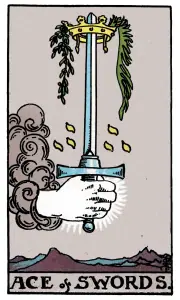
Ace of Swords tarot card from a Rider-Waite-Smith-style deck
Ace of Swords · Swords suit Artwork by Pamela Colman Smith (1910) · Public Domain Mark 1.0 · Image usage
Ask your own question: free AI reading
Arcana Minor · Swords
Number1
Upright tendencyLeans yes
Reversed tendencyLeans no

Ace of Swords upright and reversed meaning

Ace of Swords tarot card upright

Ace of Swords upright meaning

The upright Ace of Swords means clarity arrives, and it arrives with consequences. A hidden contradiction, a disputed term, or a decision you have been avoiding can now be named plainly. That gives you the chance to cut away confusion before momentum builds around the wrong conclusion.

As the Ace of the air suit, this card is the first clean stroke of thought. It might look like suddenly understanding a problem you have struggled with for weeks, hearing a direct answer after months of vague hints, or finding the exact words for something you need to say.

The card favors honesty that is proportionate and respectful. A true statement can clear the air. Truth used as a weapon, or demanded from someone before they are ready, is this card out of balance, as the reversed meaning describes.

Waite's meanings include triumph, conquest, and the triumph of force, and he calls it a card of great force in love as well as in hatred. That range reminds you that clarity can cut in either direction.

A practical way to use the card is to write the key question or claim in one sentence. If you cannot say what would make it true or false, keep working until you can. Then make the decision, or have the conversation, while the clarity is fresh.

Ace of Swords tarot card reversed

Ace of Swords reversed meaning

The reversed Ace of Swords can suggest that thought and language have lost alignment. Confusion, selective facts, poor timing, or certainty reached before the evidence may turn an apparent breakthrough into another source of error.

Confusion looks like going around in circles, unable to name the actual problem. Each attempt to explain it creates new questions.

Miscommunication looks like two people using the same word for different things. Both believe they agreed, and later discover they did not.

Premature certainty shows up as deciding before all the facts are in. A person might quit a job over one bad meeting, or end a friendship over a message they misread.

Careless clarity often means saying something true in a way that wounds unnecessarily, then defending it as honesty.

Waite's reversed card keeps the same force with disastrous results, which fits a blade turned the wrong way. The strength of the insight stays, and its direction changes.

Start with what is missing, because each gap has its own repair. A missing fact should be found before deciding. Unclear words need rewriting until another person can repeat them back. Words already said too sharply need repair, to the wording and to the relationship, and any choice you cannot undo can wait until that is done.
Ace of Swords in love, career, and money

Ace of Swords in love & relationships

Ace of Swords love meaning

Upright

For relationships, the Ace of Swords points to an honest conversation that clears up confusion. It can describe finally saying what you want, hearing a direct answer, or agreeing what the relationship actually is. For two people who have been guessing, that clarity can be a relief, even when the answer is not the one hoped for. In an established relationship, it can describe solving a long-running problem with plain words and a clear agreement. Single readers may get clear about what they want in a partner, and stop pursuing what does not fit. A direct question on a date, kindly asked, fits the card.

Reversed

When the Ace of Swords is reversed, it may show mixed messages, arguments where both people talk past each other, or harsh words said in the name of honesty. Slow the conversation down. Ask the other person to repeat what they heard, and do the same for them. Choose the timing of a hard talk carefully, and avoid starting it late at night or by text.

Ace of Swords as feelings

Upright

As feelings, the Ace of Swords suggests clarity and certainty. Someone may know clearly what they feel about you and want to say it directly. Where they have spoken plainly before, the card may reflect a settled decision. Their feelings may sound more thought-through than emotional. They may prefer a direct question to hints.

Reversed

When the Ace of Swords is reversed here, feelings may be confused or conflicted. Someone may be thinking a lot about the relationship without reaching a clear view, or may have formed an opinion based on a misunderstanding. A direct, calm conversation may clear it up. Ask what they understood, and correct any detail that went astray.

Ace of Swords: how someone sees you

Upright

To others, you may seem sharp, honest, and clear-headed, someone who says what they mean. Some may value your directness and turn to you for an honest opinion.

Reversed

Some may see you as harsh, overly critical, or hard to understand. Directness without warmth can read as criticism. Explaining your intent, and listening to how the comment landed, can soften it.

A card can suggest how someone might see you. Only that person can tell you what they actually think.

Ace of Swords in career & money

Ace of Swords career meaning

Upright

In a career reading, the Ace of Swords points to a breakthrough idea, a clear decision, or communication that cuts through confusion. It suits writing, research, analysis, editing, and strategy. Use this moment to define the problem precisely, propose a clear solution, or put an agreement in writing. If a job offer has unclear terms, such as a higher title without a clear reporting line, ask for the missing detail in writing before you decide.

Reversed

The reversed Ace of Swords can describe confusing instructions, a decision made on incomplete information, or a miscommunication between teams. Write down your understanding of the task and send it to the person who assigned it. Pause any decision that depends on a fact nobody has confirmed, and ask who can confirm it by when. If feedback felt harsh, separate the useful point from the tone before you respond.

Ace of Swords money meaning

Upright

With money, the Ace of Swords favors clear numbers and clear decisions. Read the terms of any agreement in full, including the small print, compare options side by side, and make the choice once the facts are on the page. A simple table of costs, dates, and conditions often shows the answer quickly.

Reversed

When the Ace of Swords is reversed, it may point to confusing terms, unclear fees, or a decision made in a hurry. Ask for anything you do not understand to be explained in writing, and do not sign until it is.

For investment or debt decisions, talk to a qualified financial professional.

Ace of Swords as advice and as a person

Ace of Swords as advice

Upright

As advice, the Ace of Swords suggests writing the disputed claim in one sentence. If neither side can say what would make it true or false, the blade has not yet reached the real question. Once it has, decide, and tell the people affected.

Reversed

When the Ace of Swords comes up reversed, withdraw the unsupported claim, repair the wording, and delay the irreversible choice until the missing fact is available. A clean apology for a sharp word fits here too.

Ace of Swords as a person

Upright

Described as a person, the Ace of Swords is someone clear-thinking, direct, and principled, who can cut through a confusing discussion with one precise question. They value truth and are often good at writing or argument.

Reversed

When the Ace of Swords is reversed, it can describe someone whose sharp mind turns critical, or who argues a point before understanding it. They may confuse bluntness with honesty, and may need to slow down and listen first. Their insight is real, and their delivery decides whether people hear it.

Is Ace of Swords a yes or no card?

Upright: Leans yes

Drawn upright, the Ace of Swords leans yes when the relevant facts are available and the terms are precise. The yes is strongest when you can state the decision plainly without hiding a condition. If one key fact is missing, find it first. A plain yes or no should be easy to explain to someone else.

Reversed: Leans no

Reversed, the Ace of Swords leans no for now. Confusion, misinformation, or premature certainty may be blocking a clean choice. Clarify the missing fact or the unclear term, and the question may be worth asking again. Deciding in confusion usually means deciding twice.

These tendencies use the reference question “Do current conditions support moving forward?” Your question and circumstances can change the interpretation; this is not a guaranteed outcome.

Ace of Swords and spirituality

In spiritual practice, the Ace of Swords points to a moment of insight or mental clarity. Contemplative practices that sharpen attention, such as focused meditation or study of a meaningful text, fit the card. It also asks you to examine beliefs honestly, keeping what still holds true and letting go of what does not. Write one belief down, then ask what evidence you have for it.

Symbols in Ace of Swords

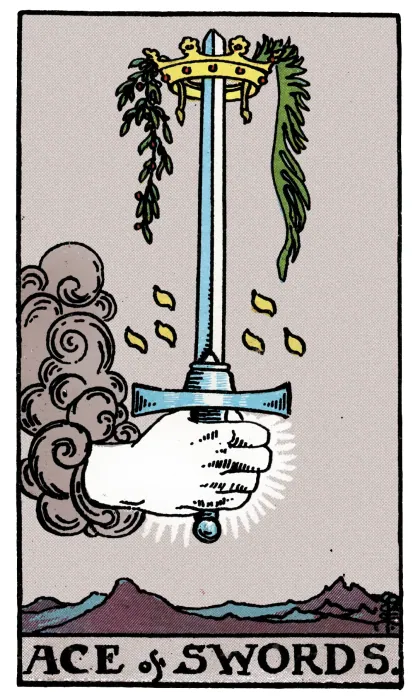
The Ace of Swords shows a white hand emerging from a gray cloud, holding a double-edged sword upright. The tip of the blade passes through a gold crown. From the crown hang two branches, olive on one side and palm on the other. Small golden flames fall around the hilt. Below, jagged gray mountains rise from bare ground.

The single upright blade stands for precision. A sword divides one thing from another, the way a clear sentence separates a fact from a guess.

The crown links clear thought with authority and responsibility. A decision made well carries weight.

The olive and palm branches place peace and victory on either side of the same sharp instrument. Clarity can end a conflict or win it.

The jagged mountains keep effort and consequence in view.

Waite describes a hand issuing from a cloud, grasping a sword whose point is encircled by a crown, and suggests the crown may carry a much higher significance than fortune-telling usually reaches.

Traditional associations: Swords · air · thought, communication, and conflict · Ace · an opening or concentrated potential. Association systems differ between traditions.

Reading notes for Ace of Swords

Example reading. A software tester has received a revised job offer. The title is higher, but the reporting line and decision authority are still unclear. They feel flattered and also uneasy. They ask, "Should I accept the revised offer?" and draw the Ace of Swords upright.

The card separates what is known from what is still unknown. The higher title is known, and the authority attached to it is not. A written description of the reporting line would close that gap. Asking for that description in writing, before signing, turns the uneasy feeling into a question with an answer.

Ace of Swords FAQ

What does Book T call the Ace of Swords?

Book T names it the Root of the Powers of Air. As with every Ace, it stands for the element in its first, undivided form, here air before it becomes any particular thought, word, or decision. That fits the sense of a single, clean idea.

What does the crown on the Ace of Swords mean?

The crown encircling the sword's point links clear thought with authority and achievement. Waite says the crown may carry a much higher significance than fortune-telling usually reaches, and leaves that significance unexplained. Many readers take it as clarity that serves a higher purpose.

Does the Ace of Swords mean communication?

Yes, often. A direct conversation can clear up ambiguity, set a boundary, or show whether two people understand a situation the same way. The card favors honesty that is proportionate and respectful, and does not give permission to be cruel in the name of truth.

How is the Ace of Swords different from Justice?

Justice weighs evidence and consequences to reach a fair outcome. The Ace of Swords is the moment of clear insight that comes first, before anything is weighed. The Ace cuts through confusion. Justice decides what that clarity requires, with balance and accountability.

Sources: A. E. Waite, The Pictorial Key to the Tarot (1910), Part III: Ace of Swords; Israel Regardie, The Complete Golden Dawn System of Magic, The Tarot: names and attributions of the Tarot trumps (Book T)