The Hanged Man Tarot Card Meaning

Quick Meaning

The Hanged Man tarot card means a deliberate pause that changes how you see a situation. Upright, it favors stepping back and letting go of the usual way of pushing forward. Reversed, it can point to waiting that has turned into stalling, sacrifice that no longer has a purpose, or a pause used to avoid a choice. For yes or no, The Hanged Man is a maybe upright and leans no reversed.

Upright
  • pause
  • new perspective
  • letting go
  • patience
Reversed
  • stalling
  • indecision
  • needless sacrifice

Updated

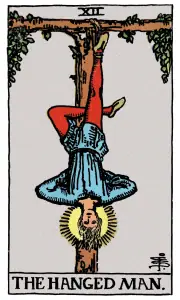
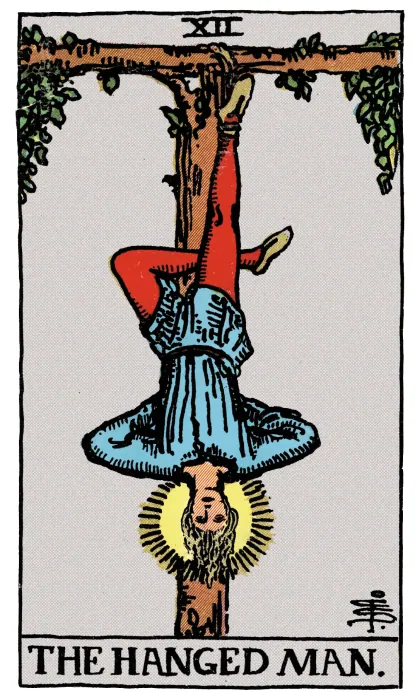
The Hanged Man tarot card from a Rider-Waite-Smith-style deck
The Hanged Man · Major Arcana 12 Artwork by Pamela Colman Smith (1910) · Public Domain Mark 1.0 · Image usage
Ask your own question: free AI reading
Arcana Major
Number12
Upright tendencyMaybe
Reversed tendencyLeans no

The Hanged Man upright and reversed meaning

The Hanged Man tarot card upright

The Hanged Man upright meaning

Upright, The Hanged Man means pausing on purpose so that you can see a situation differently. It points to patience, surrender of the usual approach, and insight that comes from stopping instead of pushing.

The Hanged Man sets aside the usual tools of effort, persuasion, and speed for a while. That might mean waiting for a decision outside your control, stepping back from an argument to understand the other side, or reconsidering a project whose current approach keeps failing.

The card suggests that the old definition of success may be part of the problem. A different view can reveal an assumption, an attachment, or a cost that ordinary effort kept hidden.

It can also involve a sacrifice that serves a purpose: giving up a short-term gain, a comfortable habit, or a fixed opinion to make room for something better.

A useful pause has something to reconsider. If two people disagree about a shared room, they might each describe how the other uses it before arguing over the furniture again. Set a limit on the pause too: decide what you will stop doing, for how long, and what question you will think about. A pause with no end can slide into the reversed card.

The Hanged Man tarot card reversed

The Hanged Man reversed meaning

Reversed, The Hanged Man can suggest stalled reflection, sacrifice without a purpose, avoidance of a choice, or refusal to pause when the usual approach is failing.

Waiting loses its usefulness when it produces neither new information nor a changed view. Someone may keep postponing a conversation until they "feel ready," while rehearsing the same argument every evening.

Sacrifice can become detached from what it was meant to serve. A person keeps giving up weekends for a group that no longer needs that help, yet feels unable to stop because being indispensable has become part of their identity.

Sometimes every available choice involves a loss. Staying undecided can feel like keeping all possibilities alive, even when a deadline or another person's needs make delay costly.

The reversal can also point to rushing. Repeating a failed approach more forcefully leaves no room for a different view.

What has the waiting taught you lately? Nothing at all means the pause has stalled. A sacrifice with no clear beneficiary may have lost its purpose. A choice you can name and keep avoiding is the third reading. For someone who has not paused at all, a short, purposeful pause still has value.
The Hanged Man in love, career, and money

The Hanged Man in love & relationships

The Hanged Man love meaning

Upright

In a love reading, The Hanged Man points to a pause in a relationship or a new way of seeing it. A couple may be waiting for a long-distance period to end, or someone may need time to understand their feelings. It favors patience and looking at the relationship from your partner's point of view. If you are single, it can describe a period of waiting that is better used for reflection than for forcing new connections. A different approach to dating may come out of it.

Reversed

Reversed, The Hanged Man may show a relationship stuck in limbo, with no movement and no decision. One person may be making sacrifices that the other does not see or value, or both may be waiting for the other to act first. It can also describe staying in a situation that is not working because leaving feels too costly. Name what you are waiting for and how long you are willing to wait.

The Hanged Man as feelings

Upright

As feelings, The Hanged Man can suggest a reflective, uncertain state. Someone may care about you while feeling unsure what to do about it, or be waiting until they understand their feelings better. They may need more time than you would like before they can say much, and the delay need not mean a loss of interest.

Reversed

The Hanged Man, reversed, may describe feelings that seem stuck, or resentment about a sacrifice. Someone may feel they have given up too much, or feel trapped between options. They may want something to change and feel unable to make the move. Frustration can build when nothing shifts.

The Hanged Man: how someone sees you

Upright

Someone may see you as patient, thoughtful, and willing to see things differently. They may notice your willingness to reconsider a judgment or give up a preference for someone else. Some may find your perspective unusual and refreshing.

Reversed

They may see you as stuck, indecisive, or as someone who gives up too much for others. Some may feel you are waiting for them to decide something. That impression may come from a period when you were holding back.

A card can suggest how someone might see you. Only that person can tell you what they actually think.

The Hanged Man in career & money

The Hanged Man career meaning

Upright

Professionally, The Hanged Man favors a pause to reconsider your direction, especially if the current approach is not working. It can describe waiting for a decision, a hiring freeze, or a project on hold. Use the time to learn a skill, rethink your goals, or talk to people who see your field differently. A sabbatical or a career break can fit here, though a pause imposed by an employer gives you less choice. Keep in touch with your network.

Reversed

Reversed, The Hanged Man can describe a career that has stalled, a job you stay in out of inertia, or extra work taken on without recognition. It can also point to waiting for permission that has never been promised. Set a date to review your situation, and decide what you will do if nothing has changed by then. If you are doing unpaid extra work, raise it.

The Hanged Man money meaning

Upright

With money, The Hanged Man favors a pause before major financial decisions. A purchase that once seemed essential may look different after your priorities change. If you are unsure, check any deadlines first, then give the decision time.

Reversed

The reversal can point to financial decisions postponed for too long, money tied up in something that is going nowhere, or sacrifices that are not paying off. Ask whether you are delaying a review or finding it hard to let go. Any decision to sell, close, or keep is best weighed on its own terms, costs, and risks.

For investment or debt decisions, talk to a qualified financial professional.

The Hanged Man as advice and as a person

The Hanged Man as advice

Upright

As guidance, The Hanged Man suggests defining what you are willing to stop doing during the pause, and giving that surrender a limit. Two weeks without pushing for an answer is a clear example. If the pause involves another person, agree what contact and timing mean for both of you.

Reversed

Once the waiting has stopped changing your view, The Hanged Man reversed asks you to take the smallest step that moves the situation forward, and tell someone which step you chose.

The Hanged Man as a person

Upright

As a person, the card can show someone unconventional and reflective, who sees things from unusual angles and is willing to make sacrifices for what they believe in. They may ask an unexpected question, and they tend to stay calm when plans stall.

Reversed

The reversed card may describe someone who feels stuck between choices, or someone who sacrifices so much that they lose sight of their own needs. They may feel unappreciated and tired.

Is The Hanged Man a yes or no card?

Upright: Maybe

Drawn upright, The Hanged Man is a maybe. The card favors pausing before you commit, especially if the current plan keeps producing the same result. A pause helps when it produces new information or changes an assumption. Once it has done its work, the answer may become clearer. Rushing the decision weakens the case for yes.

Reversed: Leans no

It leans no while waiting has become avoidance, sacrifice lacks a clear purpose, or the plan depends on staying suspended indefinitely. Setting a limit on the pause, or making a decision you have been avoiding, can change the answer. Ask yourself what you are waiting for.

These tendencies use the reference question “Do current conditions support moving forward?” Your question and circumstances can change the interpretation; this is not a guaranteed outcome.

The Hanged Man and spirituality

In spiritual practice, The Hanged Man points to surrender, contemplation, and seeing beyond ordinary concerns, along with a willingness to let go of fixed ideas about how growth should happen. Waite reads the card as relating the divine to the universe. In a personal practice, it can describe a period of not knowing that comes before understanding. Stillness or a short retreat can serve that purpose.

Symbols in The Hanged Man

The Hanged Man shows a man hanging upside down by one foot from a T-shaped wooden beam. The beam is living wood, with leaves growing from it. His other leg is bent behind the straight one, and his arms are folded behind his back. He wears a blue tunic and red leggings. A yellow halo surrounds his head, and his face is calm.

The upside-down position stands for a change in perspective. Ordinary control is out of reach, and the world looks different from here.

The calm face and halo suggest that the pause may be chosen and may bring insight. Waite stresses that the expression is one of deep entrancement, not suffering.

The crossed legs make a deliberate shape. There is order inside the constraint.

The living wood keeps the scene connected to growth. Waite notes that the figure as a whole suggests life in suspension, not death.

The arms held behind his back suggest action suspended while his view changes.

Traditional associations: Major Arcana XII · Pause, surrender, and reframing · Traditionally associated with the element of water. Association systems differ between traditions.

Reading notes for The Hanged Man

Example reading. Someone has applied for twelve jobs in the same type of role over three months, with two interviews and no offers. They ask, "What should I do differently?" and draw The Hanged Man reversed.

Reversed, the card points to a pause that has stopped teaching anything: the applications keep going out while the approach stays the same. Asking the two interviewers for feedback, or comparing the roles with their strongest experience, turns the waiting back into reflection. The change that matters is in the search strategy, not in sending more of the same.

The Hanged Man FAQ

Does The Hanged Man mean death?

No. The hanging posture is not a prediction about anyone's death. Waite stresses that the face shows entrancement, not suffering, and that the figure suggests life in suspension, not death. The card describes a pause and a change of view.

What do the cross shapes in The Hanged Man mean?

Waite points out two crosses. The wooden beam forms a Tau cross, shaped like a T. The man's legs form a fylfot cross, an ancient bent-armed symbol. These are Waite's names for the symbolic geometry, and they show that the posture is meant as a sign, not as a punishment.

What element is The Hanged Man associated with?

The Golden Dawn assigns The Hanged Man to the element of water, not to a planet or a sign. Water fits the card's themes of surrender, receptivity, and letting events flow instead of forcing them. The link describes the card's symbolism, not a person.

How is The Hanged Man different from the Four of Swords?

The Hanged Man is a pause that changes your perspective, while the Four of Swords emphasizes rest or respite from a demanding situation. One turns the world upside down to see it differently. The other sets the task aside so you can return to it restored.

Sources: A. E. Waite, The Pictorial Key to the Tarot (1910), Part II: XII — The Hanged Man; Israel Regardie, The Complete Golden Dawn System of Magic, The Tarot: names and attributions of the Tarot trumps (Book T)