Ten of Swords Tarot Card Meaning

Quick Meaning

Ten swords make the ending impossible to soften with one more argument. Dawn remains visible beyond the fallen figure. A limit, defeat, or exhausted conflict needs an honest ending. Recovery may begin slowly, or the old defeat may still shape every new situation, so the card does not promise that the pain is already over.

  • painful ending
  • finality
  • collapse
  • exhausted pattern
  • aftermath
  • dawn
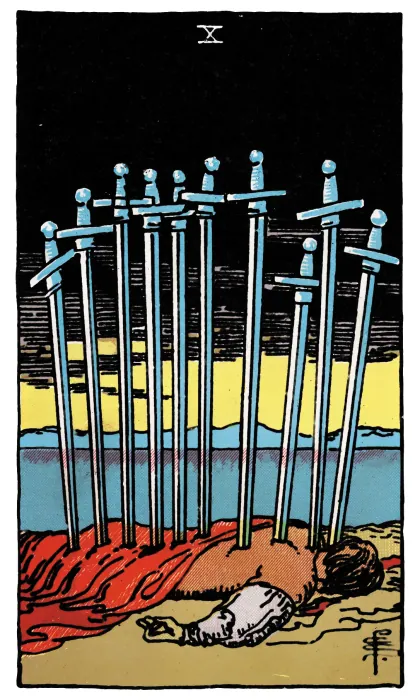
Ten of Swords tarot card from a Rider-Waite-Smith-style deck
Ten of Swords · Swords suit Artwork by Pamela Colman Smith (1909) · Public Domain Mark 1.0
Number
10
Upright tendency
Leans no
Reversed tendency
Maybe

Ten of Swords upright and reversed meaning

Upright

The Ten of Swords represents a painful conclusion after argument and strain have exhausted a particular form. The image feels absolute, but its finality belongs to the situation being examined rather than to every part of a life. Further interpretation can become another blow when the essential consequence is already clear. The card asks for proportion and dignity in describing defeat; it is not literal evidence of violence, death, or inevitable ruin.

Reversed

Reversed, the aftermath may start to contain more than the moment of impact. Ordinary activity can return while grief remains, or the same ending can be rehearsed until it becomes the only available identity. The difference is whether memory gives the event a place in time or continually recreates its full force. The distant horizon permits life beyond this conclusion without promising that the previous arrangement can be restored.

A common misreading: Ten blades do not count ten betrayals or establish that every part of life has failed.

Love, work, and practical questions

Love & relationships

Love

Upright. A relationship pattern may feel exhausted beyond another argument. The image captures the impact of that conclusion without establishing betrayal, physical harm, or the impossibility of every future connection.

Reversed. After a rupture, ordinary conversation or affection may reappear alongside grief. That broadening of experience does not itself restore the former bond or settle what relationship is now possible.

Feelings

Upright. The Ten of Swords can suggest devastation, exhaustion, humiliation, or the sense that language has been used past its limit. The feeling is exposed and absolute in the foreground, but it does not reveal another person's capacity, consent, safety, or future behavior.

Reversed. The feeling may be less total, mixed with numbness, or repeatedly revived by memory of a final conflict. This reversal does not prove reconciliation or recovery; it suggests that the emotional field can eventually contain more than the moment of defeat.
Work & money

Career

Upright. At work, a project, role, or professional assumption may feel decisively failed. The Ten emphasizes exposure after accumulated conflict: the team can no longer speak as though the previous account still explains what happened.

Reversed. Reversed, some work may resume after failure while the old model remains emotionally powerful. The card distinguishes renewed activity from restoration of the assumptions that produced the collapse.

Money

Upright. A venture or material plan may feel exhausted after accumulated strain. The imagery expresses a painful limit in its current form, not proof of insolvency or failure across every resource.

Reversed. New income, closure, or restructuring may belong to life after a failed plan. The emphasis is whether the loss still dominates every material possibility, rather than a promised financial recovery.

Yes or No Tendency

Upright: Leans no

No for the exhausted form of the situation; repeating the argument cannot by itself make it workable again.

Reversed: Maybe

Maybe for possibilities beyond the ending, with the aftermath still unresolved and no promise of restoring the previous form.

These tendencies use the reference question “Do current conditions support moving forward?” Your question and circumstances can change the interpretation; this is not a guaranteed outcome.

Symbols in Ten of Swords

An exhausted foreground and a separate bright horizon hold finality beside time beyond it.

Ten swords in the fallen figure
The completed number and overwhelming placement make finality and exhausted continuation unmistakable.
The red cloth
A vivid covering keeps life, injury, dignity, and consequence concentrated in the foreground.
The black sky
Heavy darkness represents the closed condition at its most severe point.
Golden dawn over calm water
Light beyond the hills introduces a future that does not erase the finality of the foreground.

Traditional associations: Swords · air · thought, communication, and conflict · Ten · completion, consequence, or transition. Association systems differ between traditions.

Questions about Ten of Swords

Does the Ten of Swords mean death?

The card requires proportionate language. It can symbolize defeat, burnout, exposure, or a painful conclusion, but it is not literal proof of physical harm. Real safety, health, or legal concerns require appropriate real-world assessment outside the reading, not card-directed triage or service routing.

Can the Ten of Swords be positive?

Reversed, the Ten of Swords may describe a first awareness that life extends beyond a painful ending. Time, imagination, or ordinary routine can begin to give aftermath a boundary, allowing the event to become one part of experience rather than its permanent totality.

What does the Ten of Swords mean in a love reading?

Upright: A relationship pattern or expectation may feel conclusively broken, and the image can hold the shock of that experience without predicting literal violence, death, or betrayal. Its relationship meaning is the dignity needed when another argument cannot make the former understanding workable. Reversed: After a rupture, reduced conflict may be part of the aftermath rather than evidence that the former bond has returned. Affection, grief, or ordinary conversation can reappear while the shape of the relationship remains undefined.

Elena is ArcaSeer’s named editorial voice. How Elena’s notes are created