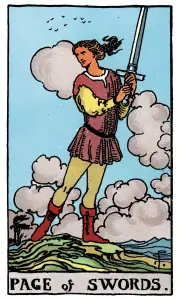
Page of Swords upright meaning
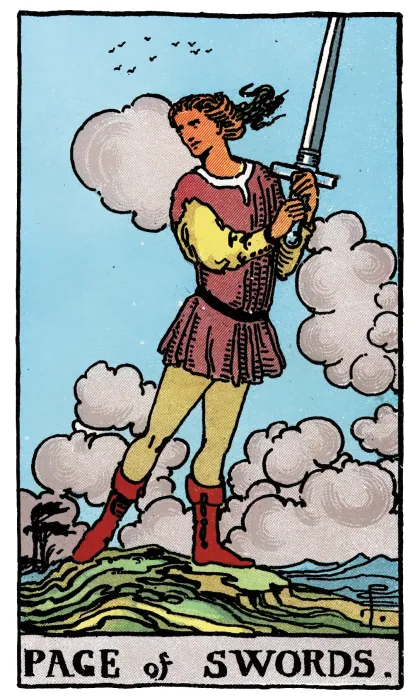
The upright Page of Swords means a lively mind meets a new question. You may be learning something new, investigating a problem, or receiving a message that makes you think.
Pages are beginners, and this Page brings more alertness than experience. Its gift is intellectual courage: asking the question nobody else asked, noticing an inconsistency, or wanting to understand how something really works. A student who raises a hand to challenge a confusing point, or a new employee who spots a flaw in a process, fits this card.
The risk is treating the first workable theory as the final answer. Curiosity is strongest when it stays open to revision, and when the Page is willing to say, "I was wrong about that."
Waite's meanings include authority, overseeing, vigilance, and examination, which suit someone who watches closely and asks questions.
A useful step is to write one precise question about the situation, and next to it, note what evidence would change your mind. Then gather that evidence. Talk to the people involved, read the source, or test the idea. Share your conclusion only once you have checked it, and say plainly what you are still unsure about. Fresh eyes are valuable when they come with willingness to learn.
Page of Swords reversed meaning
When reversed, the Page of Swords can suggest alertness turned into rumor, defensiveness, premature accusation, or information gathered without enough context.
Rumor looks like passing on something you heard before checking whether it is true. One unverified detail travels through a group and grows each time. Someone reads a single message out of context and tells three friends what it "really" meant.
Defensiveness looks like arguing every point, treating any question as an attack, or refusing to admit you might be wrong.
Premature accusation shows up as deciding what happened from fragments, then confronting someone before hearing their side.
Scattered thinking often means jumping between ideas, starting many investigations and finishing none. The mind is busy and not focused.
Waite's reversed card points to the more troubling side of these qualities, along with what is unforeseen and an unprepared state.
Ask where your information came from. A claim with no source you can name should not be repeated. Defensiveness is worth a look at what you are protecting. An accusation you are about to make can start as a question instead. Scattered attention settles when you choose one question and stay with it for a day. Speech that outruns understanding is hard to take back.