Death Tarot Card Meaning

Quick Meaning

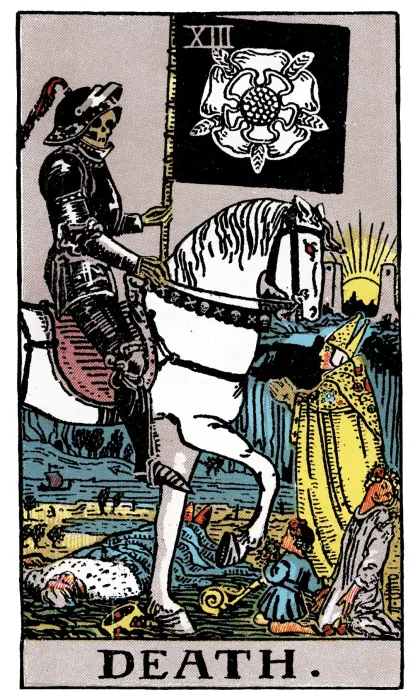
Death's rider passes every rank while a boat and a sun on the horizon keep movement visible beyond the scene; this is an ending that changes what can continue, not a prediction of literal death. Resistance appears when habit, obligation, or hope keeps assigning a finished chapter space in the future.

  • ending
  • transition
  • release
  • transformation
  • closure
  • change
Death tarot card from a Rider-Waite-Smith-style deck
Death · Major Arcana 13 Artwork by Pamela Colman Smith (1909) · Public Domain Mark 1.0
Arcana
Major
Number
13
Upright tendency
Leans no
Reversed tendency
Leans no

Death upright and reversed meaning

Upright

Death names a boundary beyond which the former arrangement cannot continue unchanged. The ending may be chosen or imposed, painful or welcome, but pretending the central condition is intact blocks recognition of what follows. Closure does not erase attachment: grief, useful knowledge, and obligations can survive the old form. The card makes room for an unfamiliar next phase without promising that the loss will automatically become beneficial.
Reversed

Reversed, an ending may be understood intellectually while daily life remains organized around its return. Habits and hope can keep the former shape occupying space it no longer has in practice. Unfinished transition work can also prolong that state: belongings, obligations, or conversations remain unresolved. Acceptance therefore has practical as well as emotional dimensions, but the card does not determine which real-world commitment should end or how it must be settled.

Love, work, and practical questions

Love & relationships

Love

Upright. The relationship itself or its established way of operating may be changing. Renewal requires an honest recognition of what cannot return unchanged, rather than relabeling the former arrangement.

Reversed. Attachment may keep an expired pattern active after it has stopped working. Grief can coexist with the need to recognize that longing does not restore a past version of the bond.

Feelings

Upright. Feelings or expectations may be changing through grief, detachment, or altered terms. The card does not specify whether a different connection will follow the one being released.

Reversed. Someone may remain attached to an earlier version of the relationship. Fear of the identity change involved in closure can persist even when the previous form is no longer workable.

Work & money

Career

Upright. A role, project, or professional identity may reach the end of its existing form. The transition still contains knowledge, handoffs, and obligations that do not disappear with the ending.

Reversed. A legacy process may consume resources after its purpose has faded. Maintenance without a clear reason can show how difficult recognition has become after substantial effort was invested.

Money

Upright. An income source or material arrangement may have reached its usable limit. The focus is the cost and obligations of transition, not a prediction of ruin or instruction to liquidate.

Reversed. Money may remain attached to an obsolete commitment because acknowledging the change makes loss concrete. Delay can defer recognition without restoring the arrangement's former purpose or usefulness.

Yes or No Tendency

Upright: Leans no

No for keeping the present form unchanged. Its continuity has ended, leaving a transition whose obligations and possibilities belong to a different phase.

Reversed: Leans no

No while resistance or incomplete closure keeps the situation organized around a finished form. Attachment does not restore its former usefulness.

These tendencies use the reference question “Do current conditions support moving forward?” Your question and circumstances can change the interpretation; this is not a guaranteed outcome.

Symbols in Death

Rank and age offer no exemption from the change moving through the scene.

The armored skeleton
The rider strips identity down to what continues beyond status and presents change as impartial.
The figures before the horse
Different responses across age and rank show that transition meets people without respecting social position.
The river, boat, and sun on the horizon
Movement and light in the distance preserve continuity beyond the immediate ending.

Traditional associations: Major Arcana XIII · Ending, transition, and irreversible change · Traditionally associated with Scorpio. Association systems differ between traditions.

Questions about Death

What element is Death associated with?

Water is the elemental link through Death’s Golden Dawn attribution to Scorpio. The card’s title does not make it an element of destruction or a literal forecast. This correspondence describes one symbolic system and can sit alongside the image’s separate themes of ending and continuity.

Is Death associated with Scorpio?

Yes, Death is associated with Scorpio in the Golden Dawn correspondence system. The association is symbolic; it does not turn the card into a statement about a Scorpio person or a prediction of physical death.

Is the Death card positive or negative?

Literal death is not a responsible conclusion from this card. Its usual work is to name the role, pattern, relationship form, or identity that has ended and cannot be restored unchanged.

What does the white flower on Death's flag mean?

Waite calls the emblem a Mystic Rose and connects it with life. Fiebig and Bürger instead describe its form as a harvest crown made of five ears of grain, emphasizing what reaches completion and can be gathered. These are two authors' readings of the same image, rather than a single botanical identification. Both can prompt reflection on what an ending leaves behind; neither turns the card into evidence that someone will physically die.