The Tower Tarot Card Meaning

Quick Meaning

Lightning strikes The Tower from outside, knocks away its crown, and forces a protected structure open. The card points to a sudden truth or collapse, while the facts already present show how serious it is. Holding in the shock or trying to control the damage may delay the reaction without fixing the weak point underneath.

  • upheaval
  • revelation
  • collapse
  • disruption
  • truth
  • liberation
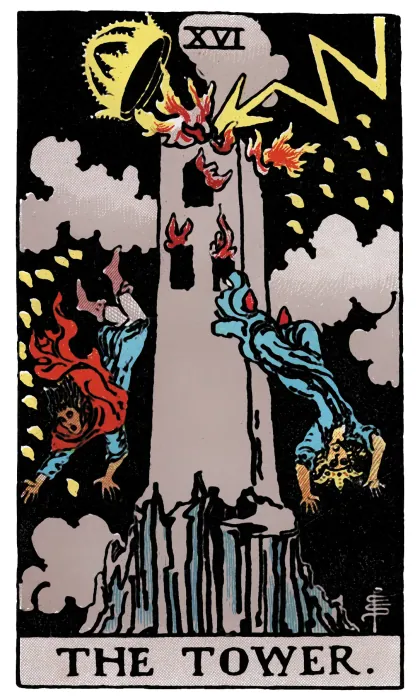
The Tower tarot card from a Rider-Waite-Smith-style deck
The Tower · Major Arcana 16 Artwork by Pamela Colman Smith (1909) · Public Domain Mark 1.0
Arcana
Major
Number
16
Upright tendency
Leans no
Reversed tendency
Leans no

The Tower upright and reversed meaning

Upright

The Tower marks a rupture that the old explanation can no longer contain. A failure, disclosure, or confrontation changes both the circumstances and the certainty once attached to them. The useful distinction is between what the event interrupted and what it exposed. A strong shock can affect a sound arrangement, while a smaller event can reveal a weakness already carrying too much weight. The card interprets the disruption rather than supplying a rebuilding sequence.
Reversed

Reversed, upheaval may be contained, internal, or delayed. Others may see little change while confidence in the old structure has already fallen away. A near miss can also create relief that makes the underlying warning easier to dismiss. Distinguish damage that stopped from weakness that remains; an unchanged surface is not enough to establish repair, and an internal rupture is not made less significant by being difficult to see.

Love, work, and practical questions

Love & relationships

Love

Upright. A revelation or confrontation may make denial impossible without predetermining a breakup. The relationship question is what the shock exposed; actual safety concerns require support beyond the reading.

Reversed. A known truth may remain unspoken to preserve appearances, or a bond may be recovering after rupture. Visible calm does not by itself distinguish real repair from suppressed conflict.

Feelings

Upright. Shock or anger may alter the person's understanding of the connection. An immediate reaction can be powerful without yet constituting the lasting decision they will make afterward.

Reversed. Feelings may be contained or unsettled after upheaval. Fear that honesty will cause another rupture can keep a calm surface in place while the underlying issue remains active.

Work & money

Career

Upright. A failed plan or public promise may expose an assumption beneath the work. Separating that weakness from the dramatic event avoids making surprise the entire explanation for what happened.

Reversed. A delayed failure or near miss can limit visible disruption while undermining confidence. Relief that the damage stopped can coexist with uncertainty about the same assumption carrying future work.

Money

Upright. Unexpected costs or lost income can expose material fragility. The event and the reason its effects spread are different questions; the card does not choose a transaction or remedy.

Reversed. Contained loss may leave vulnerability unresolved. The material distinction is between damage that ended and an arrangement that still carries the weakness revealed by the near miss.

Yes or No Tendency

Upright: Leans no

No when the present structure cannot reliably carry another commitment. Its exposed assumption matters more than predicting how dramatic a disruption might become.

Reversed: Leans no

No while a warning is minimized or repair remains incomplete. A contained shock does not establish that the underlying weakness has disappeared.

These tendencies use the reference question “Do current conditions support moving forward?” Your question and circumstances can change the interpretation; this is not a guaranteed outcome.

Symbols in The Tower

Lightning, a falling crown, and exposed people keep both lost certainty and human consequences visible.

The lightning strike
Sudden illumination and force arrive from outside the tower's controlled interior.
The falling crown
Dislodged authority shows that status and certainty cannot protect a structure from its underlying weakness.
The falling figures
The human cost of structural failure remains visible rather than being reduced to an abstract lesson.

Traditional associations: Major Arcana XVI · Disruption, revelation, and structural failure · Traditionally associated with Mars. Association systems differ between traditions.

Questions about The Tower

Is The Tower card the Tower of Babel?

The Tower of Babel is one historical title Waite records, alongside other names for the card. That makes Babel a valid historical association, not the only identity of every tower image. The Rider–Waite–Smith picture does not require you to treat the biblical story as a literal event being predicted.

Does The Tower mean death?

No: The Tower cannot determine that someone will die. Its falling figures and damaged structure depict rupture, while a reading still needs the real situation to establish what kind of disruption is involved. Do not turn dramatic imagery into a prediction about a person’s survival.

Is The Tower card always bad?

Disruption can range from a revealing conversation to a major collapse; catastrophe is not guaranteed. Scale the reading to the actual structure, the exposed weakness, and the consequences already visible.

Elena is ArcaSeer’s named editorial voice. How Elena’s notes are created