Six of Cups Tarot Card Meaning

Quick Meaning

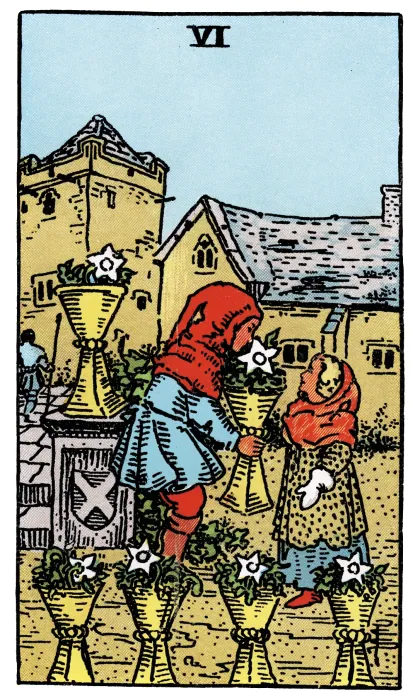
In a protected courtyard, one child offers another a flower-filled cup while adult life continues in the background, bringing memory, familiar care, or a return from the past into the present for comparison. Nostalgia becomes misleading when it edits out an old condition or keeps an inherited role in charge after it has been outgrown.

  • memory
  • nostalgia
  • kindness
  • childhood
  • return
  • familiar exchange
Six of Cups tarot card from a Rider-Waite-Smith-style deck
Six of Cups · Cups suit Artwork by Pamela Colman Smith (1909) · Public Domain Mark 1.0
Arcana
Minor · Cups
Number
6
Upright tendency
Leans yes
Reversed tendency
Maybe

Six of Cups upright and reversed meaning

Upright

The Six of Cups brings familiar kindness and earlier experience into the present. A remembered bond, place, or skill can supply comfort and useful continuity. Yet memory selects: the warmth it preserves may be more vivid than the conditions that made the old arrangement difficult. The past helps when it offers resources for today's life, rather than a role that everyone must resume exactly as it was.
Reversed

An inherited role or idealized memory may continue directing choices after it no longer fits. Familiarity can feel safe without the old conditions having improved. Another expression is release: affection can remain while access changes, and a useful skill can travel forward without returning to the former setting. The distinction is whether remembering enlarges present choice or quietly replaces it with obligations belonging to an earlier version of life.

Love, work, and practical questions

Love & relationships

Love

Upright. Shared history or an old connection can bring genuine tenderness. Comparing today's conduct with what is remembered keeps nostalgia from erasing why the relationship changed or turning earlier patterns into permanent obligations.

Reversed. An old model of love may direct expectations more than the current person does. Moving beyond it can preserve affection while changing access, with present needs and behaviour guiding what is reopened.

Feelings

Upright. Familiarity may create trust and a less guarded kind of tenderness. That emotional ease has value, but current conversation and action are still needed to establish whether the connection fits life now.

Reversed. A former bond or childhood expectation may shape the response, or an attachment may be loosening. Evaluate returning contact through present actions rather than granting the past's emotional weight authority over the relationship.

Work & money

Career

Upright. Former colleagues or skills may become useful in a new setting. The productive return adapts an earlier capability to present requirements, rather than trying to reconstruct the entire environment in which it first developed.

Reversed. Tradition may obstruct change, or older experience may be undervalued. Keeping a useful principle while updating its method gives history a contribution without allowing seniority alone to overrule current evidence.

Money

Upright. Family help or a returning client may bring resources through familiar ties. Affection can carry expectations too, so the actual distinction between a gift, loan, and obligation belongs to the participants and records.

Reversed. Past support or inherited money habits may restrict present choice. An old rule can also lose its grip, while actual obligations and available capacity determine what can responsibly change in the arrangement.

Yes or No Tendency

Upright: Leans yes

Generally yes when familiar support still fits present conditions.

Reversed: Maybe

Maybe: history must be weighed against current behaviour rather than treated as automatic permission to repeat the old arrangement.

These tendencies use the reference question “Do current conditions support moving forward?” Your question and circumstances can change the interpretation; this is not a guaranteed outcome.

Symbols in Six of Cups

A familiar gift takes place inside a protected courtyard while adult life continues beyond it.

The offered flower cup
A contained gift makes kindness, memory, and a familiar emotional exchange visible.
Two children
The figures connect the scene with earlier life, innocence, learning, and unequal stages of development.
The courtyard and departing adult
A protected village setting contrasts childhood exchange with an adult world continuing in the background.

Traditional associations: Cups · water · emotion, relationship, and imagination · Six · exchange, recovery, or movement toward harmony. Association systems differ between traditions.

Questions about Six of Cups

Does the Six of Cups mean pregnancy?

No: children in the Six of Cups do not confirm pregnancy. Waite connects the scene primarily with the past, memories, and childhood, which is different from predicting a new child. A pregnancy test addresses the physical question; the card can instead help explore family memories or hopes.

What does the Six of Cups mean in a love reading?

Upright: An old connection, shared history, or gentle familiarity may become important. Reconnection can be sincere, and established couples may benefit from remembering what first made care easy. Do not let nostalgia edit out the reason a relationship changed or turn childhood patterns into obligations. Reversed: A former partner or childhood model of love can shape expectations more than the current person does. The reversal may also support outgrowing an old attachment. Compare present behavior with present needs and refuse to let history claim automatic access.

What does the Six of Cups reversed mean?

Reversed, the past is idealized, avoided, or beginning to loosen its control. Familiarity may be mistaken for safety even when the old pattern remains unchanged.

Elena is ArcaSeer’s named editorial voice. How Elena’s notes are created