Six of Pentacles Tarot Card Meaning

Quick Meaning

The Six of Pentacles tarot card means giving and receiving: generosity, fair exchange, and the question of who decides how much is shared. Upright, it favors help that meets a real need and respects the person receiving it. Reversed, it can point to strings attached, unequal power, or help that keeps someone in a lower position. On a yes or no question, the Six of Pentacles leans yes upright and leans no reversed.

Upright
  • generosity
  • charity
  • sharing
  • fair exchange
Reversed
  • strings attached
  • imbalance
  • debt

Updated

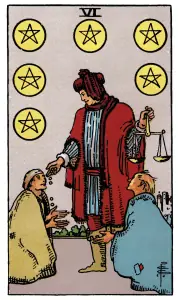
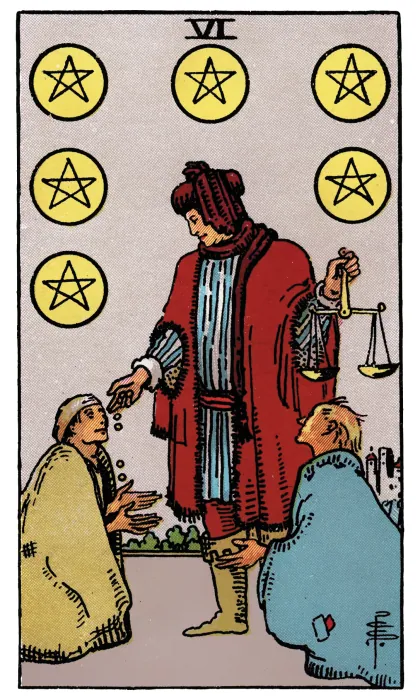
Six of Pentacles tarot card from a Rider-Waite-Smith-style deck
Six of Pentacles · Pentacles suit Artwork by Pamela Colman Smith (1910) · Public Domain Mark 1.0 · Image usage
Ask your own question: free AI reading
Arcana Minor · Pentacles
Number6
Upright tendencyLeans yes
Reversed tendencyLeans no

Six of Pentacles upright and reversed meaning

Six of Pentacles tarot card upright

Six of Pentacles upright meaning

Upright, the Six of Pentacles means resources are being shared. You may be giving help, receiving it, or taking part in a fair exchange. A friend lends a hand during a move, a mentor offers time, an employer gives a fair raise, or you donate to a cause you care about.

What sets this card apart is measure. It asks who receives, how much, and whether the share answers what the recipient actually needs, not the giver's idea of what is fair. Good generosity listens before it gives.

The card also points to balance over time. In lasting relationships, giving flows both ways. Sometimes you are the merchant, and sometimes you are the one kneeling. Both positions deserve dignity.

Waite's meanings include presents, gifts, gratification, and present prosperity. Another account he records adds attention and vigilance, and the phrase now is the accepted time.

A practical step is to ask what kind of help is actually needed before giving it. If you are giving, offer something specific and ask whether it fits. If you are receiving, say what would help most, and accept it without apologizing. If you are in a fair exchange, make the terms clear so both sides feel respected.

Six of Pentacles tarot card reversed

Six of Pentacles reversed meaning

Drawn reversed, the Six of Pentacles can suggest help with an unstated condition, an imbalance between giver and receiver, or roles that become hard to leave.

Strings attached look like a gift that comes with expectations: loyalty, gratitude, silence, or access. The exchange looks generous, and refusing it carries a cost.

Imbalance looks like one person always giving and the other always receiving, until resentment builds on one side or dependence on the other.

Roles that are hard to leave show up as the helper who keeps the other person in need, or the receiver who is never treated as an equal, even after their situation improves.

The reversed card can also describe debt or obligation that feels heavy, or giving more than you can afford to give.

Waite's reversed meanings include desire, cupidity, envy, jealousy, and illusion, which fit an exchange distorted by wanting.

To work out which applies, look at what happens if someone says no. If saying no brings a penalty, such as anger, a demand for obedience or secrecy, or support in an unrelated area being withdrawn, conditions are attached. If one person always gives, try reversing the flow in a small way. If you are stuck in a role, name it and suggest a change. Notice when gratitude is being used as leverage.
Six of Pentacles in love, career, and money

Six of Pentacles in love & relationships

Six of Pentacles love meaning

Upright

Romantically, the Six of Pentacles can describe a relationship where both people give generously, whether time, care, attention, or practical help. It favors noticing what your partner needs and offering it freely, and accepting what they offer in return. It can also describe a balanced give and take after a period where one person carried more. People who are single may meet someone through acts of kindness, such as volunteering. It can also describe being generous with yourself, giving your own needs attention. Pay attention to how a new person treats waiters, strangers, and friends. Generosity shows in small moments.

Reversed

When the Six of Pentacles is reversed, it may show an imbalance, with one partner giving much more than the other, or gifts used to gain control or make up for problems. It can also describe a partner who keeps score. Talk about what each of you gives and needs. If one person always pays, plans, or comforts, agree a fairer split. A gift should not buy silence about a problem.

Six of Pentacles as feelings

Upright

In a feelings position, the Six of Pentacles suggests care and generosity. Someone may want to support you, help you, or share what they have with you. Their feelings may show through practical kindness more than words, such as fixing something, cooking, or making time when you need it.

Reversed

With the Six of Pentacles reversed, feelings may be tangled with obligation or imbalance. Someone may feel they owe you, or that you owe them. They may give to feel needed, or hold back because they feel taken for granted. An honest conversation about balance may help.

Six of Pentacles: how someone sees you

Upright

To others, you may seem generous, fair, and kind, someone who shares and helps. Some may see you as a reliable source of support. Others may be grateful for help you gave in the past, and may want to return it.

Reversed

Some may see you as giving with conditions, or as someone who keeps score. Others may feel you rely on them too much. Making the exchange more equal, in small and visible ways, can shift that view.

A card can suggest how someone might see you. Only that person can tell you what they actually think.

Six of Pentacles in career & money

Six of Pentacles career meaning

Upright

For work questions, the Six of Pentacles points to fair pay, a raise, a bonus, mentoring, or sharing resources across a team. It can also describe asking for support, such as training or funding. If you are in a position to help, share knowledge and credit generously. If you need help, ask clearly for what you need. Check whether pay and workload are fair across the team, and raise it if not. Offer to mentor someone newer, or ask someone experienced to mentor you. Agree how often you will meet, and what each of you hopes to gain.

Reversed

The Six of Pentacles, reversed, can describe unfair pay, favoritism, help that comes with hidden expectations, or always being the person who covers for others. Notice whether your extra effort is recognized. Ask for a review of pay or workload if things feel uneven. If someone's help seems to come with conditions, ask what they expect in return.

Six of Pentacles money meaning

Upright

With money, the Six of Pentacles points to giving, receiving, or fair exchange, such as a loan repaid, a gift, or a donation. Give within your means, and keep a record of any money lent. Waite's additional meanings warn that the present must not be relied on, which fits a card about exchanges that can change over time.

Reversed

It can point to lending that strains a relationship, or gifts with strings attached. If money changes hands, write down the amount and any terms, so both people remember the same thing. Saying no kindly is allowed.

For investment or debt decisions, talk to a qualified financial professional.

Six of Pentacles as advice and as a person

Six of Pentacles as advice

Upright

As guidance, the Six of Pentacles suggests letting a gift remain a gift, without requiring gratitude to become loyalty, access, or silence. Ask what is needed, then give that. Give one thing this week without expecting anything back.

Reversed

With the Six of Pentacles reversed, you can accept or refuse help, and you can ask what is expected. Rebalance one exchange that has tilted too far, gently.

Six of Pentacles as a person

Upright

Describing a person, the Six of Pentacles can point to someone generous and fair, who shares what they have and helps others thoughtfully. They often notice who needs support. They may work in a helping role.

Reversed

When the Six of Pentacles is reversed, it can point to someone who gives in order to control, keeps careful score, or stays in the helper's role to feel important. It can also describe someone who struggles to accept help. They may need to learn that receiving can be gracious too.

Is Six of Pentacles a yes or no card?

Upright: Leans yes

Drawn upright, the Six of Pentacles leans yes, especially when the decision involves fair exchange, support, or generosity. The yes is strongest when both sides benefit and the terms are clear. If you need help to move forward, ask for it. Help offered freely fits this card well. If the help comes with conditions, read them first, and decide whether you can accept them comfortably.

Reversed: Leans no

Reversed, the Six of Pentacles leans no while the exchange is unequal or conditions are hidden. Clarify what each side expects, and say it out loud. Once terms are fair and stated openly, the question may be worth asking again.

These tendencies use the reference question “Do current conditions support moving forward?” Your question and circumstances can change the interpretation; this is not a guaranteed outcome.

Six of Pentacles and spirituality

Spiritually, the Six of Pentacles relates to generosity, gratitude, and service. Giving time or resources to others, practicing gratitude, or volunteering fits the card. It also asks you to give with humility, respecting the dignity of the person who receives. Offer one act of kindness this week that no one will thank you for, and notice how it changes your day.

Symbols in Six of Pentacles

The Six of Pentacles depicts a well-dressed merchant holding a set of balanced scales in one hand. With the other, he drops coins into the open hand of a kneeling figure. A second kneeling figure waits beside them, hands raised. Six gold coins float in the sky above. A town stands in the distance.

The scales show measurement. The merchant weighs what he gives, so generosity becomes a decision about how much. The coins dropping into an open hand show help actually reaching someone.

The two kneeling figures show different positions. One receives now, and one waits. Giving involves choices about who gets what. The standing and kneeling postures show a power difference between giver and receiver.

The town behind them places the exchange inside a community. Waite describes a person in the guise of a merchant who weighs money in a pair of scales and distributes it to the needy and distressed, calling it a sign of both his success and his goodness of heart.

Traditional associations: Pentacles · earth · resources, work, body, and material life · Six · exchange, recovery, or movement toward harmony. Association systems differ between traditions.

Reading notes for Six of Pentacles

Example reading. Someone's younger sibling has asked to borrow money for a course. They can afford it, and they also remember a previous loan that was never repaid. They do not want to damage the relationship either way. They ask, "Should I lend the money?" and draw the Six of Pentacles upright.

The reading does not say whether to lend. It helps separate the questions: is this a gift or a loan, what happened with the last one, and what does each side expect? It suggests saying the answer openly and writing down any repayment plan. Whether to lend remains their own decision.

Six of Pentacles FAQ

What is the Six of Pentacles called in Book T?

Book T titles the Six of Pentacles the Lord of Material Success and assigns it the Moon in Taurus. The title connects generosity with having enough to share, which fits the merchant who can give freely because his own position is already secure.

Why does the merchant hold scales?

The scales show that giving is a measured decision. The merchant weighs what he gives and to whom. Many readers take this as a question about fairness: whether the share answers the recipient's need or only the giver's sense of what is fair.

Is the Six of Pentacles about charity?

It can be, in part. Waite describes the merchant distributing money to the needy, and his meanings include gifts and presents. More broadly, the card covers any exchange of resources, including fair pay, mentoring, and practical help between friends or partners.

How is the Six of Pentacles different from the Four of Pentacles?

The Four of Pentacles holds resources tightly, guarding them from loss. The Six of Pentacles shares them, weighing what to give and to whom. The Four keeps. The Six distributes. One asks what to protect, and the other asks what to share.

Sources: A. E. Waite, The Pictorial Key to the Tarot (1910), Part III: Six of Pentacles; Israel Regardie, The Complete Golden Dawn System of Magic, The Tarot: names and attributions of the Tarot trumps (Book T)