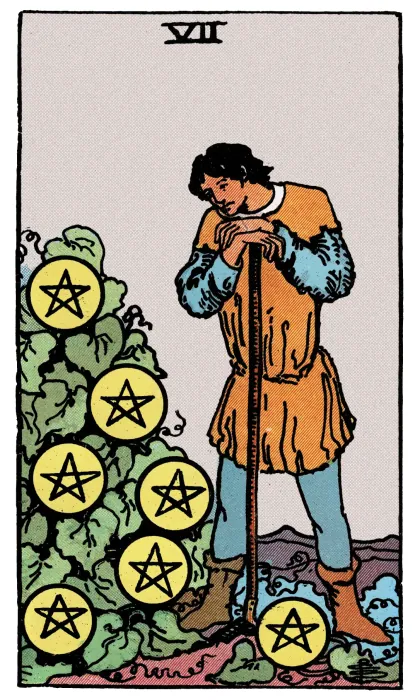
Seven of Pentacles upright meaning
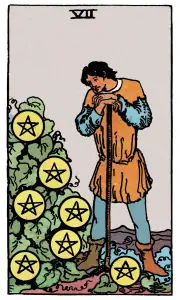
Drawn upright, the Seven of Pentacles means you have reached a point in a long process where effort and result can be seen apart. You have put in work, and now you can look at what it has produced so far.
What sets this card apart is the pause itself. It is not a harvest and not a failure. It is the moment to step back and ask honest questions. Is this growing the way I hoped? What has worked? What needs to change? Is it worth another season?
A student three years into a degree, or a writer partway through a long book, fits this card.
It also favors patience. Some things take longer to grow than expected. Seeing slow progress is not the same as seeing no progress.
Waite's phrase, his treasures and his heart, suggests deep attachment to the work, which can sustain effort and also cloud judgment.
A practical step is to write down what you set out to achieve, what you have achieved so far, and what you have learned along the way. Then choose one adjustment for the next stage. Decide on a date for your next review. Preserve what the season taught you before treating its visible crop as either failure or finished reward.
Seven of Pentacles reversed meaning
Drawn reversed, the Seven of Pentacles can suggest that fatigue has hardened into impatience, disengagement, or mechanical continuation.
Impatience looks like wanting results now and being tempted to abandon a project before it has had time to grow. A person may quit a course just before the point where it would start to pay off.
Poor returns look like effort that is not producing what was hoped, perhaps because the method needs to change.
Disengagement shows up as losing interest after a long wait. The work continues, and your attention has left it.
Mechanical continuation often means carrying on out of habit, without checking whether the effort still makes sense. Identity can become attached to enduring the wait.
Waite's reversed meaning is anxiety about money that may be lent, and his additional meanings add impatience, apprehension, and suspicion.
Like the farmer resting on the hoe, stop and look at what has actually grown. Slow but real progress is a reason to continue, with a clear review point. A method that is not working needs one variable changed and tested. Lost interest raises whether the goal still matters to you, and continuing only out of habit calls for a conscious choice to stop or recommit. Let experience keep its value, even when the hoped-for return is smaller or different.