Nine of Wands Tarot Card Meaning

Quick Meaning

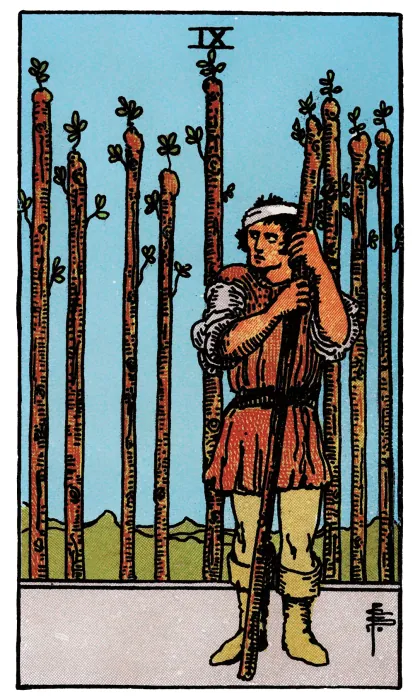
A bandaged figure grips the ninth wand before a rough fence. He watches for danger that is not visible in the scene. Caution carries knowledge earned through prior contact. If the defense now drains more than it protects—or an old threat defines every new encounter regardless of evidence—the guard has become its own burden.

  • resilience
  • vigilance
  • boundaries
  • fatigue
  • persistence
  • earned caution
Nine of Wands tarot card from a Rider-Waite-Smith-style deck
Nine of Wands · Wands suit Artwork by Pamela Colman Smith (1909) · Public Domain Mark 1.0
Number
9
Upright tendency
Maybe
Reversed tendency
Leans no

Nine of Wands upright and reversed meaning

Upright

The Nine of Wands carries experience into the present through caution and preparation. The bandage records earlier difficulty; the rough fence shows what was built in response. Endurance remains available, but the cost of staying ready belongs in the reading too. A worthwhile goal does not make every further demand worthwhile. The strongest persistence remembers what happened while still recognizing how today's conditions differ from the earlier conflict.
Reversed

An old injury can become the expectation brought to every new encounter. Defenses stop distinguishing present conditions from remembered danger, and even inactivity may feel exhausting when vigilance never relaxes. Another expression is continuing because stopping seems to invalidate all previous effort. This is a picture of strained capacity, not a health assessment: the issue is whether the guard still serves a present purpose or mainly preserves an earlier battle.

Love, work, and practical questions

Love & relationships

Love

Upright. Earlier hurt may make trust gradual and boundaries conspicuous. Patience helps when the pattern that caused the strain is addressed; continuing care need not require an endless test of another person's loyalty.

Reversed. Exhaustion may leave little room for another repair attempt, or old hurt may color ordinary uncertainty. A clear, maintainable boundary is more useful than repeatedly reopening an argument without changing its consequences.

Feelings

Upright. Someone may care while remaining cautious about hard-won stability. Consistent participation and an ability to state limits are more informative than demanding immediate openness as the sole measure of emotional depth.

Reversed. Affection can remain beneath suspicion or fatigue, but desire alone cannot make closeness less costly. Repeated changes in behaviour provide more evidence of repair than a sudden demand to trust again.

Work & money

Career

Upright. A demanding role or long project may combine experience with fatigue. The remaining work and current capacity need separate attention; having endured previous demands does not prove the next one is manageable.

Reversed. Burnout or an overextended project can make every request feel like another final test. Past effort may keep the original goal protected from re-examination, even after its value or conditions have changed.

Money

Upright. A thin reserve or earlier loss can create lasting financial vigilance. Caution has value, but treating every transaction as the old setback returning may make protection consume more attention than present conditions require.

Reversed. Prolonged strain can make even ordinary expenses feel like a breach. The material picture includes fatigue as well as amounts, so remembered threats and immediate obligations should not be treated as identical.

Yes or No Tendency

Upright: Maybe

Maybe: the goal may still matter, but present capacity must be weighed against the remaining cost.

Reversed: Leans no

Usually no while depleted vigilance prevents the present demand from being assessed on its own terms.

These tendencies use the reference question “Do current conditions support moving forward?” Your question and circumstances can change the interpretation; this is not a guaranteed outcome.

Symbols in Nine of Wands

A bandage and improvised fence show how earlier difficulty continues shaping present attention.

The bandaged head
Visible injury establishes that caution comes from prior contact with difficulty rather than abstract fear.
Eight wands behind
The row resembles a protective barrier built from accumulated experience and repeated effort.
The sideways glance
Attention remains fixed on a possible return of danger, illustrating vigilance and its emotional cost.

Traditional associations: Wands · fire · action, desire, and creative will · Nine · culmination, independence, or resilience. Association systems differ between traditions.

Questions about Nine of Wands

What does the Nine of Wands mean in a love reading?

Upright: Past hurt or repeated strain may make trust slower and boundaries more visible. The relationship can continue if both people respect recovery and address the specific pattern that caused the injury. Asking for patience is reasonable; requiring endless proof while withholding all vulnerability is not. Reversed: Someone may be too exhausted to repair another rupture, or may interpret ordinary uncertainty through the lens of an earlier betrayal. A boundary may be stated repeatedly but never enforced. Reduce the issue to one behavior and one consequence that can be maintained.

What does the Nine of Wands reversed mean?

Reversed, vigilance has become depletion, rigidity, or fear of a challenge that is no longer present. The same defense may be applied to every new situation regardless of evidence.

Is the Nine of Wands a yes or no card?

Upright: Maybe. The objective remains worthwhile, but the last stretch depends on whether endurance still exceeds the cost of continuing. Reversed: No. Fatigue or vigilance has lost contact with the present demand, allowing depleted defense to shape the answer.

Elena is ArcaSeer’s named editorial voice. How Elena’s notes are created