Five of Wands Tarot Card Meaning

Quick Meaning

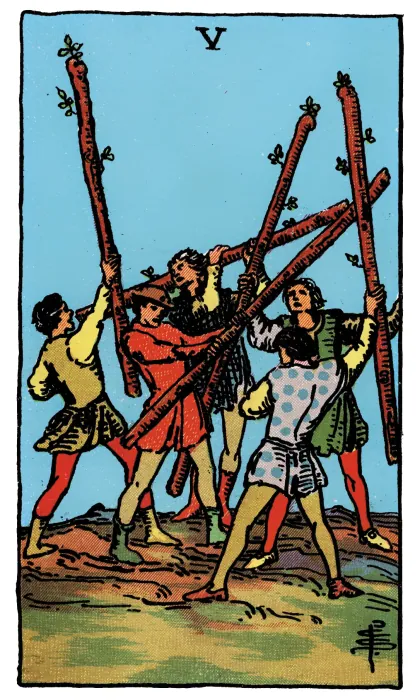
Five people raise their staffs in the same open space, yet no shared target or referee is visible. The Five of Wands therefore points to effort colliding with effort: debate or competition can sharpen skill when rules are clear, while the reversed card often shows conflict being suppressed or allowed to outlive its purpose.

  • competition
  • friction
  • practice
  • conflicting aims
  • debate
  • coordination
Five of Wands tarot card from a Rider-Waite-Smith-style deck
Five of Wands · Wands suit Artwork by Pamela Colman Smith (1909) · Public Domain Mark 1.0
Number
5
Upright tendency
Leans no
Reversed tendency
Maybe

Five of Wands upright and reversed meaning

Upright

The Five of Wands shows plenty of energy without a common formation. Different people, methods, or even competing wishes within one person interrupt each other. Friction is useful when it tests an idea or skill under understood rules; otherwise effort becomes a contest that cannot produce a shared result. Identify what each participant wants and what would count as a useful end before treating every disagreement as a feud.
Reversed

Conflict may go underground, continue past its purpose, or finally begin to settle. Quick agreement can conceal concerns that later return as resentment or rework, while exhausted participants may be unable to tolerate another sprawling debate. The useful distinction is resolution versus silence. A clearly bounded decision can close a contest; one person surrendering every need to keep the room quiet leaves the disagreement intact.

A common misreading: Not every collision in this card is a serious feud. Rehearsal, debate, and competition can teach, but only when participants know the goal, the limits, and when the contest ends.

Love, work, and practical questions

Love & relationships

Love

Upright. Preferences or outside demands may create repeated friction without threatening the whole bond. The relationship benefits when disagreements have a purpose and minor victories stop being treated as measures of affection.

Reversed. Silence may conceal irritation, or a difficult phase may finally be ending. Genuine resolution lets both people express needs; apparent peace created by one person abandoning theirs leaves the conflict active.

Feelings

Upright. Attraction can mix with rivalry or a wish to be noticed. Playful competition is only useful when it can stop easily once someone expresses a serious need or a boundary.

Reversed. Suppressed irritation, relief, or fear of confrontation can all appear behind an agreeable manner. A direct conversation reveals more than assuming that the absence of an argument means mutual peace.

Work & money

Career

Upright. Several capable people may pursue different aims inside the same brief. Competition sharpens the work when a shared problem and decision rule exist; otherwise everyone contributes effort without producing a combined result.

Reversed. Repeated debate or hidden politics can exhaust a team, though clearer roles may now emerge. A specific decision and understood responsibilities distinguish progress from another round of the same unresolved contest.

Money

Upright. Bids or competing expenses can turn a budget into a contest. The meaningful comparison is actual cost, quality, and timing, so winning an argument or offer should not be confused with value.

Reversed. A financial disagreement may be concealed or no longer useful. Real records and agreed decision rights are needed to settle the issue; the card simply makes the recurring or avoided friction visible.

Yes or No Tendency

Upright: Leans no

Usually no while competing aims lack a common method or a clear way to reach a decision.

Reversed: Maybe

Maybe, if disagreement is genuinely being resolved rather than suppressed through fatigue or pressure.

These tendencies use the reference question “Do current conditions support moving forward?” Your question and circumstances can change the interpretation; this is not a guaranteed outcome.

Symbols in Five of Wands

Crossing staffs make abundant effort visible without supplying a shared target or rule.

Five crossing staffs
The overlapping wands show effort obstructing effort because no common formation has been established.
Five differently dressed figures
Varied clothing emphasizes separate identities, interests, and methods sharing one contested space.
No visible referee or target
The image withholds a clear rule or objective, making coordination the central interpretive problem.

Traditional associations: Wands · fire · action, desire, and creative will · Five · disruption, shortage, or adjustment. Association systems differ between traditions.

Questions about Five of Wands

What does the Five of Wands mean in a love reading?

Upright: A relationship can be lively but exhausting when every preference becomes a contest. Teasing, debate, competing schedules, or outside demands may create heat without a true threat to the bond. Agree on what is negotiable and stop using minor victories as evidence of who cares more. Reversed: One or both people may avoid a necessary argument until irritation leaks into unrelated moments. The reversal can also mark the end of a quarrelsome phase. Distinguish genuine resolution from silence purchased by one person abandoning their needs.

What does the Five of Wands reversed mean?

Reversed, conflict is suppressed, avoided, or allowed to continue after it has stopped producing insight. Surface agreement may conceal resentment, while exhaustion can make even useful disagreement feel intolerable.

Is the Five of Wands a yes or no card?

Upright: No under current conditions; the opportunity can develop, but competing aims and unclear rules must be organized before the answer becomes dependable. Reversed: Maybe, but not while necessary disagreement is being avoided or the participants are too depleted to resolve the same recurring conflict.

Elena is ArcaSeer’s named editorial voice. How Elena’s notes are created