The Chariot Tarot Card Meaning

Quick Meaning

The Chariot tarot card means moving forward with determination by keeping competing pulls aimed in one direction. Upright, it favors focus, discipline, and steady progress toward a clear goal, even under pressure. Reversed, it can point to scattered effort, lost control, or force used where coordination is needed. For yes-or-no questions, The Chariot leans yes upright and leans no reversed.

Upright
  • determination
  • willpower
  • control
  • victory
Reversed
  • lost direction
  • lack of control
  • aggression

Updated

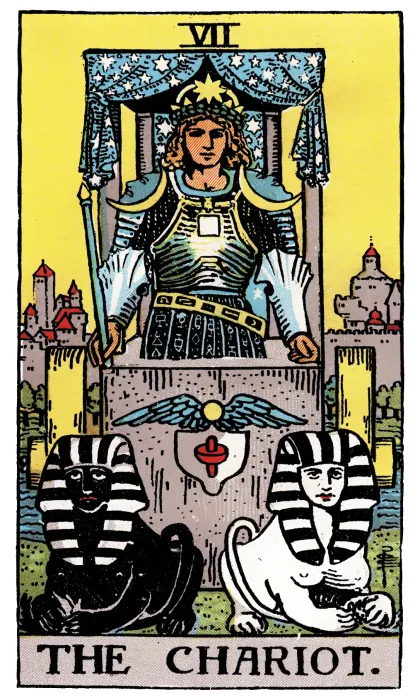
The Chariot tarot card from a Rider-Waite-Smith-style deck
The Chariot · Major Arcana 7 Artwork by Pamela Colman Smith (1910) · Public Domain Mark 1.0 · Image usage
Ask your own question: free AI reading
Arcana Major
Number7
Upright tendencyLeans yes
Reversed tendencyLeans no

The Chariot upright and reversed meaning

The Chariot tarot card upright

The Chariot upright meaning

Drawn upright, The Chariot means progress that comes from focus and discipline. It points to a clear goal, the will to reach it, and the ability to keep different pressures from pulling you off course.

The Chariot concerns the tension between a chosen direction and the pulls that could divert it. In practice, that might be ambition and fear, two teammates with different priorities, or a goal that needs both speed and care. The card does not remove the conflict. It describes someone holding the direction despite it.

The card favors committed effort in a defined direction: training for a race, finishing a degree, launching a product on schedule, or moving to a new city with a plan. It suits situations where a decision has been made and the work now is to follow through. Waite describes the figure as a conqueror, and progress here comes from repeated correction, not luck.

Determination helps most when the destination is clear. Training for an event while also expecting every weekend to stay free creates a practical conflict worth settling early.

A practical test is to say your destination in one sentence. If everyone involved would say the same sentence, the card's momentum is available. If people describe different goals, coordinating them comes first.
The Chariot tarot card reversed

The Chariot reversed meaning

Reversed, The Chariot can suggest effort without coordination, lost control, excessive pressure, or a goal pursued for appearances.

Hard work can fail to add up when the tasks pull against each other. Each task may make sense alone. A team project where every correction undoes the last fits here. So does a personal plan with three goals that compete for the same hours.

The reversal may also describe a situation moving faster than you can steer it. Deadlines arrive before decisions are made, or emotions take over a conversation that needed calm. Plans change faster than anyone can explain them.

Adding pressure is another response to stalled progress. Raising your voice, working longer hours, or pressuring others can produce movement that goes nowhere useful.

The reversed card can also describe a goal chosen for appearance. You may be racing toward something because it looks impressive, without wanting it much. Ask whether you would still choose it if nobody were watching.

To sort out which applies, look at results. Lots of work and little progress points to poor coordination. Events outpacing you point to lost control. Rising tension points to pressure. In each case, slowing down long enough to agree on direction is likely to help more than speed.

The Chariot in love, career, and money

The Chariot in love & relationships

The Chariot love meaning

Upright

For relationships, The Chariot points to two people moving in the same direction with commitment and effort. It can describe a couple working through a challenge together, such as a long-distance period, a move, or a busy stretch at work, by agreeing on a shared goal. It favors relationships where both people actively steer. If you are single, it supports going after what you want with intention, such as making the first move or setting time aside to meet people.

Reversed

The reversal may show partners pulling in different directions, a power struggle about who decides, or one person trying to control the other's choices. It can also describe rushing a relationship forward faster than it can support. A useful question is whether you both want the same destination, and whether either of you is steering alone. Agreeing on the next three months is a manageable place to start.

The Chariot as feelings

Upright

In a feelings position, The Chariot can suggest determination and a wish to pursue the connection. Someone may feel strongly while trying to keep that emotion under control. They may want a clear direction, and show it by making plans or turning up consistently even when busy.

Reversed

Reversed in this position, The Chariot can show feelings that are conflicted or frustrated. Someone may want to move forward and feel held back by circumstances, or may feel torn between you and other priorities. That frustration may come out as impatience. They may also be trying to manage strong emotions by controlling plans, such as insisting on fixed dates.

The Chariot: how someone sees you

Upright

Someone may see you as driven, focused, and determined, a person who sets goals and reaches them. They may admire your discipline, or feel slightly outpaced by it. Some may want to join your plans, and some may wonder where they fit in them.

Reversed

They may see you as pulled in too many directions, or as someone who pushes hard and occasionally runs over other people's concerns.

A card can suggest how someone might see you. Only that person can tell you what they actually think.

The Chariot in career & money

The Chariot career meaning

Upright

For work questions, The Chariot favors ambition, competition, and projects with clear goals and deadlines. It suits going for a promotion, leading a launch, competing for a contract, or pushing through a demanding phase with focus. Define the one result that matters this quarter, and plan your weeks around it. When competing priorities appear, decide which one wins before the work starts, since speed alone does not coordinate a team.

Reversed

It may describe a team where effort is high and progress is low, a project steered by too many people, or burnout from pushing too hard. It can also point to a career move made in a hurry. A launch team promising both an earlier date and extra features, without extra capacity, has a coordination problem that enthusiasm cannot settle. Ask everyone involved to write the goal in one line, and compare the answers.

The Chariot money meaning

Upright

With money, The Chariot points to disciplined progress toward a specific target, such as paying down a balance or saving for a defined purchase. Set the target, the amount, and the date, then automate what you can so willpower is not needed every week. Check progress once a month, not every day.

Reversed

It may point to impulsive spending that undoes your progress, or to competing financial goals pulling the same money in different directions. A plan can also become so rigid that ordinary needs feel like failures. Separate essential costs and existing commitments from the goals you can adjust, then choose which adjustable goal to fund first.

For investment or debt decisions, talk to a qualified financial professional.

The Chariot as advice and as a person

The Chariot as advice

Upright

As guidance, The Chariot suggests keeping your effort focused on a clear result. Write the goal at the top of each week's plan and cross off the adjustable tasks that do not serve it, keeping rest and real obligations. If others are involved, check that they share the goal.

Reversed

Reversed, The Chariot asks you to stop adding pressure long enough to name the obstacle: conflicting goals, an unmanageable pace, or a result you no longer want. Change that part of the plan before asking anyone for more effort.

The Chariot as a person

Upright

Describing a person, The Chariot may point to someone ambitious, disciplined, and competitive, who sets goals and pursues them steadily. They are good at keeping a group moving when progress gets hard, and setbacks tend to make them more focused.

Reversed

Reversed, The Chariot may describe someone pushing hard while leaving little room for others' input, or dividing their effort among too many goals. They may read a request to slow down as opposition, even when it concerns a practical limit.

Is The Chariot a yes or no card?

Upright: Leans yes

The upright Chariot leans yes when the goal is clear and the people involved share the direction. The yes depends on sustained effort that stays responsive to practical limits. If the people involved disagree about the goal, the yes weakens until it is settled.

Reversed: Leans no

It leans no while speed is replacing coordination, control has slipped, or the goal is not actually shared. Once the direction is agreed and the pace is manageable, the question is worth asking again soon. A shared written goal is a good sign that the answer has changed.

These tendencies use the reference question “Do current conditions support moving forward?” Your question and circumstances can change the interpretation; this is not a guaranteed outcome.

The Chariot and spirituality

Spiritually, The Chariot relates to discipline and direction in practice: a regular schedule, a clear intention, and the will to return to it when distracted. It can also describe balancing opposing parts of yourself, such as ambition and rest, without letting either one take over completely. A schedule helps, provided completing it has not become more important than the practice itself.

Symbols in The Chariot

The Chariot shows an armored figure standing in a stone chariot under a blue canopy scattered with stars. He wears a crown with a star and a square emblem on his chest, and holds a long wand in his right hand. In front of the chariot rest two sphinxes, one black and one white. A walled city with towers stands behind him, beyond a river.

The sphinxes rest before the chariot, with no reins visible. Their contrasting colors can suggest competing impulses, and whatever holds them together has to come from the driver.

The starry canopy places a larger aim above the immediate effort.

The square on the armor suggests a stable center inside movement: structure the driver carries with him.

The city behind the figure can suggest an established base. Read as a departure, the scene raises the question of what direction the charioteer intends to take.

The armor shows readiness. The Chariot expects resistance on the way.

Traditional associations: Major Arcana VII · Direction, discipline, and controlled momentum · Traditionally associated with Cancer. Association systems differ between traditions.

Reading notes for The Chariot

Example reading. A four-person team has been working on a group project for six weeks. Each member has redone someone else's section at least once, and the deadline is in two weeks. One member asks, "Why are we working hard without making much progress?" and draws The Chariot reversed.

The card points to the relationship between the goal and the roles. It suggests that the team may be working toward different versions of the finished project. Agreeing on the final outline and who owns each part could matter more than extra hours. It does not say anyone lacks commitment.

The Chariot FAQ

What zodiac sign is The Chariot associated with?

The Golden Dawn assigns The Chariot to Cancer, a water sign. That can seem surprising for a card about forward movement. It invites a reading in which direction is held steady despite emotional pressure, not a statement about anyone's sign.

Why does The Chariot have sphinxes instead of horses?

Waite notes that eighteenth-century versions showed white horses, and some used other animals. He adopted Eliphas Lévi's design with two sphinxes because the charioteer, in his reading, has answered the riddle of the sphinx. The sphinxes connect the card with knowledge as well as force.

Why does Waite distinguish victory from inner mastery?

Waite says the charioteer's conquests are external and may leave questions within himself unresolved. Winning an argument, completing a difficult task, or gaining recognition need not settle the motives behind the effort. In a modern reading, this distinction helps separate achieving a goal from understanding why that goal matters.

How is The Chariot different from the Six of Wands?

The Chariot is about the drive and discipline to reach a goal, while the Six of Wands is about recognition after a success. The Chariot emphasizes directing effort. The Six of Wands shows a rider among other people, with a laurel wreath marking public recognition.

Sources: A. E. Waite, The Pictorial Key to the Tarot (1910), Part II: VII — The Chariot; Israel Regardie, The Complete Golden Dawn System of Magic, The Tarot: names and attributions of the Tarot trumps (Book T)