Ten of Cups Tarot Card Meaning

Quick Meaning

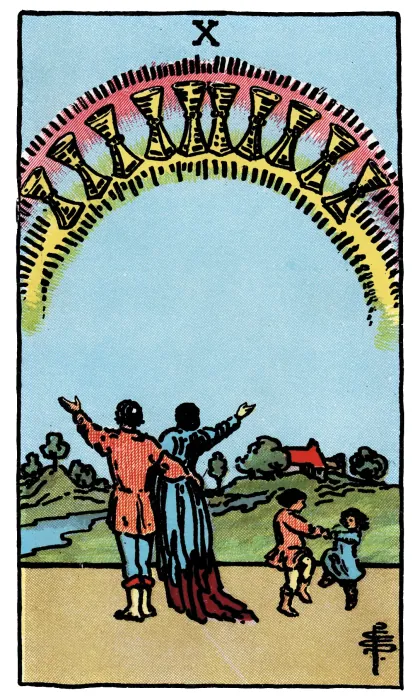
A rainbow of cups hangs over adults, children, water, and a home, placing fulfillment in a shared environment rather than one person's possession. Belonging endures through ordinary care after the joyful moment. The picture loses integrity when family or community harmony requires exclusion, denied disagreement, or pressure to appear happy together.

  • emotional fulfillment
  • family
  • shared joy
  • belonging
  • peace
  • collective well-being
Ten of Cups tarot card from a Rider-Waite-Smith-style deck
Ten of Cups · Cups suit Artwork by Pamela Colman Smith (1909) · Public Domain Mark 1.0
Arcana
Minor · Cups
Number
10
Upright tendency
Leans yes
Reversed tendency
Leans no

Ten of Cups upright and reversed meaning

Upright

The Ten of Cups makes fulfilment a shared environment rather than a possession held by one person. Home, community, and trust grow through repeated care and an ability to return after disagreement. A joyful moment can genuinely reflect those conditions, but cannot maintain them alone. The enduring question is how belonging works on ordinary days, when people are tired, needs differ, and someone must make room for repair.
Reversed

A picture of harmony can hide loneliness, exclusion, or an inability to disagree. Affection may remain while the people involved no longer share a workable vision of home or community. Conversely, an unconventional arrangement can contain real commitment despite failing an inherited ideal. The standard is lived care and individual agency: truthful disagreement may make belonging more honest, while forced happiness protects only its appearance.

Love, work, and practical questions

Love & relationships

Love

Upright. A shared vision of home can support lasting partnership or chosen family. Its strength appears in ordinary care, boundaries, and repair, rather than in expecting a harmonious picture to guarantee the future.

Reversed. Family pressure or incompatible expectations may strain a bond that still contains affection. Who feels safe and who maintains the peace matter more than preserving an ideal image at any personal cost.

Feelings

Upright. Deep affection may include a wish to build a fuller life together. That vision becomes mutual when the other person's version of home and responsibility is invited, rather than assumed to match.

Reversed. Love may coexist with doubt about the shared structure or future. Concrete conversation about values, home, and responsibility reveals more than requiring affection alone to settle incompatible expectations or family pressure.

Work & money

Career

Upright. A healthy culture or community benefit can make work meaningful beyond status. Shared wellbeing is credible where actual participation and the treatment of disagreement match the organization's description of its values.

Reversed. A public values statement may conceal unequal access or workload. The gap becomes visible in everyday experience, especially whether dissent can be heard without asking people to perform agreement they do not feel.

Money

Upright. Household resources support a shared life through money and often invisible labor. Open agreement and actual figures determine the arrangement; a happy image does not show how fairly those contributions are carried.

Reversed. Housing or family obligations may disturb apparent harmony. Existing rights, affordability, and informed agreement determine responsibilities, while the card draws attention to burdens missing from the public picture of belonging.

Yes or No Tendency

Upright: Leans yes

Generally yes where a shared life is supported by real daily care and participation.

Reversed: Leans no

Usually no when apparent harmony depends on silence or an ideal the participants do not actually share.

These tendencies use the reference question “Do current conditions support moving forward?” Your question and circumstances can change the interpretation; this is not a guaranteed outcome.

Symbols in Ten of Cups

The cups form a shared atmosphere over everyday people, home, and landscape.

The rainbow of ten cups
The complete suit appears overhead as a shared atmosphere rather than a possession held by one person.
The dancing children
Movement and play place future life and everyday participation inside the larger image of harmony.
The house and river
A visible home and flowing water connect emotional abundance with place, continuity, and practical belonging.

Traditional associations: Cups · water · emotion, relationship, and imagination · Ten · completion, consequence, or transition. Association systems differ between traditions.

Questions about Ten of Cups

Does the Ten of Cups mean pregnancy?

Marriage, children, and a flawless family are literal projections onto the scene, not promises. This Ten concerns shared emotional values and a form of belonging maintained by the people inside it, conventional or not.

What does the Ten of Cups mean in a love reading?

Upright: This card can support lasting partnership, family harmony, chosen family, or a relationship aligned around the same vision of home. It is not proof of a flawless future. Talk about conflict, care work, boundaries, and the daily routines that allow the larger picture to remain trustworthy. Reversed: Family expectations, incompatible definitions of home, unresolved conflict, or the burden of appearing perfect may strain the bond. The card does not require preserving the picture at any cost. Ask who feels safe, who performs the peacekeeping, and which difference needs an honest decision.

What does the Ten of Cups reversed mean?

Reversed, the ideal of harmony may hide conflict, exclusion, or pressure to perform happiness. A shared vision can be missing even when affection remains.

Elena is ArcaSeer’s named editorial voice. How Elena’s notes are created