The Hierophant Tarot Card Meaning

Quick Meaning

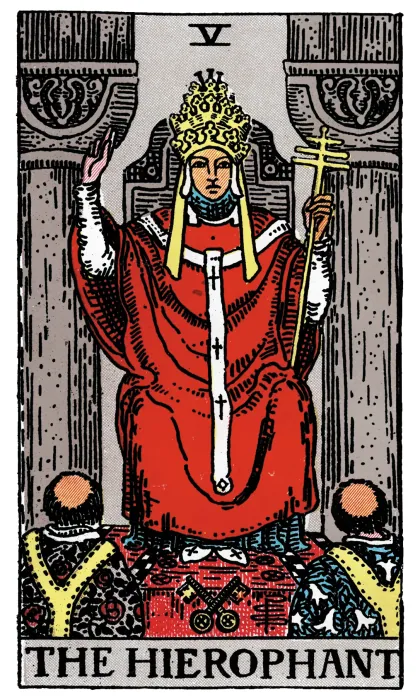
Two acolytes kneel before a religious office marked by a triple crown, blessing hand, and crossed keys. The Hierophant asks what a tradition teaches, who may interpret it, and what belonging requires. A rule that has lost its purpose deserves examination, but rejecting every shared standard can become an equally rigid reflex.

  • tradition
  • teaching
  • institutions
  • commitment
  • shared values
  • conformity
The Hierophant tarot card from a Rider-Waite-Smith-style deck
The Hierophant · Major Arcana 5 Artwork by Pamela Colman Smith (1909) · Public Domain Mark 1.0
Arcana
Major
Number
5
Upright tendency
Leans yes
Reversed tendency
Maybe

The Hierophant upright and reversed meaning

Upright

The Hierophant shows knowledge carried through a community: teaching, shared language, ritual, and standards that outlast an individual. A tested framework can preserve lessons and make commitment visible. Its value depends on purpose, not age alone. A useful teacher explains the method and helps learners develop judgment; belonging becomes meaningful when people understand what they are entering and can consciously support the values it preserves.
Reversed

Reversed, an inherited rule may have become detached from the reason it exists. Institutions can preserve status through gatekeeping or treat dissent as ignorance. Automatic rebellion can reproduce the same rigidity by rejecting safeguards along with constraints. The question is therefore not simply whether a method is conventional, but what value it serves, where it fails, and whether an alternative can explain its own responsibilities.

Love, work, and practical questions

Love & relationships

Love

Upright. Shared beliefs or formal commitment can give a relationship orientation. Family and cultural expectations become constructive when both people choose their meaning rather than treating conformity as proof of devotion.

Reversed. Outside expectations may overshadow the couple's own agreement. Resistance to conventional labels can be sincere, but the relationship still needs a clear account of what each person will maintain.

Feelings

Upright. Seriousness may be shaped by duty, faith, or a wish for recognized partnership. Direct discussion shows how the connection fits the person's actual values and long-term expectations.

Reversed. A person may resist prescribed milestones while valuing the bond, or reject definition to avoid responsibility. What arrangement they are willing to sustain matters more than their attitude to labels.

Work & money

Career

Upright. Mentorship, training, and established procedures may provide useful guidance. Their strength comes from explainable purpose and current evidence, rather than from seniority or institutional reputation alone.

Reversed. Outdated training or gatekeeping may obstruct better work. An alternative becomes credible by explaining the old method's purpose and showing where a different approach would serve it better.

Money

Upright. Institutional roles and established procedures may organize the money question. Credentials and reputation do not settle suitability; incentives, costs, and terms need to stand independently of symbolic authority.

Reversed. Inherited advice or institutional fees may fit the provider better than the person. An unconventional alternative also needs accountable expertise and comparable terms rather than rebellion as its only appeal.

Yes or No Tendency

Upright: Leans yes

Yes when a tested framework supports values consciously shared by the people involved. Guidance remains useful when its purpose can be understood.

Reversed: Maybe

Maybe: the established method may not fit, but a responsible alternative still needs form. Rejecting a convention does not by itself establish an agreement.

These tendencies use the reference question “Do current conditions support moving forward?” Your question and circumstances can change the interpretation; this is not a guaranteed outcome.

Symbols in The Hierophant

Office, followers, and keys show how a community carries teaching and controls access.

The triple crown and staff
Repeated tiers emphasize formal office, accumulated authority, and teaching carried through an institution.
The two kneeling followers
Their different robes show distinct participants receiving instruction inside the same shared structure.
The crossed keys
The keys suggest access, interpretation, and the institutional power to open or restrict a threshold.

Traditional associations: Major Arcana V · Tradition, teaching, and shared values · Traditionally associated with Taurus. Association systems differ between traditions.

Questions about The Hierophant

Why is The Hierophant associated with Taurus?

The Taurus correspondence comes from the Golden Dawn’s table of tarot and astrological attributions. It is part of that system, rather than something proved by the card’s number or religious clothing. You can use the pairing to consider continuity and established values, while keeping that interpretive connection separate from a claim that every tarot tradition uses it.

Why is The Hierophant numbered 5?

Five is The Hierophant’s place in the Rider–Waite–Smith trump sequence, where Waite labels it V. The number identifies its position; it does not by itself explain the card’s whole religious or teaching symbolism. A numerological account of five adds another interpretive method and should not be presented as the historical reason for the card’s position.

What is a hierophant?

A hierophant is an interpreter or revealer of sacred mysteries; historically, the title was associated with the Eleusinian rites. In tarot, Waite uses the title for a broader religious office while acknowledging the card’s older name, the Pope. That explains why this figure can represent teaching and initiation rather than only one particular church official.

Elena is ArcaSeer’s named editorial voice. How Elena’s notes are created