King of Cups Tarot Card Meaning

Quick Meaning

The King of Cups keeps his throne level in open water while holding both cup and scepter. He can feel deeply without letting emotion replace responsible judgment. The card turns unhealthy when calmness hides suppressed feelings or becomes a way to control others while they carry the emotional cost.

  • emotional regulation
  • diplomacy
  • compassionate authority
  • stability
  • maturity
  • measured response
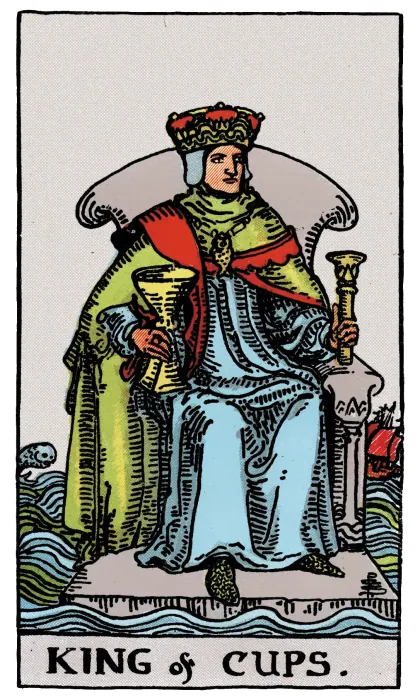
King of Cups tarot card from a Rider-Waite-Smith-style deck
King of Cups · Cups suit Artwork by Pamela Colman Smith (1909) · Public Domain Mark 1.0
Arcana
Minor · Cups
Number
14
Upright tendency
Leans yes
Reversed tendency
Leans no

King of Cups upright and reversed meaning

Upright

The King of Cups remains emotionally present while accepting responsibility for decisions. His steadiness occurs inside changing water, not at a distance from feeling. Regulation gives reactions an honest form without requiring everyone else to manage them. Diplomacy is useful when it preserves truth and agency; calm should make a fair decision possible rather than postpone it indefinitely or protect the person with the most power.
Reversed

Emotional understanding may become a way to steer people instead of hear them. Reassurance can settle a room while leaving the behaviour or unequal power unchanged. Suppressed feeling can also emerge later as withdrawal or unpredictable anger. A controlled presentation therefore proves little by itself. The deciding clue is whether composure supports honest choices and accountability, or makes others absorb the consequences of what remains concealed.

Love, work, and practical questions

Love & relationships

Love

Upright. Steady care makes difficult conversations possible without making silence the price of calm. Emotional responsibility includes naming feelings and remaining available during disagreement, rather than assuming restraint makes further communication unnecessary.

Reversed. Apparent composure may hide guilt, withdrawal, or dismissal of another person's experience. Plain language and accountable behaviour matter more than who appears calmer; restraint does not make harmful treatment less consequential.

Feelings

Upright. Care may be deep and restrained rather than dramatic. Consistency during difficult moments and a willingness to communicate make its depth more evident than a controlled manner considered on its own.

Reversed. Feeling may be concealed or expressed through emotional pressure. The possibility of hidden affection does not excuse punishment or silence; its practical effect on the other person remains part of the interpretation.

Work & money

Career

Upright. Mediation or people leadership needs empathy alongside the duty to decide. Calm becomes useful when it leads to a clear, fair response, rather than indefinitely managing the atmosphere around an unresolved issue.

Reversed. A leader may use reassurance to preserve appearances while private moods guide decisions. Documented criteria help reveal whether emotional insight serves understanding or has become a way to steer people without accountability.

Money

Upright. A volatile money conversation may benefit from emotional steadiness. Actual evidence and authority still determine allocation or agreements; composure is useful only when feeling is acknowledged without silently controlling the figures.

Reversed. Guilt or persuasive pressure may distort an apparently reassuring financial exchange. Verified information and independent judgement matter where emotional access creates influence, since familiarity with another person's feelings does not establish sound terms.

Yes or No Tendency

Upright: Leans yes

Generally yes when regulated emotion supports transparent and responsible judgement.

Reversed: Leans no

Usually no while manipulation or concealed volatility sits beneath an apparently controlled presentation.

These tendencies use the reference question “Do current conditions support moving forward?” Your question and circumstances can change the interpretation; this is not a guaranteed outcome.

King of Cups as a person

Upright

Strong feeling can be acknowledged here without making the room manage the reaction. When responsible for a decision, this person keeps empathy connected to a standard they can explain and apply fairly.

Reversed

Calmness may be used to avoid disclosure, approval made dependent on emotional compliance, or a necessary decision postponed until everyone else has adapted to what remains unnamed.

Symbols in King of Cups

A level throne stands inside moving water, joining receptivity with the responsibility to decide.

The throne in open water
Stable authority is placed directly inside emotional movement rather than protected on dry land.
Cup and scepter
The paired objects join receptivity with the responsibility to direct and decide.
The ship and leaping fish
Human navigation and spontaneous life continue around the seated ruler, showing different ways of moving through feeling.

Traditional associations: Cups · water · emotion, relationship, and imagination · King · outward mastery, direction, and responsibility. Association systems differ between traditions.

Questions about King of Cups

Is the King of Cups associated with Scorpio?

Some court-card systems associate the King of Cups with Scorpio, but the mapping is not universal. In Golden Dawn Book T, the mounted King of Cups crosses late Aquarius into Pisces, while the Prince of Cups crosses late Libra into Scorpio; later decks use different court titles. Check the actual rank and system before transferring a Scorpio label to the Rider–Waite–Smith King.

What does the King of Cups mean in a love reading?

Upright: In relationships, the King suggests steady care, emotional responsibility, and the ability to remain present during conflict. Mature calm should not be confused with silence or distance. Feelings still need words, and regulation should make honest conversation safer rather than unnecessary. Reversed: Someone may withdraw, punish indirectly, control through guilt, or insist they are rational while dismissing the other person's experience. Emotional volatility is another expression. Require plain language and boundaries; do not let apparent calm make harmful behavior harder to name.

What does the King of Cups reversed mean?

Reversed, composure becomes suppression, emotional manipulation, or instability concealed behind authority. A calm surface may be used to avoid accountability while other people carry the unresolved impact.

Elena is ArcaSeer’s named editorial voice. How Elena’s notes are created