The Emperor Tarot Card Meaning

Quick Meaning

The Emperor tarot card means structure, authority, and responsibility: someone setting clear rules and standing behind them. Upright, it favors leadership, firm boundaries, and plans with a defined shape. Reversed, it can point to rigid control, authority used for personal advantage, or a lack of anyone willing to take charge. On a yes or no question, The Emperor leans yes upright and leans no reversed.

Upright
  • structure
  • authority
  • leadership
  • stability
Reversed
  • rigidity
  • control
  • weak leadership

Updated

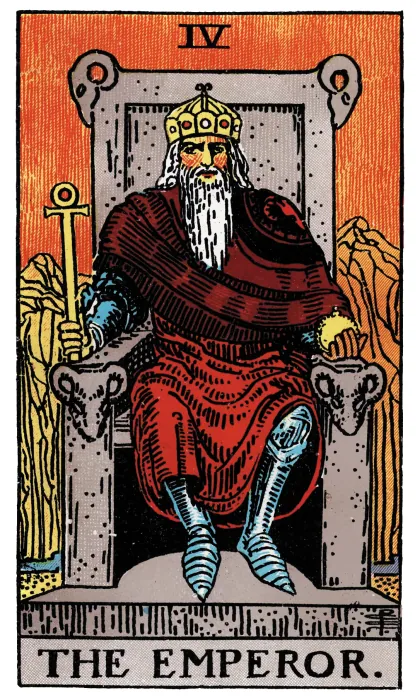
The Emperor tarot card from a Rider-Waite-Smith-style deck
The Emperor · Major Arcana 4 Artwork by Pamela Colman Smith (1910) · Public Domain Mark 1.0 · Image usage
Ask your own question: free AI reading
Arcana Major
Number4
Upright tendencyLeans yes
Reversed tendencyLeans no

The Emperor upright and reversed meaning

The Emperor tarot card upright

The Emperor upright meaning

Upright, The Emperor means that clear structure and responsible authority can steady a situation. It points to rules, plans, leadership, and boundaries that hold.

Authority and responsibility belong together in this reading. The Emperor sets the rule and also carries the consequence. A manager who defines priorities and then defends the team's time fits the card. So does a parent who sets a bedtime and enforces it calmly, or a person who decides what they will and will not accept and sticks to it.

It favors putting shape around something that has been drifting. A project with no owner, a household where nobody knows who pays which bill, or a friendship group that never manages to plan anything can all benefit from someone taking charge.

Structure is not the same as harshness. The Emperor's rules work when they are clear, consistent, and explained. They fail when they change with the ruler's mood. A rule that nobody can explain is a warning sign.

Responsibility without authority causes its own trouble. Someone expected to organize a shared event cannot settle the details if every decision is overturned by another person. Ask who is actually responsible for this situation, and whether that person has the authority to act.
The Emperor tarot card reversed

The Emperor reversed meaning

Drawn reversed, The Emperor can suggest structure that has hardened into rigidity, authority that serves one person's interests, or the absence of anyone willing to take responsibility.

Rules become rigid when they outlast their purpose. Plans cannot be adjusted, and questions are treated as challenges. A sign is that people work around the rules instead of through them. A policy nobody can justify, or a family rule that no longer fits anyone's life, are examples.

Authority used to protect personal status becomes controlling. A leader may expect obedience without explaining decisions. In a relationship, this can show up as one person deciding for both.

The reversal can also describe an empty seat of authority. Nobody sets the plan, nobody makes the hard call, and deadlines pass without anyone noticing. Everyone assumes someone else is in charge.

These can apply to you as well as to others. You may be holding on to control because letting go feels risky, or avoiding authority because it means being responsible for the outcome.

The clearest sign is what happens when someone questions a rule. If nothing can change, rigidity is likely. If disagreement is punished, control is likely. If nobody responds at all, the seat is empty.

The Emperor in love, career, and money

The Emperor in love & relationships

The Emperor love meaning

Upright

For relationships, The Emperor describes stability, commitment, and clear expectations. A partner may show care through reliability: turning up on time, keeping promises, handling practical matters. The card favors relationships where both people know where they stand and agree on the basics, such as money, time together, and future plans. If you are single, it supports being clear about what you want and what you will not accept, and choosing partners who are dependable.

Reversed

When The Emperor is reversed, it can point to control in a relationship, such as one partner making most decisions, setting rules for the other, or treating disagreement as disloyalty. It can also describe a relationship with no structure at all, where nothing is agreed and everything is uncertain. A useful check is whether decisions that affect both people are actually made by both. If raising this feels unsafe, talk to someone you trust outside the relationship first.

The Emperor as feelings

Upright

As feelings, The Emperor can suggest steadiness, protectiveness, or a serious view of commitment. Someone may feel responsible for you or want to provide a sense of security. They may express care through a practical role, such as helping with a move or a repair, more than by discussing affection at length. They may not say this directly.

Reversed

The reversed Emperor points to feelings that involve a need for control, or frustration at not having it. Someone may feel possessive, or may feel unsure of their position and cover it with firmness. Emotional distance can also appear, with feelings kept tightly managed.

The Emperor: how someone sees you

Upright

The Emperor can describe an impression of you as reliable, decisive, and in control. Someone may see you as the person who knows what to do when plans fall apart. They may respect your standards, and some may find them strict.

Reversed

They may see you as controlling or inflexible, or as someone who avoids taking charge when it is needed. Either impression can come from one tense situation, such as a disagreement about a plan.

A card can suggest how someone might see you. Only that person can tell you what they actually think.

The Emperor in career & money

The Emperor career meaning

Upright

In career readings, The Emperor favors leadership, management, and roles with clear responsibility. It suits taking ownership of a project, setting up processes, or stepping into a supervisory position. Check whether the responsibility comes with the authority and support to do the job, since a title with no say over priorities leaves you carrying consequences you cannot influence. If you are starting a business, build the structure early: written agreements, defined roles, and a simple system for tracking money.

Reversed

When The Emperor is reversed, it can describe a micromanaging boss, a workplace where rules matter more than results, or a team with no clear leader. It can also point to your own difficulty delegating. Write down who decides what in your team, and check whether everyone agrees with the list. If a rule blocks good work, find the person who can approve an exception and make your case with specifics.

The Emperor money meaning

Upright

Financially, The Emperor points to budgets, planning, and long-term stability. It favors a clear system for bills, savings, and spending limits. A written budget that everyone in the household understands fits the card well, and automatic transfers to savings on payday suit its preference for systems over willpower.

Reversed

Reversed, The Emperor can point to financial control by one person, rigid rules that ignore real needs, or no plan at all. If someone else controls money that affects you, ask to see the full picture, and set a monthly time to review it together.

For investment or debt decisions, talk to a qualified financial professional.

The Emperor as advice and as a person

The Emperor as advice

Upright

Taken as advice, The Emperor suggests taking responsibility for one area that has been drifting and putting a simple structure around it. That might be a weekly planning hour, a shared calendar, or a written agreement about who handles what.

Reversed

The advice of the reversed Emperor is to loosen one rule that no longer serves its purpose, or, if nobody is in charge, offer to take charge of one clearly defined piece. If you are the one in charge, ask one person for honest feedback about a rule you set.

The Emperor as a person

Upright

Describing a person, The Emperor may point to someone organized and decisive who prefers clear plans. They may take responsibility for arrangements, state a boundary directly, or expect a commitment to be kept. They tend to make the final call when a group cannot decide.

Reversed

The Emperor, reversed, can describe someone who needs control to feel safe, or someone who avoids responsibility and leaves others to make every hard decision. Either pattern can leave other people unsure how much say they have.

Is The Emperor a yes or no card?

Upright: Leans yes

In its upright position, The Emperor leans yes. Moving forward calls for usable structure and someone able to take responsibility. The yes is strongest when someone is clearly responsible for the next step and has the means to carry it out. If authority is unclear or contested, the yes weakens until that is settled.

Reversed: Leans no

The answer leans no while control, rigidity, or a lack of leadership is shaping the situation. If responsibility is clarified, or an inflexible plan is adjusted to fit the facts, the question is worth asking again. Start by asking who has the final say, and whether they accept responsibility for the result.

These tendencies use the reference question “Do current conditions support moving forward?” Your question and circumstances can change the interpretation; this is not a guaranteed outcome.

The Emperor and spirituality

On a spiritual level, The Emperor relates to discipline and structure in practice: regular hours, clear commitments, and a framework you can rely on. A regular time for practice, kept even on busy days, fits the card. It can also prompt questions about spiritual authority. A teacher or tradition can give useful structure, and the card asks whether that authority explains itself and accepts questions.

Symbols in The Emperor

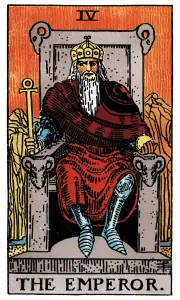
The Emperor sits on a large stone throne decorated with rams' heads. He has a long white beard, a gold crown, and a red robe over a suit of armor, with metal plates visible on his legs. In his right hand he holds a scepter shaped like an ankh, and in his left a globe. Behind him rise bare, steep mountains under an orange sky.

The stone throne stands for durable order. The rams' heads connect the card with Aries and with the drive to lead and begin. The armor under the robe suggests that this authority stays ready to defend itself.

The ankh and globe pair responsibility for life with rule over a defined territory. Waite calls the Emperor the power of this world, which fits a figure holding the world in one hand. The bare mountains can suggest the demands against which this figure's authority will be tested.

Traditional associations: Major Arcana IV · Structure, boundaries, and authority · Traditionally associated with Aries. Association systems differ between traditions.

Reading notes for The Emperor

Example reading. Three friends run a small online shop together. Orders have been delayed twice this month because nobody was sure who should handle supplier problems. One of them asks, "What does our business need right now?" and draws The Emperor upright.

A reading would point to the missing ownership of supplier issues. It would suggest assigning that responsibility to one person, with the authority to make decisions about it. With that role written down and a name beside it, the next supplier problem has an owner before it causes a third delay.

The Emperor FAQ

What zodiac sign is The Emperor associated with?

In the Golden Dawn system, The Emperor is assigned to Aries, which matches the rams' heads on the throne. Mars is connected indirectly because it traditionally rules Aries. Some readers use the Aries link for timing, roughly late March to late April, as a symbolic convention, not a forecast.

How is The Emperor different from The Hierophant?

The Emperor concerns who has authority to act, and The Hierophant concerns the teaching, customs, or shared rules people follow. A manager deciding how to handle an urgent problem fits the Emperor. A training program explaining an established method fits the Hierophant. The same person or institution can play both roles.

Is The Emperor a father figure?

It can be, but it does not have to be. The card can describe a parent, a boss, a mentor, or any person who sets rules and takes responsibility, regardless of gender. Waite pairs the Emperor with the Empress and notes that they do not precisely represent married life, even though that state is implied.

Why does Waite list compassion for The Emperor reversed?

Waite's reversed meanings include benevolence, compassion, and credit, alongside obstruction and immaturity. They read like authority softening, which can be kind or ineffective depending on the situation. Many modern readers frame the reversal as control or weak leadership, so decide which approach you use before reading.

Sources: A. E. Waite, The Pictorial Key to the Tarot (1910), Part II: IV — The Emperor; Israel Regardie, The Complete Golden Dawn System of Magic, The Tarot: names and attributions of the Tarot trumps (Book T)