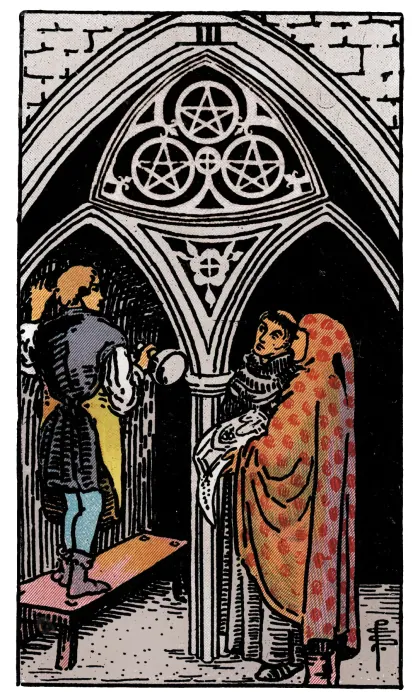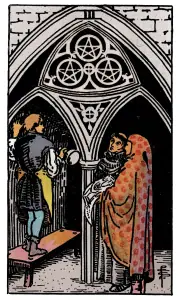
Three of Pentacles upright meaning
When upright, the Three of Pentacles means good work is being done together. A team planning a project, a builder discussing details with a client, or a student receiving feedback from a teacher all fit this card.
What sets it apart is the meeting of different kinds of contribution. One person makes, another designs, another evaluates or uses. Each role matters. The card favors keeping those differences clear while making them work together.
It also favors shared standards. Everyone involved should know what good work looks like. A clear plan, agreed measurements, and honest feedback help a project hold together.
Waite's meanings include metier, trade, and skilled labor, and he notes that it is usually regarded as a card of renown and glory.
For individuals, the card can describe recognition for skill, or a stage where you are good enough at something for others to rely on you.
A practical step is to check where your work meets someone else's. Ask what they need from you, by when, and in what form. Share a draft early and invite feedback. If you lead a project, write down who decides what, so roles are clear. Credit each person's contribution when the work is finished.
Three of Pentacles reversed meaning
Reversed, the Three of Pentacles can suggest a team that lacks coordination, respect for expertise, or a workable standard. People can be busy in parallel while their outputs fail to fit together.
Poor coordination looks like two people doing the same task, or a handover that never happens. Each person works hard, and the pieces do not match.
Lack of respect for expertise looks like overruling a specialist without listening, or a client changing the brief repeatedly without understanding the cost.
No workable standard shows up as disagreement about what finished means. One person thinks the work is done, and another thinks it has barely started.
The reversed card can also describe work done carelessly, or someone who stops trying because no one notices the difference.
Waite's reversed meanings include mediocrity, pettiness, and weakness, which fit a project that has lost its shared standard.
Trace the problem to where contributions meet. If timing is off, agree a schedule. If expertise is being ignored, ask the specialist to explain the risk in plain terms. If the standard is unclear, write down what finished looks like and get agreement. Fix the junction where pieces meet, and avoid blaming the most visible person.