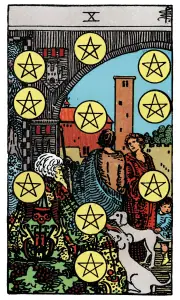
Four of Pentacles upright meaning
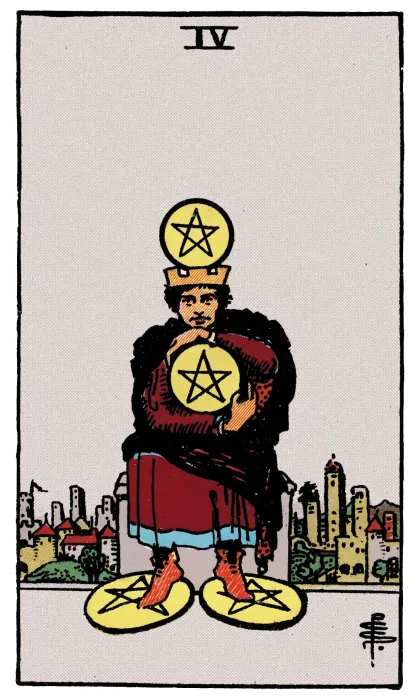
The upright Four of Pentacles means you are holding tightly to what you have. That might be money, a job, possessions, a routine, or your emotional privacy.
Saving for the future, setting a firm budget, and protecting your time are often wise. Someone who has lived through hard times may need a reserve to feel safe.
What sets it apart is the question of cost. The card can mark a moment when the fear of loss feels more vivid than the value of use. Constant guarding can make every expense, request, or shared decision seem threatening. A person might refuse to pay for a needed repair. Holding on becomes the goal instead of a means.
Waite's meanings include the surety of possessions and cleaving to what one has.
Book T calls the card the Lord of Earthly Power, which suggests control over resources, and the responsibility that comes with it.
A practical step is to notice what the guarded posture has made difficult to enjoy, welcome, or finish. If the guarding protects something you need, keep it. If it gets in the way of daily life and loosening would cost little, choose one small, safe way to loosen your grip: spend a set amount on something that improves daily life, share one task you usually keep to yourself, or say yes to one modest risk.
Four of Pentacles reversed meaning
When reversed, the Four of Pentacles can suggest resources being released, lost, or overspent, or control becoming even more rigid.
Useful release looks like loosening a grip that had become too tight. You finally spend on something you needed, delegate a task, or open up to someone after a long period of guardedness.
Overspending looks like the opposite of saving. After a period of tight control, money flows out too quickly, sometimes as a reaction to feeling deprived.
Loss shows up as resources slipping away despite your efforts, such as an unexpected cost.
Tighter control often means holding on harder as fear grows, refusing all change, or monitoring every small expense.
Waite's reversed meanings include suspense, delay, and opposition, which fit a situation where resources are stuck or contested.
The direction depends on whether loosening creates better flow or removes a necessary safeguard.
Judge the change by what has become possible around it. Letting go wisely leaves something better, so notice what improved. Faster spending needs a weekly limit, and a loss needs a list of what remains. A tighter grip raises one question: what do you fear would happen if you relaxed even slightly? Not every release is generosity, and not every limit is fear.