Eight of Cups Tarot Card Meaning

Quick Meaning

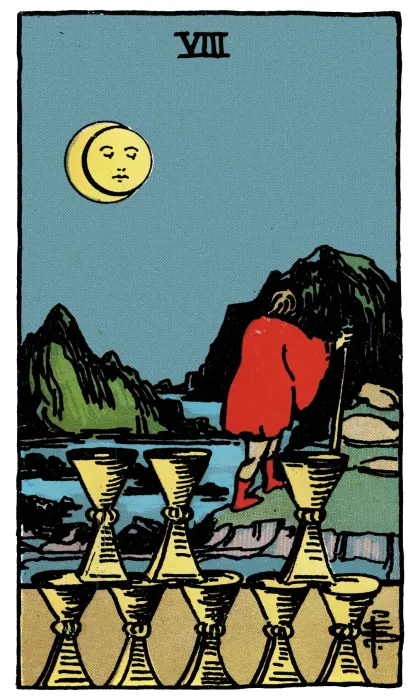
Eight cups remain upright, but a gap in their arrangement faces a traveler already walking toward rough ground. Something can still have value and yet no longer meet an essential need. Leaving stalls when it is endlessly discussed, abandoned through fear, or followed by a return to conditions that have not changed.

  • departure
  • disillusionment
  • search
  • emotional threshold
  • release
  • unfinished ending
Eight of Cups tarot card from a Rider-Waite-Smith-style deck
Eight of Cups · Cups suit Artwork by Pamela Colman Smith (1909) · Public Domain Mark 1.0
Arcana
Minor · Cups
Number
8
Upright tendency
Leans no
Reversed tendency
Maybe

Eight of Cups upright and reversed meaning

Upright

The Eight of Cups finds an essential absence inside something that still has value. The standing cups acknowledge history and investment; the gap makes continued participation less straightforward. Departure enters the picture because the arrangement is insufficient, not because everything within it was false. Yet distance cannot by itself answer the missing need. The card names a threshold whose practical and emotional costs remain part of deciding what comes next.

Reversed

The threshold may be crossed repeatedly in imagination while familiar conditions pull behaviour back. Fear of regret can make uncertainty seem like a reason never to decide. A return can also become meaningful when terms or understanding actually change. Waite includes renewed happiness and enjoyment in this reversal, so a dramatic exit is not required. Present experience distinguishes returning satisfaction from familiarity covering the same unresolved absence.

Love, work, and practical questions

Love & relationships

Love

Upright. A relationship can hold care and history while leaving an essential need unanswered. The question is whether its present form can respond, rather than treating either departure or continued investment as automatically virtuous.

Reversed. Repeated leaving and returning may preserve the same unresolved condition. Reconciliation gains substance when something specific has changed and can remain changed, rather than when familiarity temporarily softens the discomfort of separation.

Feelings

Upright. Someone may still care while believing the current relationship cannot continue. Remaining affection does not cancel an expressed departure; the meaning lies in the offer actually being made now, including any wish for distance.

Reversed. Attachment may conflict with a need to leave, or familiarity may draw someone back. Missing the bond does not itself establish reconciliation; what they presently offer matters more than the intensity of nostalgia.

Work & money

Career

Upright. A competent role may no longer provide an essential sense of purpose. Duties, finances, and the costs of staying or leaving give the dissatisfaction practical context rather than allowing the card to decide the transition.

Reversed. A repeated search or return to familiar work can leave the missing need unchanged. The distinction is whether the role has genuinely altered or whether relief from uncertainty has only quieted the dissatisfaction temporarily.

Money

Upright. An arrangement may retain obligations and material value after emotional commitment recedes. Those continuing needs belong in the decision, even when sustaining the venture or expense no longer feels worthwhile.

Reversed. Sunk costs may hold resources in an unsatisfying arrangement, while exhaustion may make any exit seem attractive. Neither attachment nor the promise of relief measures the actual financial consequence of changing it.

Yes or No Tendency

Upright: Leans no

Usually no under terms that still leave the essential need unmet.

Reversed: Maybe

Maybe: either staying or leaving needs to become a real choice beyond repeated hesitation or return.

These tendencies use the reference question “Do current conditions support moving forward?” Your question and circumstances can change the interpretation; this is not a guaranteed outcome.

Symbols in Eight of Cups

Standing cups and rough terrain make departure a costly threshold rather than the aftermath of total ruin.

Eight upright cups with a gap
Much remains intact, but the incomplete arrangement makes absence visible inside apparent sufficiency.
The departing figure
The traveler turns away voluntarily, placing agency and emotional cost in the same movement.
Staff and rough mountains
Support and difficult terrain show that departure requires effort rather than offering instant relief.
The moon over water
Changing light and water frame the exit with uncertainty, reflection, and an incomplete view of what lies ahead.

Traditional associations: Cups · water · emotion, relationship, and imagination · Eight · movement, skill, or constraint. Association systems differ between traditions.

Questions about Eight of Cups

Does the Eight of Cups always mean a breakup?

Immediate departure is only one possible response. The upright cups matter because something real remains standing; the Eight describes insufficiency inside an intact arrangement, not proof that leaving is automatically brave or necessary.

What does the Eight of Cups reversed mean?

Reversed, departure is delayed, repeated, or reconsidered. Fear of regret can keep someone returning to a situation whose central condition has not changed.

How can I interpret the Eight of Cups as a daily card?

An unmet need is active inside an arrangement that still holds value, making ambivalence more important than a simple leave-or-stay story.

Elena is ArcaSeer’s named editorial voice. How Elena’s notes are created