Ten of Wands Tarot Card Meaning

Quick Meaning

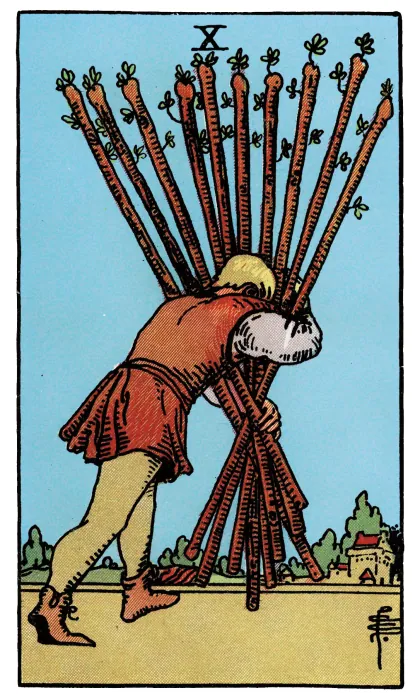
Ten bundled wands block the carrier's view even though the town is close, endangering completion because every burden has been gathered into one grip. Turning the card over can mean setting the load down, sharing it, or dropping it abruptly; the difference lies in whether unfinished obligations are honestly acknowledged.

  • burden
  • responsibility
  • overload
  • completion
  • delegation
  • consequence
Ten of Wands tarot card from a Rider-Waite-Smith-style deck
Ten of Wands · Wands suit Artwork by Pamela Colman Smith (1909) · Public Domain Mark 1.0
Number
10
Upright tendency
Leans no
Reversed tendency
Maybe

Ten of Wands upright and reversed meaning

Upright

The Ten of Wands gathers promises, maintenance, and other people's reliance into one carrier's arms. The destination can remain worthwhile even as the method of reaching it becomes burdensome. Concentrated effort may express wholehearted dedication when the goal and capacity are clear. When the bundle hides priorities, support, and the reason for continuing, however, taking on more has ceased to mean making better progress toward completion.
Reversed

Relief becomes possible when finite capacity is acknowledged, but a disappearing burden has not necessarily ended. Responsibility may be released thoughtfully or passed to someone without the time, information, or authority needed to carry it. The distinction is whether the unfinished obligation remains visible and understood. A lighter arrangement changes how the work is held; careless unloading merely changes whose strain is missing from the picture.

Love, work, and practical questions

Love & relationships

Love

Upright. Care work, planning, or repair may have accumulated with one partner. The imbalance becomes visible through recurring responsibilities; appreciation has little effect if practical participation continues to leave the same person carrying everything.

Reversed. A fairer arrangement may be emerging, or one person may be withdrawing without discussion. Honest limits and a mutually understood redistribution distinguish sustainable relief from leaving the shared burden to someone else.

Feelings

Upright. Affection can be genuine while obligation leaves little room to enjoy the connection. The emotional issue is accumulated pressure, with care becoming easier to sustain when responsibility no longer rests in one place.

Reversed. Relief, guilt, and resentment may accompany a newly stated limit. Whether someone negotiates their remaining responsibilities or simply disappears shows more than assuming that every request for space is responsible release.

Work & money

Career

Upright. Success may create more clients, maintenance, or undefined tasks than one role can hold. Actual duties and capacity determine how work can be shared; reliability should not conceal the concentration of responsibility.

Reversed. A handoff may lighten the role only if context, authority, and time travel with it. The meaningful question is what the next person actually receives, rather than whether the original owner feels relieved.

Money

Upright. Several manageable obligations can together narrow cash flow and future choices. Accumulation is the issue: the combined upkeep may make a reachable goal heavy even when no individual expense looks decisive.

Reversed. An obligation may genuinely end or merely move elsewhere. Any apparent relief needs its actual terms and consequences understood; hidden costs do not disappear simply because a different person now carries them.

Yes or No Tendency

Upright: Leans no

Usually no when concentrated responsibility obscures the destination and available capacity.

Reversed: Maybe

Maybe, if the load is genuinely reorganized with its consequences understood rather than silently transferred.

These tendencies use the reference question “Do current conditions support moving forward?” Your question and circumstances can change the interpretation; this is not a guaranteed outcome.

Symbols in Ten of Wands

The load hides the carrier’s view even though the destination remains close.

The bundle of ten wands
Separate responsibilities have accumulated into one load that is difficult to organize or see around.
The obscured face
The burden blocks forward vision, suggesting that overload can hide priorities and alternatives.
The nearby town
A visible destination keeps completion in reach while asking whether the present method can safely arrive there.

Traditional associations: Wands · fire · action, desire, and creative will · Ten · completion, consequence, or transition. Association systems differ between traditions.

Questions about Ten of Wands

What does the Ten of Wands mean in a love reading?

Upright: One person may be carrying the planning, care work, conflict repair, or future of the relationship. Commitment is not measured by silently doing it all. Name the recurring tasks and decide together who will take each one; gratitude without changed participation leaves the same person under the load. Reversed: A couple may finally renegotiate an unequal pattern, or one person may withdraw from shared responsibility without warning. The difference is visible in the process. Healthy release includes an honest limit, a revised agreement, and concern for the practical consequences.

What does the Ten of Wands reversed mean?

Reversed, the load may be dropping, denied, or transferred irresponsibly. Relief is possible, but abandoning commitments without communication can place the same burden on someone with less choice.

Is the Ten of Wands a yes or no card?

Upright: No. Responsibility has become too concentrated for the destination to stay visible beneath the load. Reversed: Maybe. The load can change shape, but relief is useful only if the burden is not simply handed to another carrier.

Elena is ArcaSeer’s named editorial voice. How Elena’s notes are created