The Fool Tarot Card Meaning

Quick Meaning

The traveler in The Fool stands lightly equipped at the cliff's edge, ready to begin before experience can supply certainty. The card favors a small, reversible first step; out of balance, excitement ignores a known risk or fear refuses any beginning at all.

  • new beginnings
  • freedom
  • curiosity
  • spontaneity
  • risk
  • inexperience
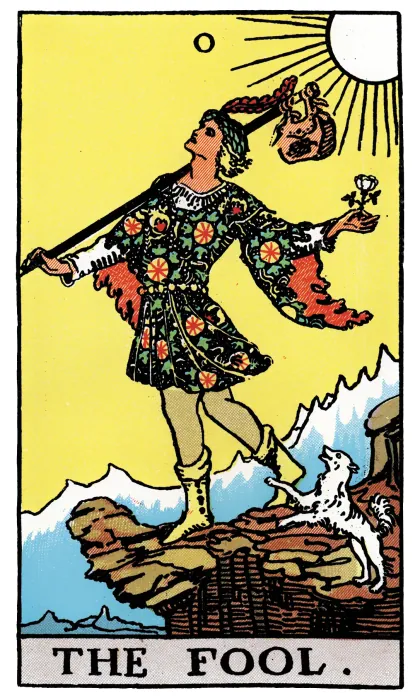
The Fool tarot card from a Rider-Waite-Smith-style deck
The Fool · Major Arcana 0 Artwork by Pamela Colman Smith (1909) · Public Domain Mark 1.0
Arcana
Major
Number
0
Upright tendency
Leans yes
Reversed tendency
Maybe

The Fool upright and reversed meaning

Upright

The Fool meets an unfamiliar situation before experience can supply certainty. Curiosity matters because participation may reveal what planning alone cannot, but the light luggage also shows limited preparation. A useful beginning gives learning room to change the plan. The distinction is between accepting that a path is not fully known and dismissing consequences that are already visible; openness works best when the first commitment remains proportionate to what is understood.
Reversed

Reversed, excitement can run ahead of preparation, turning a promising opening into a commitment whose terms have not been understood. Fear can create the opposite problem: refusing any beginning because being inexperienced feels exposed. Distinguish them by looking at the missing information. Recklessness brushes aside a known gap, while excessive hesitation continues after the uncertainty has been understood and limited. Neither pattern becomes clearer by treating confidence as evidence.

Love, work, and practical questions

Love & relationships

Love

Upright. Fresh interest or a new shared experience can loosen old assumptions. A connection develops through curiosity matched by reliable behavior, with enough room for both people to express their limits.

Reversed. Inconsistency can hide behind spontaneity, while fear of rejection can prevent a sincere approach. Notice whether the uncertainty is shared honestly or repeatedly left for one partner to carry.

Feelings

Upright. Interest may feel playful, open, and not yet defined. Enjoying discovery can be sincere without indicating that someone has already decided what commitment they want to offer.

Reversed. Excitement may alternate with avoidance or embarrassment about vulnerability. The relevant distinction is between needing time to understand a feeling and keeping the connection undefined because responsibility feels inconvenient.

Work & money

Career

Upright. An unfamiliar role offers learning as well as exposure. Duties, training, pay, and support reveal whether beginner mistakes can be accommodated and what the opportunity would actually require.

Reversed. A rushed launch or offer may make enthusiasm do the work of clear terms. Vague responsibilities remain important even when the prospect of beginning is unusually attractive.

Money

Upright. A new income source or purchase can bring possibilities whose ongoing cost is not yet visible. Recurring charges and the cost of changing course matter alongside the initial appeal.

Reversed. Novelty can make uncertain spending seem harmless; fear can also make any beginning seem reckless. The financial distinction depends on actual costs and exposure, not the mood of adventure.

Yes or No Tendency

Upright: Leans yes

Yes for a genuine beginning with room to learn. The first commitment should fit what is understood, rather than requiring certainty about the entire path.

Reversed: Maybe

Maybe: preparation may be incomplete, or hesitation may exceed the known risk. Clarifying that difference matters more than seeking another burst of confidence.

These tendencies use the reference question “Do current conditions support moving forward?” Your question and circumstances can change the interpretation; this is not a guaranteed outcome.

Symbols in The Fool

The cliff, light luggage, and open landscape hold possibility and exposure together.

The cliff edge
The figure is close enough to the drop for consequence to be part of the picture. The card holds anticipation and exposure together.
The small white dog
The dog is active at the figure's feet, so it can be read as companionship, instinct, or an alert that keeps enthusiasm connected to the surroundings.
The staff and small wallet
The traveler carries something, but not a large store of provisions. The detail supports readiness to depart while leaving experience and resources visibly limited.
The sun and distant mountains
The bright sky gives the scene clarity and optimism, while the mountains keep effort and unknown terrain in view.

Traditional associations: Major Arcana 0 · Beginnings, openness, and untested potential · Often linked with the element of air. Association systems differ between traditions.

Questions about The Fool

Why is The Fool numbered 0?

Zero gives The Fool a position outside the numbered sequence I–XXI. Waite explicitly treats it as an unnumbered card even while printing 0, and describes a spirit beginning its search for experience. Reading that zero as open possibility is an interpretation of this unusual place in the sequence, not a claim that the card has no meaning.

Why is The Fool associated with Uranus?

Uranus is a modern correspondence added to an older elemental one: the Golden Dawn assigns The Fool to Air. Some later authors connect its freedom and departure from convention with Uranus, as discussed in Llewellyn’s treatment of the outer planets. Both labels can belong to a stated reading system; Uranus is not a universal or original requirement for reading this card.

Is The Fool tarot card a jester?

Some historical versions show a fool or jester, but the Rider–Waite–Smith image shows a young traveler at a cliff. Waite mentions an earlier court-jester version with bells and motley clothing, then gives his own figure a different, more idealized appearance. The title therefore does not require every deck to depict a palace entertainer.

Elena is ArcaSeer’s named editorial voice. How Elena’s notes are created