Page of Cups upright meaning
When upright, the Page of Cups means a feeling or idea has surfaced in an unexpected way. A sweet message arrives, a creative impulse appears out of nowhere, a new crush begins, or you notice a tenderness you did not expect.
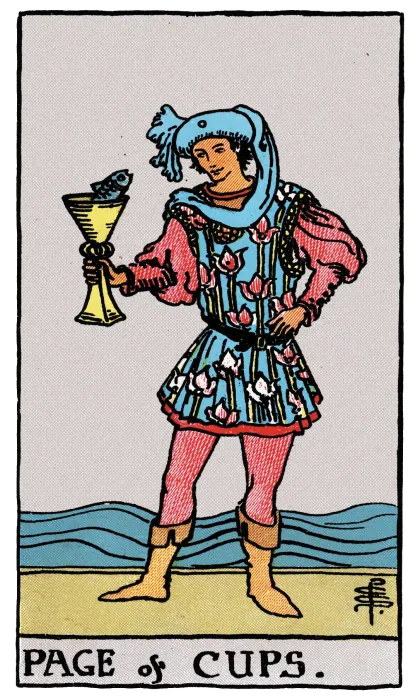
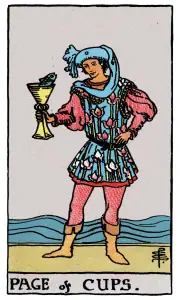
This card is playful in a way the other Pages are not. The fish in the cup is odd and charming, not serious. The card favors meeting surprising feelings with curiosity instead of judgment. You do not have to know what the feeling means yet. Write the poem, send the kind message, sketch the idea, or admit to yourself that you are drawn to someone.
It also describes emotional learning. Pages are beginners. The Page of Cups is learning how to feel, express, and receive emotion. Expressions may be awkward or tentative, and that is part of learning.
Waite's meanings include news, a message, application, reflection, and meditation, and a young person drawn to be of service.
Try writing down the unexpected feeling or idea in a few words, then express it simply in one small way. A short message, a doodle, or a few lines in a journal can be enough. Let the meaning grow through expression, without demanding a grand explanation first.
Page of Cups reversed meaning
Drawn reversed, the Page of Cups can suggest emotional immaturity, mixed or unclear messages, sensitivity used to avoid difficult conversations, or a creative block.
Emotional immaturity looks like moods that swing quickly, hurt feelings over small things, or expecting others to guess what you feel.
Unclear messages look like hints instead of requests. Someone sends signals that are hard to read, and then feels hurt when they are misunderstood. A sign is posting a sad song and never saying you felt left out.
Avoidance shows up as retreating into fantasy or sensitivity to avoid an uncomfortable reality. Daydreams replace action.
A creative block often means ideas that will not come, or ideas that feel silly and get abandoned. Someone may start three drawings in a week and finish none of them.
Waite's reversed meanings include taste, inclination, attachment, and also seduction, deception, and artifice.
One test is whether the feeling has been expressed in plain words. If not, name it simply and directly, without making the other person decode it. If the problem is mood swings, notice what triggers them, and wait before replying while the feeling is strong. If creativity is blocked, lower the stakes: make something deliberately imperfect, just to begin again.