Five of Cups Tarot Card Meaning

Quick Meaning

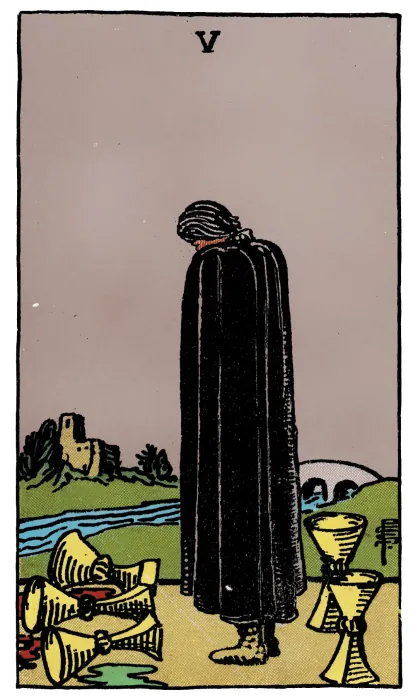
Three cups have spilled in front of the cloaked figure, while two remain upright behind and a bridge still crosses the river. Loss deserves its full weight without becoming the whole landscape. As grief begins to move, support or possibility can re-enter view; when regret defines the self, the same loss keeps organizing the present.

  • grief
  • regret
  • loss
  • remaining support
  • mourning
  • reorientation
Five of Cups tarot card from a Rider-Waite-Smith-style deck
Five of Cups · Cups suit Artwork by Pamela Colman Smith (1909) · Public Domain Mark 1.0
Arcana
Minor · Cups
Number
5
Upright tendency
Leans no
Reversed tendency
Maybe

Five of Cups upright and reversed meaning

Upright

The Five of Cups gives a real disappointment space without allowing it to erase the whole landscape. What spilled cannot simply be put back, and the two remaining cups do not make the loss unimportant. They show that support, skills, or relationships can still exist beyond the current focus. Naming the particular loss keeps grief distinct from the larger claim that everything has been ruined or nothing useful remains.

Reversed

Attention may begin moving from the lost outcome toward acceptance, repair, or renewed participation. Progress can be uneven and does not require calling the loss beneficial. The harder expression repeats regret while avoiding the acknowledgement or changed behaviour still possible. The difference is what the present can now contain: room for another response, or an expectation that the original outcome must return before anything else can matter.

A common misreading: Do not use the two standing cups to demand a quick bright side after a real loss. Yet grief is not the only possible setting: Fiebig and Bürger also read the dark figure as someone entering unfamiliar territory. Ask whether the darkness describes mourning, uncertainty, or both before deciding what the remaining cups can offer.

Love, work, and practical questions

Love & relationships

Love

Upright. A failed hope or rupture may need genuine mourning. Acknowledging the particular loss leaves room to recognize surviving relationships and boundaries when ready, without demanding replacement or a premature bright side.

Reversed. Forgiveness or acceptance can make future connection possible without restoring the former bond. Reconciliation depends on changed causes and rebuilt trust, not simply on a wish to escape the pain of separation.

Feelings

Upright. Sadness or guilt may keep attention on what went wrong. Care can remain, but the need for space should not be interpreted as a promise that the person will eventually return.

Reversed. Affection may soften into acceptance or renewed openness. Someone can release resentment while still choosing distance; present behaviour determines what healing means rather than requiring it to recreate the earlier relationship.

Work & money

Career

Upright. Rejection or a failed project may dominate professional self-assessment. The outcome deserves attention without becoming a verdict on all ability; skills and relationships can remain useful even after a significant disappointment.

Reversed. A setback may become usable information rather than a continuing wound. Actual feedback and opportunity determine the next professional step, while the card describes an increasing ability to notice what the loss left intact.

Money

Upright. A realized loss or regretted expense can eclipse remaining resources. The card describes regret narrowing attention; a fuller material account includes what remains without pretending that the amount lost has ceased to matter.

Reversed. Expectations may adjust after a setback, or sunk-cost attachment may disguise itself as renewed hope. The difference is whether present resources are gaining attention or the old arrangement still controls every possibility.

Yes or No Tendency

Upright: Leans no

Usually no while the loss dominates the current decision.

Reversed: Maybe

Maybe, leaning yes where acceptance allows remaining resources and present evidence to matter again.

These tendencies use the reference question “Do current conditions support moving forward?” Your question and circumstances can change the interpretation; this is not a guaranteed outcome.

Symbols in Five of Cups

The remaining vessels and a bridge keep support visible alongside the spilled cups.

Three spilled cups
Visible loss cannot be restored to its prior container, establishing grief as a response to a real event.
Two upright cups
Remaining emotional resources exist behind the figure without erasing what has been lost.
The river and bridge
Water separates the present from shelter, while the nearby bridge supplies a possible route across.

Traditional associations: Cups · water · emotion, relationship, and imagination · Five · disruption, shortage, or adjustment. Association systems differ between traditions.

Questions about Five of Cups

Does the Five of Cups mean death?

No: the Five of Cups cannot predict a death. Its spilled cups can help express grief or loss that is already part of a situation, while the standing cups show what remains. Reading it as bereavement requires that real context; the card alone does not establish what has been lost or what will happen.

What does the Five of Cups mean in a love reading?

Upright: A breakup, betrayal, apology, or unmet hope may require genuine mourning. Do not rush toward replacement or demand gratitude for what remains. When the immediate grief is acknowledged, look at the relationships, boundaries, and self-respect still available to support the next decision. Reversed: Someone may be ready to forgive, accept an ending, or stop comparing every connection with the past. Reconciliation is possible only if the cause of the rupture has changed. Returning because grief feels unbearable is not the same as repairing trust.

What does the Five of Cups reversed mean?

Reversed, grief begins to move, or regret becomes harder to release because identity has formed around the loss. Recovery and repetition can look similar from the outside; behavior shows the difference.